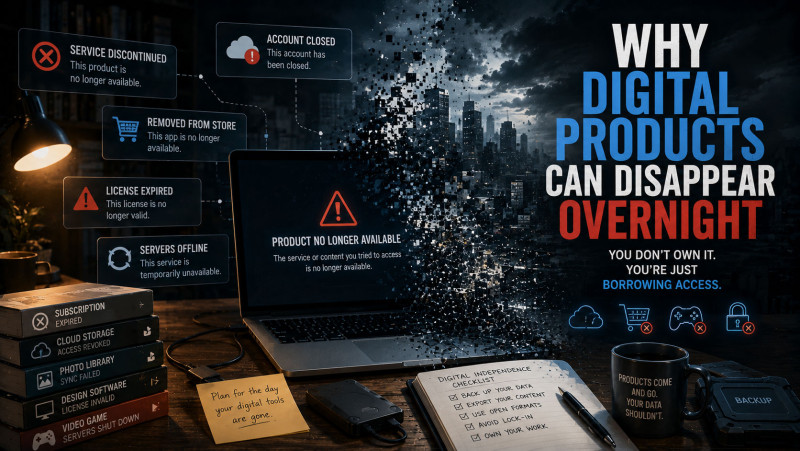
There was a time when buying something meant that you could reasonably expect to keep it.
You bought a book, took it home, and could read it for as long as the pages remained intact. You bought a camera and could continue using it even if the manufacturer eventually stopped making that particular model. You bought a record, a DVD, or a piece of furniture, and its existence did not depend on the company that originally sold it continuing to operate.
Digital products have changed that relationship in ways that are easy to overlook.
A piece of software can be purchased and then disappear from the market. A game can become unplayable because its servers have been shut down. A smart device can lose important functionality because the company behind it closes its cloud service. A digital library can change overnight because licensing agreements expire. An application you have relied on for years can be abandoned, leaving you with a product that technically still exists but gradually becomes unusable.
The strange part is that nothing necessarily breaks in the traditional sense. There may be no cracked screen, worn-out component, or missing physical object. The product can simply stop being available, supported, compatible, or accessible.
That is one of the defining weaknesses of the modern digital economy. Digital products are incredibly convenient, but their existence is often tied to systems and decisions that customers do not control.
The Difference Between Buying and Accessing
One of the reasons this issue is so easy to miss is that digital products often look and feel like things we own.
You click "Buy." Money leaves your account. The software appears on your computer or phone. A game becomes part of your library. A movie appears in your collection. From the consumer's perspective, the transaction feels complete.
Legally and technically, however, the situation can be very different.
In many cases, what you receive is a license or permission to use the product under certain conditions. Those conditions can involve an account, a specific platform, authentication servers, digital rights management, recurring payments, or continued support from the company.
None of this necessarily makes a digital product bad. There are legitimate reasons companies use these systems. Software needs security updates, online services require infrastructure, and creators need ways to protect commercial work that can otherwise be copied perfectly at almost no cost.
The problem is that consumers can easily confuse having access to something with owning something independently.
That distinction may not matter for years. Then the company shuts down the service, and suddenly it matters a great deal.
The Cloud Made Everything Easier, but More Dependent
Cloud computing has transformed the way people use software.
Files synchronize automatically across devices. Businesses can collaborate from different locations. Applications can be updated without users installing new versions manually. A small company can access infrastructure that would once have required an expensive server room and an entire technical team.
There is an enormous amount to like about this model.
The tradeoff is that more of the product now exists somewhere else.
An application that once ran entirely on your computer may now depend on a remote database, authentication service, cloud storage provider, payment system, or external API. The interface may be installed locally, but important parts of the product can live somewhere you cannot see and cannot control.
That creates a different kind of ownership.
You may possess the application, but you are still relying on someone else's infrastructure to make it useful.
When everything works, the distinction is almost invisible. When something goes wrong, it becomes impossible to ignore.
What Happens When a Company Shuts Down?
Companies do not exist forever.
Some fail because they run out of money. Others are acquired. Some discover that a product is not profitable enough to justify continued development. A company might change its strategy and decide that a particular application no longer fits its future.
From the company's perspective, shutting down a product can be perfectly rational.
For customers, it can be extremely disruptive.
Imagine running a business on a piece of software for several years. Your employees know how to use it, your data is stored inside it, and other systems have been connected to it. Then you receive an announcement that the service will be discontinued in three months.
You now have a problem that has little to do with the original product.
You need to find a replacement, evaluate alternatives, migrate your data, retrain employees, rebuild integrations, and make sure nothing important gets lost in the process.
The company may consider the shutdown a routine business decision.
For the customer, it can become a major operational project.
The Product Does Not Have to Be Bad to Disappear
This is an important distinction.
Digital products do not necessarily disappear because they failed.
Sometimes they disappear because they succeeded in a way that made them strategically inconvenient.
A larger company might acquire a smaller competitor and decide to consolidate its products. A platform might eliminate a service because it wants customers to move to a newer product. A company might stop supporting an application because maintaining two versions of similar technology is too expensive.
The customers may still love the old product.
That does not guarantee that the company will keep it alive.
This is one of the fundamental differences between a physical product and a software product. A manufacturer can stop producing a particular camera, but the cameras already sold can continue functioning independently. A software company can stop supporting an application and potentially affect every user at once.
The product's future is tied to the organization behind it.
Smart Devices Make the Problem Obvious
The rise of connected hardware has made digital dependence easier to see.
A traditional light switch does not need a corporate account. A conventional security camera can continue recording as long as it has power and storage. A basic thermostat does not need to communicate with a remote server every time you adjust the temperature.
Smart versions of these products can depend on much more.
They may require a mobile application, a user account, cloud infrastructure, remote authentication, and an ongoing relationship with the manufacturer.
That can create impressive functionality. It can also create an uncomfortable dependency.
If the company shuts down the cloud service, a device that was physically working perfectly may lose important features. In some cases, the device may become nearly useless.
The hardware did not fail.
The business supporting the hardware disappeared.
The Internet of Things Has an Uncomfortable Weakness
The more devices become connected, the more difficult it becomes to separate hardware from software.
A modern car contains an enormous amount of software. A refrigerator can have internet connectivity. A home security system can depend on cloud infrastructure. Speakers, cameras, watches, appliances, and other everyday objects increasingly communicate with remote services.
This creates a powerful convenience.
It also creates a new form of technological fragility.
The lifespan of a physical object can be much longer than the lifespan of the software company supporting it.
A refrigerator might reasonably be expected to last for more than a decade. A technology startup may not.
When those two lifespans collide, the consumer can end up owning a perfectly functional piece of hardware whose most useful features have disappeared.
Subscriptions Change the Meaning of Ownership
The subscription model has made this issue even more complicated.
Subscriptions are not inherently bad. Many services require ongoing infrastructure, and continuous payments can allow companies to maintain software, provide updates, operate servers, and support customers.
The problem is that subscriptions have gradually expanded into areas where consumers traditionally expected ownership.
Software that was once purchased for a one-time fee may now require an annual payment. Entertainment that could once be purchased on physical media is increasingly accessed through streaming services. Features that used to be part of a product may now be offered as recurring services.
Over time, consumers can spend considerably more money while still not acquiring a permanent copy of what they are using.
The economic relationship has shifted from purchasing a thing to maintaining permission to access it.
That can be perfectly reasonable when the customer understands the arrangement.
It becomes frustrating when the distinction is hidden behind familiar language such as "buy," "library," or "collection."
Digital Media Shows the Difference Clearly
Streaming has made entertainment easier to access than at almost any point in history.
A person can open an application and immediately watch thousands of movies or listen to millions of songs. There is no physical storage problem, no need to maintain shelves of discs, and no need to wait for a delivery.
But a streaming catalog is not the same thing as a personal collection.
A movie can disappear because a licensing agreement ends. A television series can move to another service. A song can become unavailable in a particular country. A platform can change its business model.
The consumer still has the same account.
The title is simply gone.
This is not necessarily a flaw in streaming. It is a consequence of the model. What people sometimes call ownership is actually ongoing access controlled by the platform.
Once you understand that distinction, the behavior of digital media companies makes much more sense.
Games Are One of the Biggest Examples
Video games have become increasingly dependent on digital infrastructure.
A modern game might require online authentication, cloud saves, account services, multiplayer servers, downloadable content, third-party services, or a specific digital storefront.
That creates incredible possibilities. Games can receive new content years after launch. Developers can fix bugs remotely. Players can compete with people around the world. Entire virtual worlds can continue evolving long after release.
But the same infrastructure can become a liability.
When servers are retired, multiplayer features can disappear. When authentication systems are removed, games can become difficult to launch. When digital storefronts close, older titles can become much harder to obtain.
The game itself may still exist.
The ecosystem required to experience it may not.
This raises difficult questions about the preservation of interactive culture. If a game is part of the history of the medium, should its continued accessibility depend entirely on whether its publisher still sees commercial value in maintaining it?
Software Can Die Slowly
Not every digital product disappears overnight.
Some die gradually.
A company stops releasing updates. The operating system changes. New hardware appears. Security vulnerabilities accumulate. Third-party services stop supporting old versions. Eventually, the software still opens, but fewer things work properly.
This slow decline can be more difficult to recognize than a formal shutdown.
There is no single day when the product ends.
Instead, users gradually discover that their old workflow is becoming harder to maintain.
This happens frequently with software that was once popular but no longer receives active development. A product can survive for years through sheer inertia, but compatibility problems eventually catch up with it.
Digital products therefore have more than one way to disappear.
They can be shut down.
They can be abandoned.
Or they can simply become impractical.
Dependencies Are Often Invisible to Users
Modern software is built on layers of dependencies.
An application may rely on cloud hosting, authentication systems, payment providers, databases, analytics platforms, mapping services, notification systems, and external APIs. Developers may understand these relationships, but ordinary users rarely see them.
The interface gives the impression of one product.
Behind it may be dozens of independent systems.
If one critical dependency changes, the entire experience can be affected.
This is one reason software businesses sometimes face unexpected problems even when their own product is working correctly. An external service changes its pricing, modifies its API, restricts access, or shuts down completely, and suddenly another application has to adapt.
Digital products exist inside ecosystems.
Their survival can depend on the survival of those ecosystems.
APIs Can Disappear Too
For developers, APIs are one of the clearest examples of this problem.
An API allows one application to communicate with another service. It is one of the foundations of modern software, and it makes it possible to build sophisticated products without creating every component from scratch.
But an API belongs to someone.
That company can change the terms.
It can charge more.
It can impose technical restrictions.
It can require a new authentication method.
Or it can shut the API down.
A developer who built an application around that service may have no choice but to rewrite part of the product.
This means that even successful software can contain hidden dependencies on decisions made by companies somewhere else.
Acquisitions Can Be More Dangerous Than Failure
Consumers often assume that the biggest threat to a digital product is the company going bankrupt.
Sometimes the more significant threat is an acquisition.
A product can be profitable and popular while still being eliminated after an acquisition because the new owner wants the technology, customers, patents, employees, or market position rather than the original product.
The acquiring company may decide that maintaining the old service is unnecessary.
From its perspective, the product has served its purpose.
For customers who spent years building their workflows around it, that decision can be difficult to understand.
The product did not lose its usefulness.
Its owner simply lost interest in maintaining it.
Vendor Lock-In Makes Disappearance More Painful
The longer people use a digital product, the more difficult it can become to leave.
A business might store years of customer information in one platform. A creative professional might organize thousands of projects inside a particular application. A team might build dozens of automated workflows around a service.
Eventually, the product becomes part of the organization's infrastructure.
That creates switching costs.
A competitor might offer a better product, but moving everything may be so expensive that the customer stays anyway.
This is known as vendor lock-in, and it can become particularly dangerous when the vendor itself becomes unstable.
The customer is not simply choosing whether to continue using the product.
They are choosing whether to rebuild part of their digital life.
Data Portability Is More Important Than Features
When choosing digital products, people often focus on features.
How fast is it?
Does it have AI?
Does it integrate with other tools?
Does it have a modern interface?
How many users does it support?
Those questions matter.
But another question deserves equal attention: How easily can I leave?
Can the data be exported?
Is the export complete?
Is it stored in a common format?
Can another application read it?
Will important metadata be preserved?
Can the business operate temporarily without the service?
These questions are not exciting during a product demonstration.
They can become extremely important years later.
A product that makes leaving easy may ultimately be a safer long-term choice than one with hundreds of impressive features but no practical exit path.
Open Standards Can Protect Against Obsolescence
Open standards are one of the quiet defenses against digital disappearance.
When information is stored in widely supported formats, it is easier to move between applications and preserve over time.
A document stored in a common format is less dependent on the company that created the original software. A collection of images in standard formats can be opened by many different programs. Data stored in structured, documented formats is easier to migrate.
This does not guarantee permanence.
Technology changes.
File formats evolve.
But open standards reduce the risk that one company's disappearance will make your information inaccessible.
They provide something valuable in a digital economy: options.
Digital Preservation Is Becoming a Cultural Problem
The issue goes beyond consumer purchases.
An enormous portion of modern culture exists only in digital form.
Independent games, websites, blogs, online communities, digital artwork, podcasts, videos, software projects, and social media archives all contribute to the historical record of our time.
Much of this material exists on privately controlled platforms.
If those platforms disappear, the content can disappear with them.
That creates an unusual historical situation. We are producing more recorded information than any previous generation, but some of it may be less durable than the physical records created centuries ago.
A handwritten document can survive long after the person who created it is gone.
A website may disappear when a hosting bill is no longer paid.
A digital archive can contain millions of files and still become inaccessible because the software required to interpret them has vanished.
The problem is not a lack of information.
It is the preservation of access.
What Happens to Digital Products When We Die?
There is also a personal side to digital ownership that receives surprisingly little attention.
Physical possessions can be inherited relatively easily. Books, photographs, records, artwork, and other objects can be passed from one generation to another.
Digital possessions are more complicated.
Accounts may be personal. Licenses may be non-transferable. Passwords may be unknown to family members. Services may have rules that prevent another person from accessing purchased content.
A lifetime of digital purchases can therefore become surprisingly difficult to transfer.
The files may exist.
The rights to use them may not.
That is a strange situation for something that was supposedly "owned."
Businesses Need to Think About Digital Exit Strategies
For companies, this issue deserves to be treated as a form of operational risk.
Before adopting a critical SaaS platform, businesses should understand what happens if the provider disappears. They should know how data can be exported, how quickly it can be migrated, and whether essential information remains usable outside the platform.
They should also consider what happens after an acquisition, a major price increase, or a significant change in product direction.
No business wants to plan for its software vendor to disappear.
But responsible planning often means considering unlikely events before they become emergencies.
A backup is useful precisely because you hope you never need it.
Consumers Can Reduce Their Own Exposure
Individuals have fewer resources than large companies, but some basic precautions can make a significant difference.
Important files should not exist only inside a single cloud service. Original photographs, creative projects, financial records, and other irreplaceable information are worth keeping in more than one location.
When buying digital products, it is worth understanding whether the purchase represents permanent access, a license, or a subscription.
When purchasing connected hardware, consumers can also ask whether the product remains useful if the manufacturer's cloud service disappears.
These decisions do not require rejecting modern technology.
They simply require recognizing where dependence exists.
Convenience and Independence Are Sometimes Opposites
The digital economy has made an enormous number of things easier.
You can access your files from almost anywhere. Software can update itself. Entertainment can be delivered instantly. Devices can communicate with one another. Businesses can operate using infrastructure that would once have been impossibly expensive.
But convenience often requires someone else to maintain the system.
The more sophisticated the service, the more dependencies it may have.
This creates a tradeoff that consumers do not always see. A simple local application may be less convenient than a cloud platform, but it can also be more independent. A physical copy of a movie takes up space, but it is not going to disappear because a licensing agreement changed. A local backup requires effort, but it does not depend on a company's survival.
There is no universally correct choice.
The important thing is understanding the tradeoff.
Digital Products Need to Be Designed for Failure
One of the strongest ideas emerging from this problem is that digital products should be designed with their eventual failure in mind.
That does not mean expecting every company to shut down.
It means acknowledging that companies can change direction, services can be discontinued, and technologies can become obsolete.
A responsible product should make it possible for customers to recover their data. Important functions should ideally degrade gracefully rather than disappear completely when a remote service becomes unavailable. Hardware should not become useless simply because a cloud account is discontinued when local operation could reasonably remain possible.
The best digital products may ultimately be those that respect the possibility that customers will one day leave.
That sounds counterintuitive from a business perspective.
In reality, it can build trust.
The Most Durable Digital Products May Be the Most Open
There is an interesting relationship between openness and longevity.
Products built around proprietary ecosystems can be incredibly powerful, but their future depends heavily on the companies controlling those ecosystems.
Products based on open formats, documented interfaces, local storage, and interoperability can sometimes survive beyond the companies that originally created them.
That does not make open technology automatically better.
But it makes it more resilient.
A digital product that can be copied, migrated, repaired, or replaced has a better chance of surviving technological change than one whose continued existence depends on a single company's servers.
The Real Question Is What Happens When the Business Model Ends
Every digital product exists because someone has decided it is worth maintaining.
That business decision can change.
Perhaps the product is no longer profitable. Perhaps customers have moved elsewhere. Perhaps a new technology has replaced it. Perhaps the company has been acquired. Perhaps the cost of maintaining old infrastructure has become too high.
None of these outcomes are unusual.
What is unusual is how little control customers sometimes have when they occur.
That is why digital ownership deserves more attention.
Consumers do not need guarantees that every product will exist forever. That would be unrealistic.
They need reasonable ways to preserve what they paid for and move their information elsewhere when the original product reaches the end of its life.
We May Need a Better Definition of Ownership
The digital economy has forced us to reconsider what it means to own something.
If you can access a product only while a company operates a particular server, how much control do you really have over it?
If a purchase requires a subscription to remain usable, is it still accurate to describe it as ownership?
If your data can only be exported through a proprietary system, how independent is your possession of that data?
These questions do not have simple answers, and the answer may be different for different types of products.
But they are becoming harder to avoid.
As more of our work, entertainment, communication, and personal history moves into digital systems, the distinction between ownership and access becomes increasingly important.
The Digital World Is Fast, but It Should Not Be Disposable
The great promise of digital technology is that information can survive almost indefinitely.
A photograph can be copied without losing quality. Software can be reproduced perfectly. A document can exist in multiple places at once. Digital archives can preserve enormous amounts of information without requiring physical warehouses.
Yet the systems surrounding that information can be surprisingly temporary.
A company can disappear.
A platform can change.
A service can shut down.
A file format can become obsolete.
A license can expire.
A server can be turned off.
The answer is not to reject digital products or return to a world where everything is physical. Digital technology has created enormous benefits, and those benefits are not going away.
The better solution is to build a digital economy that recognizes the difference between convenience and permanence.
Products should give users meaningful ways to export their data. Platforms should avoid unnecessary lock-in. Connected hardware should remain useful for as long as reasonably possible. Digital purchases should make their limitations clear. Businesses should plan for the possibility that their software providers will eventually change or disappear.
Because digital products do not need to last forever to be valuable.
But when they reach the end of their commercial lives, the people who depended on them should not have to lose everything with them.
That may be the real challenge of digital ownership in the years ahead: not making every product permanent, but making sure that when a product disappears, the value people created with it does not disappear at the same time.