



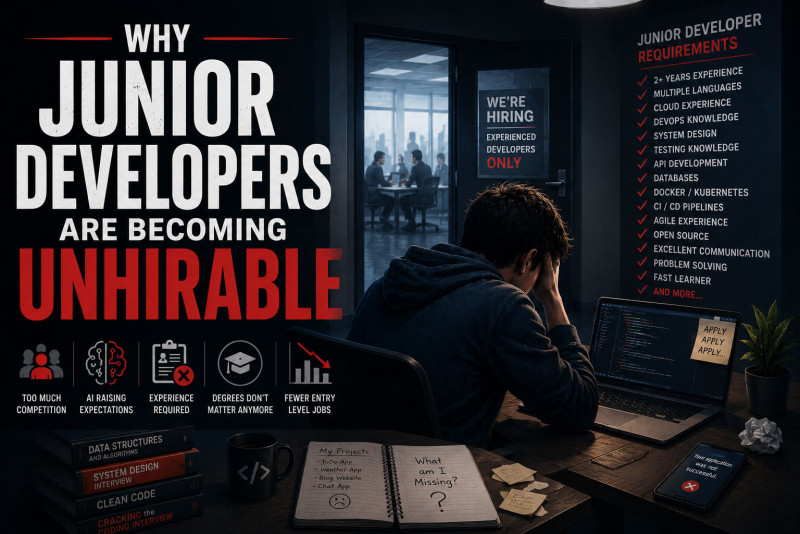
For years, becoming a software developer followed a familiar path.
Learn a programming language.
Build a few projects.
Create a portfolio.
Apply for junior positions.
Gain experience.
Grow into a senior role.
It was never easy, but it was achievable.
Today, many aspiring developers are discovering that the first step, landing a junior position, has become the hardest part of the journey.
Companies continue to advertise software jobs, yet entry-level opportunities appear to be shrinking. Competition has intensified, expectations have risen, and new technologies are reshaping what employers look for in candidates.
The result is a growing number of talented beginners struggling to find their place in an industry that once welcomed them.
The Entry-Level Job Is No Longer Entry-Level
One of the biggest frustrations for new developers is the experience requirement.
Job descriptions labeled as "Junior" frequently ask for:
- Two to five years of professional experience
- Knowledge of multiple programming languages
- Experience with cloud platforms
- Understanding of DevOps practices
- Familiarity with modern frameworks
- Database management
- Version control systems
- API development
- Testing and deployment workflows
For someone trying to get their first job, these expectations can feel impossible.
How do you gain professional experience if no one is willing to hire beginners?
Artificial Intelligence Has Changed Expectations
AI coding assistants have become powerful productivity tools.
They help developers:
- Generate boilerplate code
- Explain unfamiliar concepts
- Debug applications
- Write documentation
- Create tests
- Refactor existing code
For experienced developers, these tools increase efficiency.
For junior developers, they create a different challenge.
Employers increasingly expect new hires to deliver results faster because AI can assist with routine tasks.
Instead of reducing expectations, technology has often raised them.
Companies Are Hiring More Carefully
Economic uncertainty has changed hiring strategies across the technology industry.
Many organizations now prefer smaller teams with experienced engineers capable of handling complex projects independently.
When budgets become tighter, businesses often prioritize professionals who require less training and can contribute immediately.
Unfortunately, junior positions are frequently the first to disappear during these periods.
Bootcamps Created More Competition
Over the past decade, coding bootcamps and online learning platforms have made software education more accessible than ever.
That is undoubtedly a positive development.
However, it has also dramatically increased the number of people applying for the same entry-level roles.
Today, a single junior opening may receive hundreds, or even thousands, of applications.
Many candidates possess similar skills, similar portfolios, and similar certifications.
Standing out has become significantly more difficult.
Building Projects Is No Longer Enough
There was a time when a personal portfolio could quickly capture an employer's attention.
Today, many hiring managers review countless portfolios featuring the same tutorial applications.
To differentiate themselves, aspiring developers increasingly need projects that demonstrate:
- Real-world problem solving
- Original ideas
- Long-term maintenance
- Clean architecture
- Collaboration with others
- Production deployment
- Active users or customers
The focus has shifted from simply writing code to demonstrating the ability to build useful software.
Communication Has Become a Technical Skill
Programming is rarely a solo activity.
Modern software development depends on collaboration between developers, designers, product managers, testers, and clients.
Technical knowledge remains essential.
So do communication skills.
Employers increasingly value developers who can:
- Explain technical decisions clearly
- Ask thoughtful questions
- Work effectively within teams
- Accept constructive feedback
- Learn continuously
- Adapt to changing priorities
Writing good software is only part of the job.
Working well with people has become equally important.
Open Source Is Becoming Real Experience
As traditional junior positions become more competitive, many developers are finding alternative ways to build credibility.
Contributing to open-source projects offers opportunities to:
- Collaborate with experienced developers
- Learn professional workflows
- Improve code quality
- Build a public portfolio
- Demonstrate consistency
- Gain practical experience
Unlike tutorial projects, open-source contributions show employers how candidates work in real development environments.
The Skills Employers Value Most
Technology changes constantly, but certain qualities remain consistently valuable.
Employers increasingly look for developers who demonstrate:
- Curiosity
- Adaptability
- Problem-solving
- Reliability
- Clear communication
- Strong fundamentals
- Continuous learning
- Professionalism
Programming languages may change.
Frameworks come and go.
The ability to learn remains one of the most important skills in software development.
The Industry Is Changing, Not Disappearing
The demand for software continues to grow.
Businesses still need websites, applications, APIs, automation, cybersecurity, artificial intelligence, and cloud infrastructure.
The difference is that the path into the industry is becoming more demanding.
Breaking into software development now requires more than technical ability alone.
Candidates increasingly need practical experience, a visible portfolio, strong communication skills, and the willingness to continue learning long after formal education ends.
Opportunity Still Exists
Becoming a junior developer has undoubtedly become more challenging.
Artificial intelligence, changing hiring practices, economic uncertainty, and increased competition have all raised the bar.
But challenging does not mean impossible.
Every experienced engineer was once a beginner looking for an opportunity.
The developers who continue building meaningful projects, contribute to real communities, stay curious, and adapt to new technologies will continue creating opportunities for themselves.
The first job may be harder to secure than it was a decade ago.
But for those willing to keep learning and demonstrating their value, software development remains one of the most dynamic and rewarding careers of the modern era.