



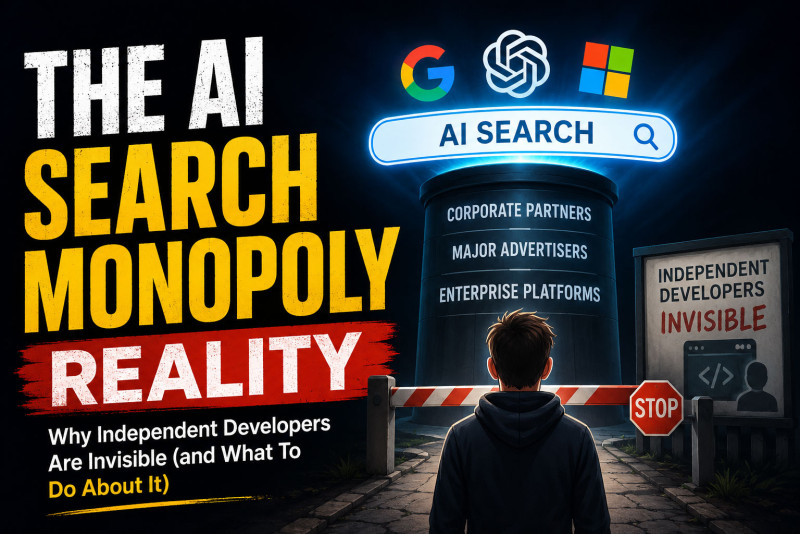
For years, independent developers believed the internet rewarded the best products.
The formula seemed straightforward:
-
Build something useful.
-
Create content around your product.
-
Improve your website.
-
Invest time in SEO.
-
Wait for search engines to send visitors.
That approach worked reasonably well during the early years of the web. A small developer with a great product could compete against larger companies by understanding their audience and producing valuable content.
Today, that reality is changing rapidly.
Search Is No Longer an Open Playing Field
Traditional search engines acted as massive indexes of websites. While large companies certainly had advantages, smaller creators still had opportunities to rank for niche topics and attract targeted traffic.
AI-powered search is different.
Instead of presenting users with a list of websites, AI systems increasingly:
-
Summarize information directly in search results.
-
Generate answers without requiring users to visit websites.
-
Pull information from sources they already consider authoritative.
-
Favor brands that are already widely referenced across the web.
-
Keep users inside their own ecosystems rather than sending traffic elsewhere.
For large corporations, this creates even more visibility.
For independent developers, it often means becoming invisible.
Why Small Developers Struggle to Appear in AI Search
The challenge isn't necessarily product quality.
Many independent developers create products that are:
-
Better designed.
-
More affordable.
-
More innovative.
-
More responsive to customer feedback.
-
More focused on solving specific problems.
The problem is visibility.
AI systems rely heavily on signals such as:
-
Brand recognition.
-
Existing authority.
-
Media coverage.
-
Large numbers of citations.
-
Strong online presence across multiple platforms.
Most independent developers simply don't have access to these advantages.
As a result:
-
A technically superior product may never be mentioned.
-
A niche solution may never appear in AI-generated recommendations.
-
A self-hosted platform may be ignored entirely despite offering more value than larger competitors.
The system naturally reinforces companies that are already well known.
The Myth of Organic Traffic
Many developers continue investing countless hours into SEO because they believe organic discovery is still the primary growth channel.
Unfortunately, the landscape has changed.
The reality today is that:
-
Organic search traffic is becoming harder to earn.
-
AI-generated answers reduce clicks to independent websites.
-
Large brands dominate high-value search terms.
-
New websites take significantly longer to gain visibility.
-
Search algorithms increasingly favor established authority.
This doesn't mean SEO is completely dead.
It means SEO is no longer a reliable business strategy by itself.
Building an entire business around the hope of future organic traffic is becoming increasingly risky.
Why Marketplaces Are Not the Answer
When search traffic becomes difficult to obtain, many developers turn to marketplaces.
The logic seems reasonable:
-
Marketplaces already have visitors.
-
Buyers are actively searching for products.
-
Listing a product is relatively easy.
-
Sales can happen immediately.
However, marketplaces introduce a different set of problems.
Inside a marketplace:
-
Your product sits next to hundreds of competitors.
-
Price becomes the primary differentiator.
-
Customers often remember the marketplace, not your brand.
-
Building long-term customer relationships becomes difficult.
-
Your success depends on rules you cannot control.
The marketplace owns the audience.
You simply rent access to it.
The Real Choice Independent Developers Face
Once you accept two realities, everything becomes much clearer:
-
Search engines are becoming less effective at discovering independent creators.
-
Marketplaces rarely help developers build sustainable businesses.
At that point, the focus shifts from traffic acquisition to audience ownership.
Instead of asking:
"How do I rank higher?"
A better question becomes:
"How do I build an audience that follows me regardless of where I publish?"
What Actually Works Today
The strongest independent software businesses increasingly focus on assets they control directly.
These include:
Building an Email List
An email list remains one of the few channels that cannot be taken away by an algorithm update.
Benefits include:
-
Direct communication with potential customers.
-
Product launch announcements.
-
Customer feedback opportunities.
-
Repeat sales.
-
Long-term relationship building.
Creating Useful Content
Content should no longer exist solely for SEO purposes.
Instead, focus on content that:
-
Solves real problems.
-
Demonstrates expertise.
-
Builds trust.
-
Educates potential buyers.
-
Establishes authority within a niche.
Building Communities
Communities create visibility that algorithms cannot easily suppress.
Examples include:
-
Developer communities.
-
Industry forums.
-
Private groups.
-
Discord servers.
-
Slack communities.
-
Professional networks.
Developing a Recognizable Brand
People rarely remember feature lists.
They remember brands they trust.
Strong branding helps:
-
Differentiate products from competitors.
-
Improve word-of-mouth referrals.
-
Increase customer loyalty.
-
Create long-term recognition.
The Future Belongs to Audience Ownership
The internet is becoming increasingly centralized.
A small number of companies now control:
-
Search discovery.
-
Social media visibility.
-
Advertising platforms.
-
AI-generated recommendations.
-
Digital marketplaces.
Independent developers cannot outspend these companies.
They cannot out-advertise them.
They cannot out-scale them.
What they can do is build something those platforms cannot own:
-
Trust.
-
Reputation.
-
Community.
-
Direct customer relationships.
-
A loyal audience.
Those assets continue generating value regardless of how search algorithms change.
Final Thoughts
The biggest mistake an independent developer can make today is believing that better SEO alone will solve a visibility problem.
The internet no longer works that way.
Instead of spending years chasing rankings and algorithm updates, focus on building assets that remain under your control:
-
Build an audience.
-
Grow an email list.
-
Create valuable content.
-
Establish authority within a niche.
-
Develop a memorable brand.
-
Own the relationship with your customers.
Search engines may change.
AI platforms will continue evolving.
Marketplaces will rise and fall.
But an audience that trusts you will remain one of the most valuable assets your business can ever own.