



For most of modern history, work and place were tightly connected. People generally lived close to where they worked, traveled for business when necessary, and treated vacations as periods when they temporarily stepped away from employment. The office was a physical location, and traveling somewhere else usually meant leaving work behind.
Remote work has complicated that relationship.
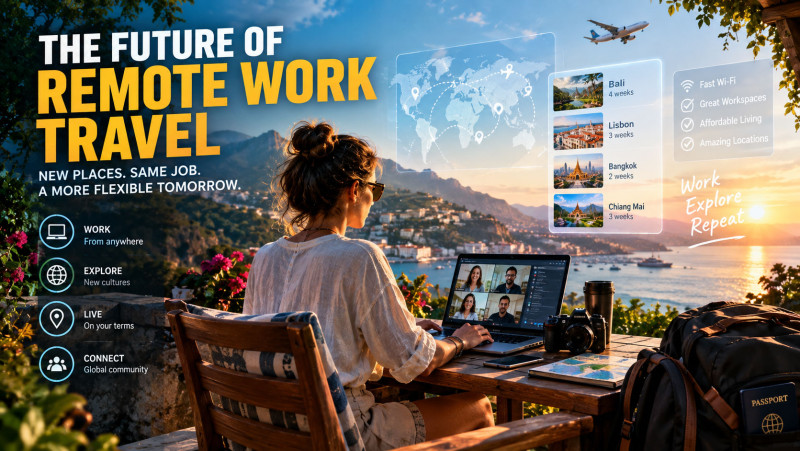
A laptop and reliable internet connection can now allow someone to work from a hotel room in another city, a rented apartment overseas, a coworking space in a foreign country, or a quiet house far from the urban centers where many companies are based. What once required a business trip or a sabbatical can increasingly become part of someone's normal working life.
This has created a new category of travel that sits somewhere between tourism, relocation, and business travel.
Remote work travel is not simply about digital nomads sitting beside a swimming pool with a laptop. It is becoming a broader question about how people organize their lives when employment no longer requires them to remain in one place.
The consequences could reach far beyond travel itself.
They could influence housing markets, cities, airlines, hotels, immigration policies, local economies, workplace culture, and even how people define the difference between living somewhere and visiting it.
The End of the Traditional Business Trip
Business travel has traditionally operated around a simple model. An employee works from one location, travels to another location for a specific professional reason, completes the assignment, and returns home.
Remote work creates a different possibility.
Instead of traveling because work requires physical presence, someone can choose where to work because technology makes physical presence unnecessary.
That reverses the relationship between work and travel.
A person might spend several weeks in another city without taking traditional vacation time. They might attend a few meetings remotely, work normal hours, explore the destination before or after work, and eventually move somewhere else.
The trip does not have a clear beginning and end in the traditional sense.
The traveler is still working, but they are also experiencing a different environment.
This distinction matters because it turns travel from something that happens around work into something that can happen alongside work.
The Rise of the Workcation
The so-called workcation has become one of the clearest expressions of this shift.
Instead of taking a week completely away from employment, a worker may travel somewhere desirable while maintaining a normal or slightly modified schedule. A beach town, mountain community, historic city, or foreign capital can become a temporary workplace.
The concept sounds simple, but it changes what people expect from accommodation.
A hotel room designed primarily for sleeping may not be enough for someone spending eight hours a day working there. Reliable Wi-Fi, comfortable desks, quiet spaces, power outlets, good lighting, video-call environments, and longer-stay pricing become more important.
Hotels and vacation rentals therefore face a new opportunity.
The ideal property for remote workers is not necessarily the one with the largest swimming pool. It may be the one that combines a pleasant living environment with everything required to function as a temporary office.
That creates a new kind of hospitality product.
Travel Could Become Slower
Traditional tourism often rewards efficiency.
Visitors try to see as much as possible within a limited amount of time because they know they will soon return home. A traveler might spend three days in a city, visit major attractions, take photographs, eat at recommended restaurants, and move on.
Remote workers have a different incentive.
If someone can work from a destination for three or four weeks, there is less pressure to experience everything immediately. They can visit a museum on a Tuesday afternoon, explore a neighborhood on a quiet morning, or take a day trip when their schedule allows.
This creates the possibility of slower travel.
Instead of constantly moving between destinations, remote workers may stay longer and develop more familiarity with the places they visit.
That can benefit local businesses because a person staying for a month may spend money differently from a tourist staying for three days. They may shop at local grocery stores, use neighborhood cafés, visit gyms, pay for transportation, attend community events, and establish routines.
They are not simply passing through.
For part of their stay, they are participating in the local economy.
The Digital Nomad Is Evolving
The image of the digital nomad has often been associated with young freelancers moving continuously between inexpensive destinations.
That lifestyle exists, but it represents only one version of remote work travel.
The next generation of remote travelers may include employees of established companies, entrepreneurs, consultants, creative professionals, engineers, managers, and families. Some may spend several months abroad each year. Others may simply work from different parts of their own country.
The important change is not that everyone will become a digital nomad.
It is that mobility is becoming more compatible with ordinary employment.
Someone does not necessarily have to abandon a permanent home or become a full-time traveler to benefit from location flexibility.
They might work remotely from another state for a month, spend part of the summer near family, rent a place in another country for several weeks, or combine occasional travel with a stable home base.
Remote work travel is therefore becoming less about a particular lifestyle identity and more about flexibility.
Cities Are Competing for Temporary Residents
As workers gain greater freedom over where they spend their time, cities have another reason to compete for them.
Tourists traditionally contribute through hotels, restaurants, attractions, transportation, and entertainment. Remote workers can contribute through many of the same channels, but their longer stays can create a different economic relationship.
A person who spends six weeks in a city may become a customer of local businesses rather than simply a visitor to them.
This has encouraged cities and regions to promote themselves as remote-work destinations. Reliable infrastructure, affordable housing, transportation, coworking spaces, quality of life, safety, and cultural attractions can all become part of a city's competitive identity.
The competition may increasingly resemble a global marketplace for human attention and temporary residence.
Cities are not just asking people to visit.
They are asking them to stay.
Housing Could Become the Biggest Problem
The promise of remote work travel comes with a serious complication: housing.
When large numbers of visitors choose to stay for weeks or months instead of days, demand for short- and medium-term accommodation can increase. In places already experiencing housing shortages, additional demand from remote workers and tourists can put pressure on rents and property prices.
The problem becomes especially complicated when attractive neighborhoods are converted from long-term housing into short-term rentals.
A city can benefit economically from visitors while simultaneously making it harder for permanent residents to afford living there.
This is not an argument against remote work travel.
It is a reminder that mobility has consequences.
The future of remote work travel will require cities to find a balance between welcoming economically valuable visitors and maintaining enough housing for people who actually live and work there permanently.
Without that balance, the most popular remote-work destinations may eventually become victims of their own success.
Countries Are Rethinking Immigration
Traditional immigration systems were largely designed around relatively clear categories.
You might be a tourist, a student, a temporary worker, or a permanent resident.
Remote work creates an awkward category in between.
A person may spend several months in another country while being employed by a company based somewhere else. They may not take a local job, yet they are clearly conducting professional activity while physically present.
This has encouraged governments to reconsider how existing immigration frameworks apply to remote workers.
Some countries have introduced or explored visas designed specifically for remote professionals and longer-term digital nomads. The underlying idea is straightforward: attract people who can bring outside income into the local economy without directly competing for local employment.
But the legal and economic questions are more complicated than they first appear.
Tax residency, healthcare, employment law, data security, social protections, and corporate obligations can all become relevant when an employee works from another jurisdiction.
Remote work makes geography less important for the employee.
It does not make geography irrelevant to governments.
Time Zones Will Shape the Future
Technology allows people to work from almost anywhere, but that does not mean every location works equally well.
Time zones remain a powerful constraint.
An employee working for a company based in New York may find it easy to work from Toronto but considerably harder to maintain the same schedule from Tokyo. Someone employed by a European company may find parts of Africa and the Middle East convenient but face substantial scheduling challenges in North America.
This creates an interesting form of geographic clustering.
Remote work may make international mobility easier, but people will often choose destinations that fit their professional schedules.
The most successful remote-work destinations may therefore be those that combine attractive lifestyles with practical working hours.
A beautiful location becomes much less appealing if every important meeting happens at three in the morning.
The Coworking Space Becomes Part of the Travel Infrastructure
Airports and hotels have long been essential infrastructure for travelers.
Coworking spaces may increasingly join them.
For remote workers, a coworking facility can provide reliable internet, meeting rooms, private offices, social interaction, and a professional environment that a hotel room cannot always offer.
More importantly, coworking spaces can create communities.
A traveler arriving alone in a new city can walk into a shared workspace and immediately encounter people with similar lifestyles. Those connections can lead to friendships, partnerships, professional opportunities, and local knowledge.
This social dimension may become increasingly important as remote work becomes more common.
The freedom to work anywhere can also produce isolation.
Coworking spaces offer a partial solution by creating physical communities for people whose professional lives have become increasingly digital.
Remote Work Travel Will Not Eliminate the Office
Despite predictions that remote work will make traditional offices obsolete, the future is likely to be more complicated.
Some companies will remain primarily remote. Others will require employees to work in offices regularly. Many will settle somewhere in between.
The hybrid model could actually create more opportunities for remote work travel.
An employee might work remotely most of the time but travel to company headquarters for several days each month. Another might work from home for most of the year but spend a few weeks working from another location.
Physical meetings may become less frequent but more intentional.
Instead of commuting to an office every day simply because it is the default, employees may gather when collaboration, planning, training, or social connection genuinely benefits from being together.
That could make business travel less frequent but potentially more meaningful.
Families Will Change the Equation
Remote work travel becomes significantly more complicated when children are involved.
A single professional can decide to spend six weeks in another country relatively easily. A family must consider schools, childcare, healthcare, housing, transportation, schedules, and the needs of multiple people.
Yet this also represents one of the most interesting possibilities.
If remote work becomes sufficiently flexible, families could spend extended periods living in different regions without completely disrupting their careers. School calendars, remote education, international schools, and flexible employment could make longer stays more practical.
This could eventually produce a different relationship between childhood and travel.
Instead of taking short vacations to foreign countries, some families may spend entire seasons living in them.
The child does not experience the destination purely as a tourist.
They experience it as a temporary home.
Travel Companies Will Have to Understand Remote Workers
The travel industry has traditionally divided customers into categories such as leisure travelers and business travelers.
Remote workers do not fit neatly into either.
They need elements of both.
They may care about comfortable accommodation, local experiences, and leisure activities, but they also require strong connectivity, workspaces, quiet environments, flexible booking policies, and longer stays.
Companies that understand this combination could develop entirely new products.
Hotels might offer dedicated work suites. Airlines could introduce services aimed at longer-stay professionals. Travel platforms could provide search tools based on internet reliability, coworking availability, time-zone compatibility, and monthly rental pricing.
Even insurance products may evolve around people who spend extended periods working outside their home country.
The more common the lifestyle becomes, the more infrastructure will emerge around it.
The Environmental Question Is Complicated
Remote work travel is sometimes presented as an inherently sustainable alternative because people no longer need to commute to offices every day.
That is only part of the equation.
If remote workers travel frequently by airplane, the reduction in commuting can be offset by additional long-distance transportation. A person who avoids a daily car commute but takes several international flights every year may not necessarily reduce their environmental impact.
The future therefore depends partly on how remote workers travel.
Longer stays can be more efficient than constant movement. Trains can replace some short flights. Regional travel can reduce unnecessary air mileage. Choosing one destination for several months rather than visiting six destinations in six weeks creates a very different environmental footprint.
Remote work does not automatically produce sustainable travel.
It simply creates the possibility of traveling differently.
The Biggest Shift May Be Psychological
Perhaps the most significant change created by remote work travel is not technological or economic.
It is psychological.
For generations, people were taught to think of location as relatively fixed. You lived somewhere because your job was there. If you changed jobs, you might move. If you traveled, you eventually returned home.
Remote work weakens that assumption.
A person's professional identity can increasingly exist separately from their physical location.
That creates freedom, but it also introduces new questions.
Where is home if you spend several months in different places?
What does community mean when your social network is distributed across countries?
How long can you stay somewhere before you stop feeling like a visitor?
And perhaps most importantly, does having the ability to live anywhere actually make people happier?
Technology can solve the problem of physical distance.
It cannot automatically solve the human need for belonging.
The Risk of Turning Every Place Into a Workplace
There is another side to the remote work revolution that deserves attention.
If people can work anywhere, there is a temptation to work everywhere.
The traditional vacation at least created a clear boundary. You left work behind and temporarily belonged to another world.
Remote work travel can blur that boundary completely.
A traveler may visit a beautiful city but spend the best hours of the day answering messages. They may sit in a scenic location while remaining psychologically connected to an office thousands of miles away.
The ability to work from anywhere does not necessarily mean people should work from everywhere.
The healthiest version of remote work travel will probably require intentional boundaries. Some trips may genuinely combine work and exploration. Others may be better experienced without a laptop.
Flexibility only becomes valuable when people have enough control to decide when to use it.
A New Relationship Between Work and Place
Remote work travel represents something larger than a trend in tourism.
It is part of a broader transformation in the relationship between employment and geography.
For centuries, work largely determined where people lived. Industrialization concentrated workers around factories. Corporate economies concentrated professionals around cities and office buildings. Digital technology began weakening those geographic constraints.
The next stage may not eliminate location.
It may make location more optional.
People could increasingly choose where they live based on lifestyle, family, climate, community, affordability, culture, and personal priorities rather than simply proximity to an employer.
That does not mean everyone will travel constantly.
In fact, the future may produce the opposite.
Some people may use remote work to travel more. Others may use it to stay home. Someone might move closer to family without changing careers. Another person might spend winters somewhere warmer. A third might build a life around several recurring locations.
The important change is having more control over the relationship between work and place.
The Future May Be Less About Working Anywhere Than Living More Flexibly
Remote work travel is often described as the ability to work from anywhere.
That description is appealing, but it may ultimately be too narrow.
The deeper transformation is the possibility of designing a life in which employment does not dictate every decision about geography.
Travel can become longer and slower. Cities can compete for temporary residents. Hotels can become workplaces. Coworking spaces can become social infrastructure. Countries can reconsider immigration rules. Families can experiment with extended stays abroad.
At the same time, housing pressure, taxation, environmental costs, isolation, and blurred work-life boundaries will force the movement to mature.
The future of remote work travel will not be a world where everyone lives permanently out of a suitcase.
It will be a world with more choices.
Some people will remain rooted in one place because that is what they want. Others will move between cities, countries, and seasons. Many will occupy the space between those extremes, maintaining a home base while periodically changing their surroundings.
For the first time on a large scale, technology is giving people the possibility of separating the question of where they work from the question of where they live.
What they do with that freedom will ultimately depend less on technology than on what kind of life they want to build.