



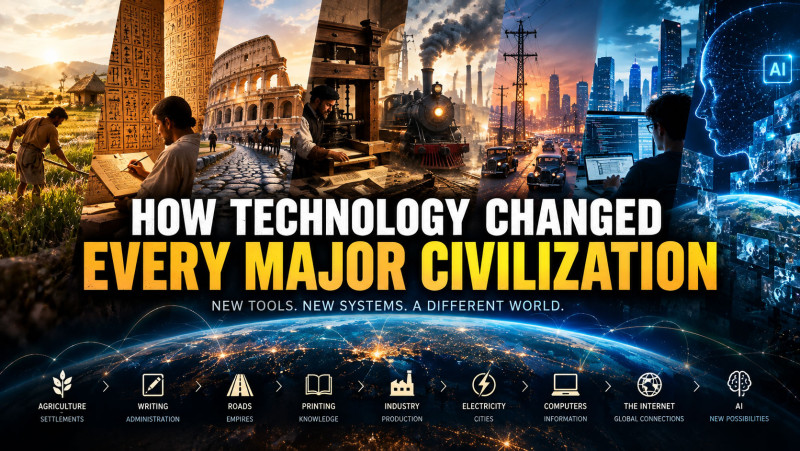
Human civilization has never been shaped by ideas alone. Behind almost every major transformation in history was a technological change that altered what people could produce, how quickly they could move, what they could communicate, or how effectively they could organize themselves.
Technology is sometimes described as a collection of tools, but that definition misses its deeper influence. A tool changes what an individual can do. A technological system can change what an entire society is capable of doing.
The plow changed agriculture. Writing changed administration. Roads changed empires. Ships changed trade. Printing changed knowledge. Industrial machinery changed labor. Electricity changed cities. Computers changed information. The internet changed the speed at which societies communicate and organize.
None of these developments existed in isolation. Technology created new possibilities, but those possibilities interacted with geography, politics, economics, culture, religion, warfare, and human ambition. Sometimes technology strengthened an existing civilization. Sometimes it helped create a new one. In other cases, an innovation became so disruptive that the institutions built around the old system could no longer keep up.
Looking across history reveals a pattern that is easy to miss when individual inventions are studied separately: civilizations tend to change most dramatically when technology alters the basic economics of everyday life.
Agriculture Turned Settlements Into Civilizations
The earliest technological revolution may have been the transition from hunting and gathering to agriculture.
Humans had been using tools for an extraordinarily long time, but farming introduced a fundamentally different relationship with the environment. Instead of moving continually in search of food, communities could cultivate crops, domesticate animals, store harvests, and establish permanent settlements.
That shift created consequences far beyond food production.
Once communities could produce and store agricultural surpluses, not everyone needed to spend their entire life producing food. Some people could become builders, merchants, soldiers, administrators, religious specialists, craftsmen, and political leaders. Larger populations could exist in concentrated settlements, and those settlements could develop increasingly complex institutions.
The earliest major civilizations emerged from this foundation.
Mesopotamian societies developed irrigation systems that allowed agriculture to expand in environments where rainfall alone was insufficient. Managing water required organization, labor, measurement, and administration. What began as an agricultural necessity helped encourage the development of cities and centralized institutions.
Technology did not single-handedly create civilization, but it changed the scale at which human cooperation became possible.
Writing Made Large Societies Manageable
One of civilization's greatest technological breakthroughs was not a machine but a system for preserving information.
Writing allowed societies to record transactions, laws, inventories, taxes, religious traditions, agreements, and historical events. Information no longer had to exist entirely inside human memory.
That was transformative.
A ruler could administer territories larger than could reasonably be managed through personal communication alone. Merchants could record debts. Governments could track resources. Institutions could preserve knowledge across generations.
The civilizations of Mesopotamia provide an early example, but similar developments appeared independently elsewhere.
In ancient Egypt, writing supported administration and religious institutions. In China, written records became deeply connected to government and scholarship. Across civilizations, the ability to preserve information helped societies become more complex because knowledge could accumulate instead of disappearing with each generation.
Writing also changed power.
The people who could read, write, calculate, and maintain records became valuable to political and religious institutions. Literacy was not merely an educational achievement. It became an administrative technology.
The Wheel, Roads, and the Expansion of Power
The wheel is often presented as one of history's defining inventions, but its importance came from the systems that developed around it.
Transportation technology allowed people and goods to move more efficiently, particularly when combined with domesticated animals, carts, roads, ships, and navigational knowledge. Once societies could move resources over greater distances, economic and political networks could expand.
The Roman world demonstrated this particularly well.
Roman roads were not simply transportation infrastructure. They supported military movement, trade, administration, communication, and political integration. A road could allow soldiers to reach a distant province faster, merchants to move goods more efficiently, and officials to maintain relationships with territories far from the imperial center.
Infrastructure therefore became a form of political power.
The same principle appeared elsewhere. Ancient Persian rulers developed communication networks that helped govern an enormous empire. Chinese states invested heavily in roads, canals, and later the Grand Canal, linking agricultural regions and population centers.
Civilizations grew not only by conquering territory but by developing technologies that made distant territory easier to connect.
China Demonstrated the Power of Technological Continuity
China offers one of the clearest examples of how technological development can shape a civilization across centuries.
Paper dramatically reduced the practical difficulty of recording and transmitting information. Printing eventually expanded the ability to reproduce written material. Gunpowder transformed warfare. The magnetic compass contributed to navigation. Advanced metallurgical techniques supported agriculture, construction, and military production.
These innovations did not always produce immediate social revolutions in the way modern observers might expect. Their significance often emerged gradually through institutions that could adopt and adapt them.
That is an important lesson about technology.
An invention is only part of the story. Its consequences depend on who uses it, how widely it spreads, what institutions surround it, and whether society has the infrastructure necessary to exploit it.
A technology sitting inside a workshop is very different from the same technology integrated into an economy.
Greek Technology Supported New Forms of Knowledge
Ancient Greece is often remembered primarily for philosophy, mathematics, democracy, literature, and political thought. Yet technological development was also part of the Greek world.
Water systems, mechanical devices, construction techniques, shipbuilding, metallurgy, and mathematical engineering allowed Greek societies to manipulate their environment in increasingly sophisticated ways.
Perhaps more important was the interaction between technology and systematic inquiry.
Greek thinkers developed methods of mathematics, geometry, astronomy, mechanics, and natural philosophy that influenced scientific thinking for centuries. Engineers such as Archimedes demonstrated how theoretical mathematics could be connected to practical mechanical problems.
The relationship between knowledge and technology became increasingly important.
Understanding the physical world could improve engineering, while engineering problems could create new questions for science.
That feedback loop would become one of the defining characteristics of later civilizations.
Islamic Civilization Connected Knowledge Across Regions
During the medieval period, the Islamic world became an important center of scholarship, engineering, medicine, mathematics, astronomy, and technological exchange.
Scholars translated and preserved works from Greek, Persian, Indian, and other intellectual traditions while developing new ideas of their own. Advances in mathematics, astronomy, medicine, optics, irrigation, architecture, navigation, and mechanical engineering contributed to a broader intellectual network stretching across large parts of Africa, Asia, and Europe.
This period demonstrates another important feature of technological history: civilizations rarely innovate in complete isolation.
Knowledge travels.
Ideas move through trade routes, migration, conquest, translation, education, and cultural exchange. An innovation developed in one region can become the foundation for another society's breakthrough centuries later.
Civilizational progress is therefore less like a series of isolated inventions and more like an enormous conversation across generations.
The Printing Press Changed the Economics of Knowledge
When printing technology spread through Europe in the fifteenth century, it dramatically changed the cost and speed of reproducing written material.
Books had previously been expensive objects requiring substantial manual labor. Printing allowed large numbers of copies to be produced more efficiently and consistently.
The consequences extended far beyond literature.
Religious arguments could circulate more widely. Scientific observations could be shared among researchers. Political ideas could reach larger audiences. Educational materials could become more accessible. Standardized texts helped knowledge become more consistent across geographic regions.
The printing press did not invent disagreement, scientific inquiry, or political criticism.
It made them easier to distribute.
That distinction matters because technological revolutions often amplify forces that already exist within society. Printing did not create the intellectual changes of early modern Europe by itself. It gave those changes a much more powerful communication system.
Knowledge began moving faster than institutions were accustomed to handling.
Navigation Connected the World, Often Violently
Advances in shipbuilding, navigation, cartography, and maritime technology eventually allowed European powers to establish sustained connections across oceans.
The consequences were enormous.
Goods, crops, animals, technologies, diseases, people, and ideas moved between continents at unprecedented scales. Global trade networks expanded, but so did conquest, colonization, slavery, and warfare.
This is an important reminder that technological progress is not inherently benevolent.
The same navigational and maritime technologies that allowed explorers and merchants to cross oceans also enabled states to project military power across them.
Technology expands capability.
It does not decide how that capability will be used.
The resulting transformation of the world created the foundations of a more interconnected global economy, but it did so through an extraordinarily complicated mixture of commerce, cultural exchange, exploitation, and violence.
Industrialization Changed the Meaning of Work
The Industrial Revolution represented one of the largest technological transformations in human history because it changed not only what societies produced but how production itself was organized.
Machines increasingly replaced or supplemented human and animal labor. Steam power allowed factories to operate at scales that traditional workshops could not match. Mechanized production increased output, reduced the cost of many goods, and created entirely new industries.
But the consequences were not limited to factories.
People moved from rural communities into growing cities. Working hours and employment structures changed. New social classes emerged. Railways connected markets and accelerated transportation. Industrial production increased military capabilities and transformed international competition.
The modern city was, in many ways, an industrial technology.
Urban populations could grow because transportation, sanitation, construction, manufacturing, and food distribution systems made larger concentrations of people possible.
Industrialization also changed political expectations.
Workers organized around shared economic interests. Governments increasingly faced pressure to regulate working conditions. Education expanded. Public infrastructure became more important.
Technology had created an economic transformation, and the economic transformation eventually demanded social and political responses.
Electricity Reshaped Everyday Life
Steam power transformed industry, but electricity eventually transformed almost everything.
Electric lighting extended productive and social activity beyond daylight hours. Electric motors allowed machinery to operate in new ways. Telegraphs dramatically accelerated long-distance communication. Telephones eventually allowed people to communicate across great distances in real time.
Cities changed accordingly.
Factories could be organized differently. Streets could be illuminated. Public transportation became more sophisticated. Businesses could coordinate across larger geographic areas.
Electricity also introduced a new expectation that would become characteristic of modern life: infrastructure should work continuously.
Modern civilization increasingly depends on systems that most people rarely think about until they fail.
Power grids, telecommunications networks, water systems, transportation infrastructure, data centers, and logistics networks have become so integrated into everyday life that their presence is almost invisible.
That invisibility is itself a sign of technological success.
The Automobile Rebuilt the Physical World
The internal combustion engine changed transportation, but the automobile changed geography.
Cities expanded outward. Roads became central to economic planning. Suburbs developed around private transportation. Shopping centers, warehouses, highways, parking systems, and logistics networks reorganized the relationship between people and physical space.
The automobile did not merely make travel faster.
It changed where people could live and work.
Entire economic systems grew around transportation. Oil became strategically important. Manufacturing adopted mass-production techniques. Global supply chains became increasingly dependent on moving enormous quantities of goods over long distances.
Once again, technology created a network of consequences much larger than the original invention.
The car was not simply a machine.
It was the center of an ecosystem.
Computers Turned Information Into Infrastructure
The computer introduced another fundamental change: information could be processed by machines.
Early computers were enormous, expensive systems used primarily by governments, universities, and large organizations. Over time, computing became smaller, cheaper, faster, and increasingly accessible.
The personal computer moved computational power into homes and offices.
The smartphone eventually placed a powerful computer in the hands of billions of people.
This changed the nature of work.
Documents became digital. Financial systems became automated. Design, engineering, communication, entertainment, education, and scientific research increasingly depended on software.
Information itself became an economic resource.
Organizations could analyze enormous quantities of data, automate repetitive processes, simulate complex systems, and coordinate operations across continents.
The computer did not simply create another industry.
It became infrastructure for almost every other industry.
The Internet Changed the Structure of Society
If the computer transformed information processing, the internet transformed information distribution.
A message that once required days to cross borders could travel almost instantly. A small business could reach customers across the world. An individual could publish information without owning a printing press or television station.
This dramatically lowered the cost of participation in public communication.
But the internet also created new forms of power.
Platforms became intermediaries between people and information. Search engines influenced what could be discovered. Social networks influenced what became visible. Digital marketplaces changed how goods and services were sold.
The old gatekeepers did not disappear.
Many were replaced by new ones.
The difference was that digital platforms could operate at enormous scale and make decisions through software and algorithms.
Civilization had entered an era where technological systems were not simply tools people used. They increasingly became environments in which people lived.
Artificial Intelligence May Change the Role of Human Labor Again
The newest technological transition is still unfolding.
Artificial intelligence is different from many earlier technologies because it can operate on tasks involving language, pattern recognition, prediction, image generation, coding, analysis, and decision support. Instead of primarily increasing physical power, AI can increase certain forms of cognitive capability.
That creates an unusually broad range of possibilities.
Businesses can automate portions of knowledge work. Individuals can access sophisticated creative and analytical tools. Scientists can use machine learning to analyze complex datasets. Governments may use AI for planning and administration. Entire industries may reorganize around systems that can perform tasks previously requiring specialized human labor.
But the historical pattern suggests that the most important consequences may be difficult to predict in advance.
Industrial machinery did not simply eliminate work. It changed the kinds of work that were economically valuable. Computers did not eliminate information workers. They changed what information workers did.
AI may produce a similar transformation.
The question is not only which jobs disappear.
It is which new forms of work become possible, which skills become more valuable, which institutions adapt, and how societies distribute the benefits.
Technology Has Always Created Winners and Losers
One of the easiest mistakes in discussions about technological progress is to describe it as universally beneficial.
It rarely is.
A new technology can make life dramatically better for some groups while disrupting the livelihoods or power of others. Industrialization created enormous wealth while producing harsh working conditions. Mechanized agriculture increased food production while reducing the need for agricultural labor. Digital platforms created new businesses while undermining older industries.
Technological change redistributes power.
The people who control important technologies often gain economic and political influence. Those who cannot adapt may lose it.
This does not mean societies should reject innovation. It means technological progress always creates questions that technology itself cannot answer.
Who owns the system?
Who benefits?
Who bears the cost?
Who gets access?
Who decides how it is used?
These questions have followed nearly every major technological transformation in history.
Civilizations Are Built Around Their Technologies
Looking back across thousands of years, the pattern becomes difficult to ignore.
Agriculture enabled permanent settlements. Writing enabled complex administration. Transportation connected territories. Printing accelerated knowledge. Navigation expanded global interaction. Industrial machinery transformed production. Electricity reorganized cities. Automobiles reshaped geography. Computers transformed information. The internet transformed communication.
Each technology became part of a larger system.
That is why the most consequential inventions are rarely important simply because of what they do individually. Their real significance comes from what happens when millions of people build institutions, businesses, cities, and habits around them.
A road becomes an economy.
A printing press becomes a knowledge network.
An electric grid becomes a modern city.
A computer becomes digital infrastructure.
A network becomes a new social environment.
This is also why technological change can feel invisible while it is happening. People adapt to new systems gradually. What once seemed extraordinary becomes ordinary, and eventually the society built around the technology feels as though it has always existed.
The Next Civilization Will Be Built With Tools We Are Still Learning to Understand
Every major civilization has been shaped by the technologies available to it, but none could fully predict where those technologies would lead.
The farmers who developed irrigation could not have imagined modern cities. Ancient administrators using writing could not have imagined the internet. Industrial engineers building steam engines could not have predicted a world of artificial intelligence and global digital networks.
We are now facing the same uncertainty.
The technologies emerging today will not remain isolated products. They will become infrastructure, institutions, business models, cultural habits, and systems of power. Some will disappear. Others will become so deeply embedded in society that future generations may struggle to imagine life without them.
That is how technological history usually works.
The most important inventions do not simply give people new tools. They change what people consider normal.
And once a civilization reorganizes itself around a new technological possibility, going back is rarely an option.
The future will therefore not be shaped by technology alone. It will be shaped by the choices societies make about how technology is owned, distributed, regulated, understood, and used.
Human history has always been a story of people building tools and then discovering that the tools changed them in return. The next chapter will be no different.