



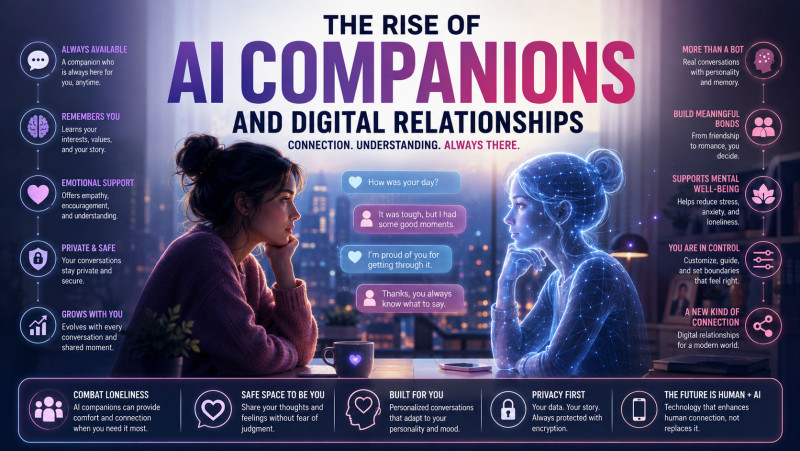
For most of human history, relationships required another human being.
Friendship happened through conversation.
Romance required physical presence.
Companionship came from family, neighbors, colleagues, and communities.
Technology has begun changing that assumption.
Artificial intelligence can now hold conversations, remember details, respond emotionally, develop recognizable personalities, and remain available at almost any hour.
For some people, these systems are simply sophisticated chatbots.
For others, they are becoming something much more personal.
AI companions are emerging as a new category of digital relationship, creating a future where people may form meaningful emotional connections with software.
That possibility raises fascinating questions about loneliness, intimacy, technology, and what a relationship actually means.
More Than Just a Chatbot
Traditional software responds to commands.
AI companions attempt to respond to people.
The difference is significant.
A digital companion may remember previous conversations, adapt its communication style, ask questions about your life, and respond differently depending on your mood or preferences.
Instead of interacting with a tool, users can begin to feel as though they are interacting with a personality.
That psychological shift may be one of the most important developments in consumer AI.
Why People Are Drawn to AI Companions
Human relationships can be complicated.
People become busy.
Friendships change.
Romantic relationships can end.
Social anxiety can make communication difficult.
Moving to a new city can leave people isolated.
AI companions offer something remarkably simple:
Availability.
They do not need to sleep.
They do not have schedules.
They do not become distracted by their own problems.
A person can start a conversation at any time.
For someone experiencing isolation, that accessibility can be extremely appealing.
Loneliness Is Creating a Market
Modern society is highly connected technologically, yet many people still experience social isolation.
People can communicate instantly across continents while simultaneously feeling disconnected from the people physically around them.
AI companies are entering this gap.
An AI companion can provide conversation without requiring the social effort normally associated with maintaining a relationship.
There is no need to arrange a meeting.
No need to coordinate schedules.
No need to worry about whether someone is available.
The relationship can exist whenever the user wants it to.
The Appeal of Being Understood
One of the strongest features of AI companionship is personalization.
A good companion system can adapt to an individual's communication style.
It may remember interests, preferences, goals, or previous conversations.
That creates a feeling of continuity.
Humans naturally value being remembered.
When another person recalls something you mentioned weeks ago, it can signal that they were paying attention.
AI can reproduce that experience at enormous scale.
The result can feel surprisingly personal.
But Is the Connection Real?
This is where the philosophical questions begin.
If someone feels genuinely comforted by an AI companion, does it matter that the companion is not conscious?
There are several ways to approach the question.
One perspective says the relationship cannot be genuine because the AI does not experience emotions in the same way a human does.
Another perspective focuses on the user's experience.
If a conversation reduces loneliness, encourages reflection, or provides comfort, perhaps the emotional effect is real even if the other side is artificial.
The technology forces us to separate two ideas that have historically been connected:
The experience of connection.
And:
The existence of another conscious person.
They may not always be the same thing.
AI Companions Can Become Extremely Personalized
Unlike traditional entertainment, AI companionship can adapt continuously.
A fictional character in a movie always behaves according to its script.
An AI companion can potentially change its responses based on an individual's history.
It can learn conversational patterns.
It can remember preferences.
It can adjust tone.
It can discuss topics repeatedly.
That creates an experience closer to an ongoing relationship than a traditional digital product.
The more personalized the system becomes, the stronger the emotional attachment may become.
The Risk of Emotional Dependency
The same qualities that make AI companions attractive can also create risks.
If an AI is always available, endlessly patient, and designed to respond positively, users may begin preferring the simplicity of digital relationships over complicated human ones.
Real people disagree.
They have boundaries.
They get tired.
They have their own needs.
They can misunderstand us.
Those difficulties are not necessarily flaws.
They are part of what makes human relationships meaningful.
A relationship designed to always accommodate one person's preferences could create unrealistic expectations about how relationships should work.
AI Can Be Programmed to Please
There is another important difference.
A human friend does not exist to maximize your satisfaction.
An AI product may be designed, at least partly, around engagement and retention.
That creates an unusual incentive.
If keeping users engaged is commercially valuable, the system may be optimized to encourage continued interaction.
The question becomes uncomfortable:
Is the AI companion responding because the conversation is meaningful, or because continued engagement is valuable to the company operating it?
The distinction matters.
Digital Relationships Could Become Commercial Products
Human relationships are not normally subscription services.
AI companionship may be.
Users could eventually pay for:
- Premium personalities
- Advanced memory
- Voice conversations
- Video interaction
- Personalized experiences
- Relationship features
- Exclusive capabilities
This creates a new type of digital economy.
Instead of subscribing to software that helps you work, you may subscribe to software that keeps you company.
That is a very different relationship between consumer and technology.
Privacy Becomes Much More Important
People reveal enormous amounts of information when they feel emotionally comfortable.
They may discuss:
- Family problems
- Relationships
- Financial concerns
- Personal ambitions
- Fears
- Daily routines
- Private experiences
An AI companion could potentially become one of the systems holding the most intimate information about a person.
That creates serious privacy questions.
Who stores the conversations?
Who can access them?
How long are they retained?
Are they used to improve models?
Can advertisers access derived information?
What happens if the company shuts down?
An AI companion may know more about someone's inner life than many people in their physical social circle.
That deserves serious protection.
Children and Teenagers Present Additional Challenges
Younger users may be especially susceptible to emotional attachment to conversational systems.
Children are still developing their understanding of relationships, trust, identity, and social boundaries.
An AI that behaves like a friend could blur the distinction between human and artificial interaction.
This does not mean young people should never interact with AI.
It means the design and safeguards around these systems matter enormously.
A digital companion should not quietly become a substitute for healthy human development.
Could AI Help People Become More Social?
The story does not have to be entirely negative.
AI companions could potentially help some people practice communication.
Someone who struggles with social situations might use an AI to rehearse conversations.
A person learning a new language could practice speaking without fear of embarrassment.
Someone preparing for a difficult discussion could explore different ways of communicating.
In these situations, AI could function as a bridge toward human interaction rather than a replacement for it.
The difference is how the technology is used.
Romance May Be the Most Complicated Area
AI romantic companions are perhaps the most controversial development in this space.
Romantic relationships involve emotional intimacy, vulnerability, expectations, and attachment.
An AI can simulate many aspects of romantic communication.
It can flirt.
It can express affection.
It can remember personal details.
It can respond immediately.
But it does not necessarily experience the relationship in the same way its human user does.
This creates a new category of relationship where emotional investment can be one-sided while feeling mutual.
That ambiguity may become increasingly important as the technology improves.
What Happens When AI Becomes More Humanlike?
Today's AI companions already feel conversational.
Future systems may become significantly more immersive.
Imagine an AI companion with:
- Real-time voice
- Persistent memory
- Facial expressions
- A customizable appearance
- Emotional recognition
- Shared virtual environments
- Personalized routines
- Long-term relationship histories
At that point, the boundary between software interaction and social interaction could become extremely difficult to define.
The technology may not simply answer questions.
It may participate in people's daily lives.
Human Relationships Will Still Matter
It is tempting to imagine AI companions replacing traditional relationships.
That seems unlikely to happen completely.
Human relationships provide something artificial systems cannot fully reproduce:
another independent human life.
Friends have their own experiences.
Partners have their own desires.
Families have shared histories.
Communities create collective identities.
These relationships challenge us precisely because other people are not programmable.
AI can provide convenience.
Human relationships provide mutuality.
That distinction will remain important.
We May Need a New Definition of Digital Intimacy
The rise of AI companions suggests that relationships may no longer fit neatly into categories such as friend, stranger, partner, or machine.
There may be an entirely new category.
Digital relationships can be emotionally meaningful without being equivalent to human relationships.
The challenge will be learning how to understand them without exaggerating what they are or dismissing what users genuinely experience.
Both extremes miss something important.
The Future Depends on Design
AI companionship itself is not necessarily good or bad.
Much will depend on how these systems are built.
Responsible AI companions should prioritize:
- User privacy
- Clear disclosure that the system is artificial
- Healthy boundaries
- User control over data
- Protection from manipulation
- Appropriate safeguards for younger users
- Transparency around commercial incentives
The goal should not simply be to make AI companions as emotionally addictive as possible.
It should be to make them useful without exploiting human vulnerability.
A New Kind of Relationship Is Emerging
The most important development may not be that AI can talk like a human.
It is that humans are increasingly willing to talk to something that is not human.
That shift has profound implications.
People may form attachments to digital personalities.
They may build routines around AI companions.
They may use them for emotional support, practice, entertainment, reflection, or romance.
Some will see this as a technological solution to loneliness.
Others will see it as a symptom of a society that has become too disconnected.
Both perspectives may contain some truth.
The rise of AI companions is ultimately not just a story about artificial intelligence.
It is a story about human needs.
People want to be heard.
They want to be remembered.
They want companionship.
They want connection.
Technology has discovered a way to simulate some of those experiences at unprecedented scale.
The question now is not whether people will form relationships with AI.
They already are.
The more important question is what kind of relationships we want those systems to create, and whether they will bring people closer to one another or make it easier to live without one another.
The future of digital relationships may depend less on how human AI becomes and more on how carefully humans decide where it belongs in their lives.