



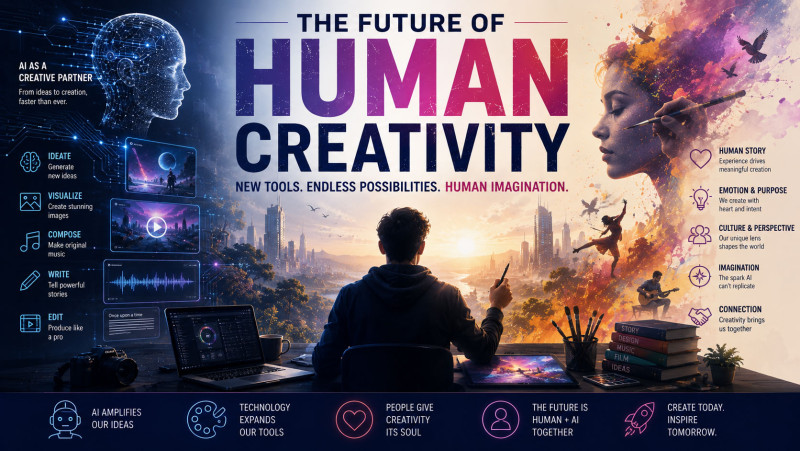
For centuries, creativity was considered one of the defining qualities of being human.
We painted, composed music, wrote stories, designed buildings, invented machines, and created entire cultures from ideas that existed first in someone's imagination.
Today, that assumption is being challenged.
Artificial intelligence can generate images in seconds, compose music, write stories, create videos, design logos, and produce ideas at a scale that would have been impossible for a human creator alone.
For some people, this represents an extraordinary expansion of creative possibility.
For others, it raises an uncomfortable question:
If machines can create, what happens to human creativity?
The answer may not be that humans become less creative.
It may be that creativity becomes more important than ever.
Creativity Is More Than Producing Something
One of the biggest misconceptions about creativity is that it simply means producing an output.
A painting is an output.
A song is an output.
A story is an output.
But creativity begins long before the finished product.
It involves deciding what is worth creating in the first place.
A human creator brings:
- Personal experience
- Emotion
- Memory
- Curiosity
- Cultural influence
- Values
- Intention
- Perspective
These elements shape the reason something is created.
AI can generate an image of a lonely city.
But the human who asks why loneliness matters may be contributing something much deeper than the image itself.
AI Can Generate More, But Does More Mean Better?
Generative AI has dramatically reduced the cost of producing content.
A person can now generate dozens of concepts in the time it previously took to develop one.
This creates enormous possibilities.
Creators can experiment more quickly.
Small businesses can produce professional-looking materials.
Independent filmmakers can visualize ideas.
Writers can explore different approaches.
Designers can test concepts rapidly.
But an abundance of content creates another problem.
When almost anyone can generate thousands of images, videos, or articles, the value of simply producing more content decreases.
The scarce resource becomes judgment.
Knowing what deserves to exist becomes more important than knowing how quickly it can be produced.
The End of the Blank Page
For many creators, the hardest part of the process is getting started.
A blank page can feel intimidating.
AI can change that.
Instead of staring at an empty document, a writer can begin with a rough idea.
A designer can generate visual directions.
A filmmaker can experiment with scenes.
A musician can explore arrangements.
The machine becomes a creative catalyst.
This does not necessarily replace creativity.
It can remove some of the friction that prevents creativity from happening.
Human Taste May Become More Valuable
When production becomes cheap, selection becomes valuable.
Imagine a world where millions of songs, images, videos, and stories can be generated every day.
The challenge is no longer finding something that exists.
The challenge is finding something worth experiencing.
That makes taste increasingly important.
Creative professionals may spend less time producing individual pieces and more time:
- Selecting ideas
- Editing outputs
- Developing concepts
- Establishing artistic direction
- Building narratives
- Defining a visual identity
The creator becomes less like a factory and more like a director.
Originality Is Getting Harder
AI systems learn from enormous amounts of existing material.
That creates an interesting contradiction.
AI can help produce something that looks new while drawing from patterns that already exist.
Humans face the same challenge.
Almost every artistic tradition builds upon previous work.
The difference is that humans experience the world directly.
A personal memory, unusual conversation, unexpected mistake, cultural experience, or difficult moment can create an idea that could not have been predicted simply by analyzing existing content.
Human experience remains an enormous source of originality.
Experience Cannot Be Fully Automated
Consider a photographer documenting a family member.
The photograph is not valuable only because of its composition.
It may carry decades of memories.
Consider a musician writing about grief.
The music may matter because the person actually experienced the emotion.
Consider a filmmaker telling a story about their hometown.
The details may come from lived experience.
AI can imitate the language of these experiences.
But it does not live them.
That distinction may become increasingly important as generated content becomes more common.
The Rise of the Creative Director
The future may not belong exclusively to people who can produce everything manually.
Instead, creative careers may increasingly reward people who can direct technology effectively.
A future creative professional might:
- Develop the concept
- Define the artistic vision
- Generate initial possibilities
- Evaluate results
- Refine the strongest ideas
- Combine multiple tools
- Add personal elements
- Make the final creative decisions
The skill is not simply knowing how to use AI.
It is knowing what to ask for, what to reject, and what to change.
Imperfection May Become Valuable
Modern technology tends to optimize.
Sharper images.
Cleaner audio.
Faster production.
More efficient workflows.
But human creativity often contains imperfections that make work memorable.
A slightly unusual brushstroke.
An unexpected lyric.
A strange camera angle.
A voice that is not technically perfect.
A story that takes an unconventional direction.
As AI-generated content becomes increasingly polished, imperfections may become signals of authenticity.
The things technology tries to remove may become part of what audiences value.
Audiences May Start Asking Who Made It
The rise of generated content could create a new form of creative transparency.
Audiences may increasingly want to know:
Was this made by a person?
Was AI involved?
How much of the work was generated?
Who made the creative decisions?
What experiences inspired it?
This does not necessarily mean AI-assisted work will be rejected.
Instead, people may become more interested in the relationship between the human and the technology.
Authenticity could become part of the product.
Creativity Could Become More Accessible
There is also an enormous positive possibility.
Throughout history, many people have had creative ideas without possessing the technical skills required to express them.
Someone might have a great film concept but no filmmaking experience.
Someone might imagine a beautiful visual but not know how to draw.
Someone might have a song in their head but never learn an instrument.
AI can reduce some of these barriers.
The person with the idea can increasingly become the person who brings it to life.
That could unlock an enormous amount of previously inaccessible creativity.
The Creator Economy May Change
Creative industries have traditionally relied on specialized roles.
A production may require:
- Writers
- Designers
- Editors
- Illustrators
- Musicians
- Animators
- Developers
- Marketing teams
AI could allow smaller teams to accomplish work that previously required much larger organizations.
This could strengthen independent creators.
A single person may be able to produce sophisticated projects without enormous financial resources.
But it could also make competition more intense.
When everyone has powerful creative tools, having the tools is no longer enough.
The idea becomes the differentiator.
Education Will Need to Change
Creative education may also evolve.
Students traditionally learn techniques first.
How to draw.
How to write.
How to edit.
How to compose.
How to photograph.
Those skills will remain valuable.
But future education may place greater emphasis on:
- Critical thinking
- Creative direction
- Storytelling
- Research
- Originality
- Ethical judgment
- Collaboration
- Problem solving
Knowing how something works will still matter.
Knowing what should be created may matter even more.
Creativity Will Become More Collaborative
The relationship between humans and AI does not have to be competitive.
It can be collaborative.
A human can provide:
Purpose.
AI can provide:
Possibilities.
A human can provide:
Experience.
AI can provide:
Variation.
A human can provide:
Judgment.
AI can provide:
Speed.
The strongest creative workflows may combine these strengths rather than treating one as a replacement for the other.
There Will Be More Bad Content Too
Greater creative accessibility has an obvious downside.
If everyone can create more, the amount of low-quality content will also increase.
The internet already contains enormous amounts of content that nobody remembers.
Generative AI could multiply that problem.
We may eventually reach a point where producing content is almost effortless.
At that point, attention becomes even more difficult to earn.
Creators will need to give audiences something that automated volume cannot easily provide.
Meaning.
Perspective.
Trust.
Personality.
Connection.
Human Creativity May Become More Distinctive
Paradoxically, AI could make human creativity more visible.
Imagine a future where millions of images can be generated instantly.
A genuinely personal photograph may feel more meaningful.
Imagine millions of songs created automatically.
A live performance from a human musician may feel more intimate.
Imagine endless AI-generated stories.
A deeply personal memoir may carry greater emotional weight.
When synthetic content becomes abundant, human origin may become a differentiator.
The Real Question Is What We Choose to Create
The future of creativity will not be determined solely by technology.
It will also be determined by human choices.
Will we use AI to produce more disposable content?
Will we use it to explore ideas we could never afford to pursue before?
Will we allow algorithms to decide what creativity should look like?
Or will we use these tools while maintaining our own judgment?
Technology provides capabilities.
Humans decide what those capabilities mean.
Creativity Is Not Going Away
The camera did not destroy painting.
The synthesizer did not destroy music.
Digital editing did not destroy filmmaking.
The internet did not destroy writing.
Each technological shift changed the tools available to creators.
Artificial intelligence may represent a much larger transformation, but the underlying pattern remains familiar.
Technology changes how people create.
It does not eliminate the human desire to create.
The future may contain more artificial content than any previous era.
It may also contain more human creativity.
The difference will depend on what people choose to do with the tools in front of them.
Perhaps the most valuable creator of the future will not be the person who can produce the most content.
It will be the person who still has something meaningful to say.