



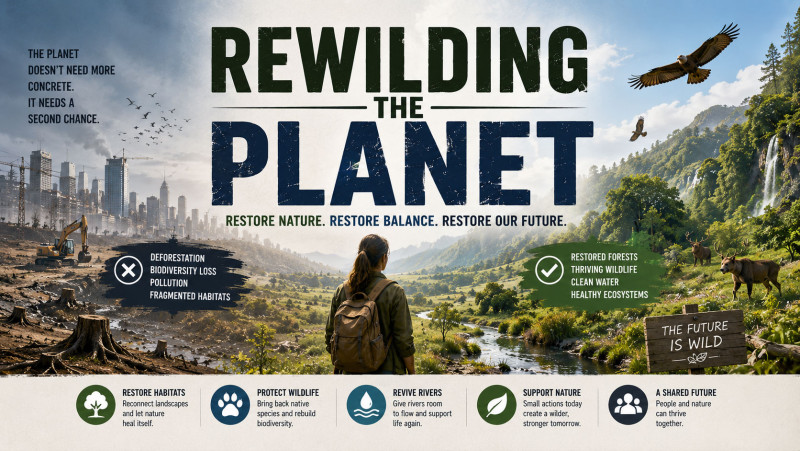
For much of human history, nature was not something people had to deliberately restore.
Forests covered enormous areas. Rivers moved freely across landscapes. Large animals migrated across continents. Wetlands absorbed floods, grasslands supported vast ecosystems, and predators played important roles in keeping food chains balanced.
Then human expansion transformed the planet.
Cities replaced habitats. Rivers were redirected. Forests were cleared. Large animals disappeared from many regions. Agricultural land expanded, while ecosystems became increasingly fragmented.
Conservation has traditionally focused on protecting what remains.
Rewilding takes a different approach.
Instead of simply preventing nature from disappearing, rewilding asks whether damaged ecosystems can be given enough space and opportunity to recover.
It is an ambitious idea, and it is becoming one of the most interesting movements in modern environmental conservation.
What Does Rewilding Actually Mean?
Rewilding is not simply planting trees or creating another nature reserve.
At its core, it involves restoring natural processes that have been disrupted by human activity.
That can include:
- Restoring wetlands
- Reconnecting fragmented habitats
- Reintroducing native species
- Restoring natural river systems
- Allowing forests to regenerate
- Protecting wildlife corridors
- Reducing human pressure on ecosystems
The goal is not necessarily to recreate a landscape exactly as it existed centuries ago.
Instead, rewilding aims to create functioning ecosystems capable of sustaining themselves.
Predators Can Change Entire Ecosystems
One of the most fascinating aspects of rewilding is the role of predators.
When large predators disappear, prey populations can increase dramatically.
That can lead to overgrazing, vegetation loss, and changes throughout the ecosystem.
Reintroducing predators can alter animal behavior as well as population numbers.
Prey may avoid certain areas where predators are present, allowing vegetation to recover.
Those changes can affect insects, birds, smaller mammals, rivers, and even soil conditions.
A single species can influence an entire landscape.
This is sometimes described as a trophic cascade.
Rivers Need Room to Move
Modern societies have heavily modified rivers.
They have been:
- Straightened
- Dammed
- Channelized
- Diverted
- Surrounded by development
These changes can make rivers easier to control, but they can also disrupt natural ecosystems.
Rewilding projects sometimes restore wetlands, remove unnecessary barriers, reconnect floodplains, and allow rivers to follow more natural paths.
The benefits can extend beyond wildlife.
Healthy floodplains can absorb excess water, reduce erosion, improve water quality, and provide habitat for countless species.
Allowing nature to perform some of these functions can be more effective than constantly engineering around them.
Forests Can Regenerate
Forestation is often discussed as though every damaged landscape needs to be planted manually.
Sometimes it does.
But forests can also regenerate naturally when pressure is removed.
If grazing decreases, native vegetation may return.
If invasive species are controlled, native plants can recover.
If surrounding forests remain intact, seeds can spread naturally.
This process can produce ecosystems better adapted to local conditions than large-scale planting programs designed from scratch.
Rewilding often asks a simple question:
What would happen if we gave nature more time and space to recover on its own?
Wildlife Needs Connected Habitats
A protected forest surrounded by highways, farms, and cities can become an ecological island.
Animals may have nowhere to move.
Populations become isolated.
Genetic diversity can decline.
Rewilding therefore focuses not only on individual protected areas, but also on connections between them.
Wildlife corridors can allow animals to move between habitats.
These corridors can take many forms:
- Forest connections
- River systems
- Grassland networks
- Coastal habitats
- Protected migration routes
Connectivity can determine whether ecosystems remain resilient as environmental conditions change.
Rewilding Can Help Address Climate Change
Rewilding is not a replacement for reducing greenhouse gas emissions.
However, healthy ecosystems can contribute to climate resilience.
Forests store carbon.
Wetlands can retain carbon while reducing flood risks.
Healthy soils can store organic matter.
Seagrass ecosystems can capture and retain carbon.
Restored ecosystems can also help communities adapt to extreme weather.
Nature is not simply a victim of climate change.
It can also become part of the response.
Cities Can Be Rewilded Too
Rewilding does not have to happen in remote wilderness.
Urban areas contain enormous opportunities for ecological restoration.
Cities can create:
- Native gardens
- Green roofs
- Urban forests
- Restored streams
- Pollinator corridors
- Wetland parks
- Wildlife-friendly public spaces
These projects can benefit both people and wildlife.
Trees provide shade.
Vegetation can reduce urban heat.
Wetlands can absorb stormwater.
Green spaces can improve quality of life.
Urban rewilding demonstrates that environmental restoration does not necessarily require choosing between nature and human development.
Farmers Are Part of the Conversation
Rewilding can sometimes create tension with agriculture.
Farmers depend on productive land.
Large-scale wildlife restoration can affect grazing, crops, and livestock.
That means successful rewilding cannot simply ignore rural communities.
Projects need to consider:
- Land ownership
- Farming income
- Wildlife damage
- Local employment
- Food production
- Community concerns
In some regions, farmers can become partners in conservation through habitat restoration, regenerative practices, wildlife corridors, and sustainable land management.
The future of rewilding will depend heavily on cooperation.
Not Every Species Should Be Reintroduced
Rewilding is sometimes portrayed as bringing back every animal that once lived in a particular location.
Reality is much more complicated.
Species introductions can create unintended consequences.
Animals may encounter landscapes that have changed dramatically since their disappearance.
Climate conditions may be different.
Human settlements may have expanded.
New diseases may exist.
A species that once belonged to an ecosystem may not fit easily into its modern version.
Rewilding therefore requires careful scientific research rather than simple nostalgia.
Nature Is More Complicated Than a Blueprint
One of the biggest lessons from ecological restoration is that ecosystems are difficult to control.
Remove one species and another may expand.
Introduce a new predator and animal behavior may change.
Restore a wetland and water flows may shift.
Stop managing a forest and unexpected species may appear.
This uncertainty can be frustrating.
But it is also the point.
Healthy ecosystems are dynamic.
They change constantly in response to weather, species interactions, fire, disease, and climate.
Rewilding works best when humans allow ecosystems to regain some of that natural complexity.
The Economic Argument Matters
Environmental conservation is often presented as a cost.
But damaged ecosystems also create enormous economic expenses.
Flooding can destroy infrastructure.
Soil degradation reduces agricultural productivity.
Polluted water increases treatment costs.
Loss of pollinators can affect food production.
Declining fisheries threaten coastal economies.
Rewilding can provide natural services that would otherwise require expensive infrastructure.
A restored wetland, for example, can perform some flood management functions without requiring a concrete structure.
Nature can be infrastructure.
Rewilding Is Also About Patience
Modern projects are often judged within short political and financial cycles.
Ecological recovery operates on a different timeline.
A forest may require decades to mature.
A wildlife population may need generations to stabilize.
A river may take years to recover its natural patterns.
This creates a challenge for policymakers.
The people who invest in restoration today may not experience its full benefits.
But that does not make the investment less valuable.
Some of the most important environmental decisions are measured in decades rather than election cycles.
Humans Are Still Part of the Ecosystem
Rewilding does not mean removing people from nature.
Humans have shaped landscapes for thousands of years.
Many ecosystems considered "natural" today have been influenced by agriculture, controlled burning, hunting, grazing, and other human activities.
The objective is therefore not to pretend humans never existed.
It is to create healthier relationships between human societies and the ecosystems around them.
That requires recognizing where intervention is necessary and where nature may be better at managing itself.
The Future May Be Less About Control
For centuries, environmental management often focused on controlling nature.
We built dams to control rivers.
We removed predators to control wildlife.
We cleared forests to control land use.
We planted specific crops to control food production.
Rewilding represents a different philosophy.
Instead of asking how much control humans can exert, it asks:
How much control can we responsibly give back?
That shift may become increasingly important as ecosystems face mounting pressure.
A Wilder Future Is Still Possible
The planet does not need to return to some imaginary version of the past.
It needs functioning ecosystems capable of supporting life in a rapidly changing world.
That means restoring forests where possible.
Protecting wetlands.
Connecting habitats.
Supporting biodiversity.
Recovering rivers.
Giving wildlife room to move.
And designing human communities that leave space for nature rather than pushing it to the margins.
Rewilding will not solve every environmental problem.
It cannot replace emissions reductions, responsible resource use, or effective conservation.
But it offers something increasingly valuable: a vision of environmental recovery rather than environmental decline.
For generations, humanity has become remarkably good at transforming nature.
The next great challenge may be learning when to step back.
Sometimes the most powerful thing we can do for the planet is not build something new.
It is give nature the opportunity to rebuild itself.