



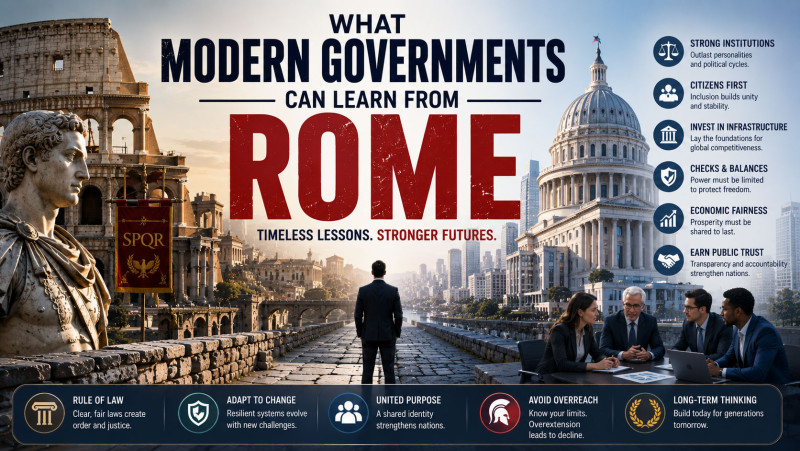
Few civilizations have influenced the modern political world as deeply as Rome.
Its republic inspired generations of political thinkers. Its legal traditions influenced modern legal systems. Its roads, public infrastructure, administrative structures, and institutions helped shape the way later societies understood government at scale.
But Rome is also a warning.
The Roman state survived for centuries, expanded across enormous territories, adapted to political crises, and eventually transformed from a republic into an empire. Its story contains remarkable examples of institutional resilience alongside equally important lessons about corruption, inequality, political polarization, excessive expansion, and the dangers of concentrating power.
Modern governments are obviously not ancient Rome.
Technology, economics, democratic institutions, and social structures are fundamentally different.
Yet some of the problems Rome faced are surprisingly familiar.
Strong Institutions Matter More Than Strong Personalities
One of Rome's greatest achievements was developing institutions capable of governing a large and complicated society.
The Roman Republic contained multiple centers of political authority, including elected officials, assemblies, magistrates, and the Senate.
The system was far from democratic by modern standards, and political power was heavily concentrated among elites.
Nevertheless, Rome demonstrated an important principle:
A government cannot depend entirely on the personality of one leader.
Institutions create continuity.
When leadership changes, functioning institutions can preserve stability.
Modern governments can learn from this by strengthening systems that remain effective regardless of who occupies a particular office.
Laws Need to Be Understandable
Roman law became one of the most influential legal traditions in history.
The Romans gradually developed increasingly sophisticated rules governing property, contracts, citizenship, inheritance, commerce, and public responsibilities.
One important lesson is that laws work best when citizens can understand the basic rules governing their society.
Complex legal systems are unavoidable in modern states.
But excessive complexity can create confusion, increase administrative costs, and make ordinary citizens dependent on specialists simply to understand their rights and responsibilities.
Good governance requires not only creating laws, but making them accessible.
Infrastructure Is an Investment in the Future
Rome understood something modern governments sometimes rediscover during crises:
Infrastructure is not simply an expense.
It is an investment.
Roman roads connected distant regions.
Aqueducts supplied cities with water.
Ports supported trade.
Public buildings created civic spaces.
These projects helped facilitate economic activity and administrative control across a vast territory.
Modern governments face a similar challenge.
Reliable infrastructure supports:
- Transportation
- Communication
- Energy
- Commerce
- Public health
- Economic development
A government that continually postpones infrastructure investment may reduce short-term spending while creating much larger costs later.
Expansion Creates Opportunities and Risks
Rome grew because it was extraordinarily effective at expansion.
New territories brought resources, trade routes, tax revenue, and strategic advantages.
But expansion also created enormous responsibilities.
The larger Rome became, the more difficult it was to administer.
Military commitments increased.
Borders became harder to defend.
Different cultures and political interests had to be integrated.
The lesson for modern governments is not about territorial conquest.
It is about scale.
Organizations and institutions can become so large that coordination becomes increasingly difficult.
Growth without administrative capacity can turn an advantage into a vulnerability.
Citizenship Can Strengthen a State
Rome's concept of citizenship evolved significantly over time.
Citizenship was initially relatively restricted, but Rome gradually extended it to larger populations throughout its territories.
Eventually, citizenship became much more broadly distributed across the empire.
This helped create a larger shared political identity.
Modern governments face different circumstances, but the broader principle remains relevant:
People are more likely to feel invested in a political system when they believe they genuinely belong to it.
A stable society requires more than laws.
It requires a sense of shared membership and participation.
Political Polarization Can Become Dangerous
The Roman Republic experienced intense political conflict.
Competing factions fought over land, wealth, military power, citizenship, and political influence.
Political disagreements became increasingly personal and destructive.
Eventually, institutional norms weakened.
The result was not caused by one disagreement or one individual.
It was a long process in which political competition became increasingly difficult to manage within existing institutions.
Modern democracies can learn an important lesson from this.
Disagreement is not necessarily a weakness.
Healthy disagreement can improve government.
The danger appears when political opponents are treated as enemies who must be eliminated rather than competitors who must eventually share the same system.
Economic Inequality Can Undermine Stability
Rome experienced substantial economic inequality.
Wealth became concentrated among powerful elites while many ordinary citizens faced economic insecurity.
Large estates expanded.
Small farmers struggled.
Political conflicts increasingly reflected deeper economic divisions.
Modern economies are vastly different, but economic inequality remains politically significant.
When large portions of society believe the economic system consistently benefits only a small group, trust in institutions can decline.
Governments cannot create perfect equality.
But they can recognize that economic stability and political stability are closely connected.
Public Trust Is a Form of Infrastructure
Roman institutions depended on people believing that the political system could continue functioning.
When corruption, political violence, and institutional manipulation became increasingly visible, confidence in the Republic weakened.
Modern governments face the same basic challenge.
Public trust cannot be created through slogans alone.
It develops when institutions consistently demonstrate:
- Competence
- Transparency
- Accountability
- Fairness
- Reliability
Trust is difficult to build and easy to lose.
Once citizens stop believing institutions operate fairly, even legitimate decisions can become difficult to enforce.
Government Needs to Adapt
Rome survived for so long partly because it was capable of changing.
Its political structure evolved dramatically.
The Republic became an empire.
Citizenship expanded.
Administrative systems developed.
Military structures changed.
Economic relationships shifted.
Rome was never completely static.
Modern governments face an even faster pace of change.
Technology, demographics, climate pressures, global markets, and artificial intelligence are transforming societies rapidly.
Institutions that refuse to adapt can eventually become disconnected from the people they are supposed to serve.
Stability does not mean refusing to change.
Sometimes stability requires change.
Centralized Power Can Solve Problems and Create Them
The Roman Empire demonstrated the advantages of centralized authority.
A strong central government could make decisions quickly, coordinate enormous territories, and respond to military threats.
But concentrated power also creates risks.
When too much authority depends on a small number of individuals, institutions may become weaker.
Succession becomes dangerous.
Political competition can become violent.
Bad decisions can spread throughout the entire system.
Modern governments need executive authority.
But they also need meaningful checks, independent institutions, transparent processes, and mechanisms for accountability.
Power is most stable when it is constrained.
Governments Should Know Their Limits
One of the most important lessons from Rome is that no political system is immune to limits.
Economic resources are finite.
Administrative capacity is finite.
Military power is finite.
Public attention is finite.
Political legitimacy is finite.
A government can promise more than it can realistically deliver.
When expectations consistently exceed capacity, frustration grows.
Effective governments must therefore understand not only what they can accomplish, but what they cannot.
Knowing the limits of a system is a strength, not a weakness.
The Fall Was Not One Simple Event
The decline of the Western Roman Empire is often presented as though one event caused everything to collapse.
History is more complicated.
Political instability, economic pressures, military challenges, internal conflicts, administrative problems, demographic changes, and external pressures all played roles over long periods.
This itself is an important lesson.
Modern societies should be careful with simple explanations for complex problems.
Large political systems rarely fail because of one issue.
They become vulnerable when multiple weaknesses reinforce one another.
The Most Important Lesson Is Institutional Resilience
Rome's greatest lesson may not be about its roads, armies, emperors, or monuments.
It is about resilience.
Political systems must be capable of surviving:
- Leadership changes
- Economic crises
- Social conflicts
- External threats
- Technological disruption
- Institutional failures
A healthy government does not assume crises will never happen.
It builds systems capable of responding when they do.
That means investing in institutions before they are needed.
Rome Was Both a Model and a Warning
Modern governments should not attempt to recreate Rome.
The Roman world was fundamentally different from ours, and many aspects of Roman society would be unacceptable by modern standards.
But history does not need to provide perfect models to be useful.
Rome demonstrates how institutions can support enormous societies.
It shows how infrastructure can create long-term economic value.
It demonstrates how citizenship can help build shared identity.
It also reveals how inequality, polarization, corruption, excessive concentration of power, and institutional weakness can gradually undermine political stability.
The most valuable historical lessons are rarely instructions to copy the past.
They are reminders of patterns to recognize.
Rome survived for centuries because it repeatedly adapted to changing circumstances.
Its decline became possible when political and institutional problems grew harder to manage.
For modern governments, the lesson is clear.
Strong societies are not built simply by creating powerful governments.
They are built by creating institutions that citizens can trust, infrastructure that supports future generations, laws that remain meaningful, and political systems capable of adapting without abandoning their fundamental principles.
Rome ultimately reminds us that no government is permanent.
Institutions must be maintained.
Trust must be earned.
Power must be balanced.
And every generation inherits the responsibility of deciding whether the systems it received will be stronger or weaker when it passes them on.