



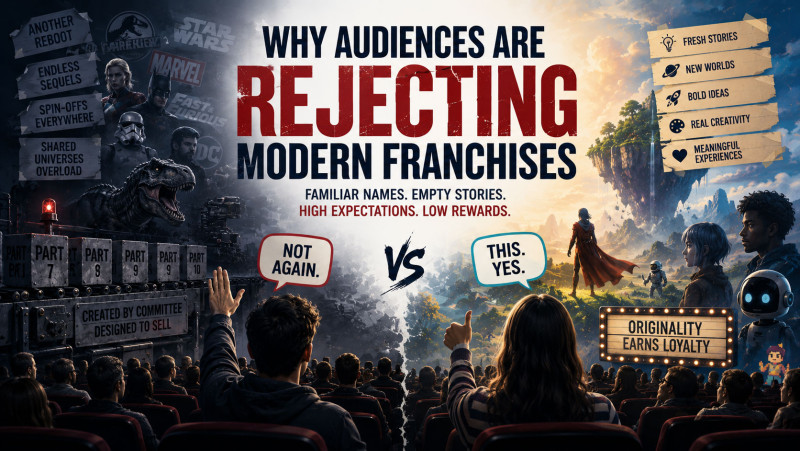
Hollywood, gaming, television, and even publishing have increasingly come to depend on familiar names.
Sequels.
Remakes.
Reboots.
Spin-offs.
Shared universes.
Established characters.
For decades, franchises have been one of the safest ways for entertainment companies to reduce financial risk. A recognizable title can attract an audience before anyone has seen the finished product.
Yet something appears to be changing.
Audiences are not necessarily rejecting entertainment itself. They are becoming more selective about which franchises deserve their time and money.
A familiar name is no longer enough.
In some cases, it may even create higher expectations that a new release struggles to meet.
Familiarity Became the Business Model
The logic behind franchises is straightforward.
If audiences already know a character or fictional universe, companies do not have to introduce an entirely new concept.
A successful franchise already has:
- Brand recognition
- Existing fans
- Established characters
- Marketing value
- Merchandise opportunities
- Potential for multiple releases
This can make familiar properties extremely attractive to studios and publishers.
The problem begins when familiarity replaces creativity.
Audiences Have Seen This Before
Modern audiences have access to an enormous amount of entertainment.
They can watch films from almost any decade.
They can play thousands of games.
They can discover independent creators from around the world.
They can explore international television and cinema.
This abundance has changed expectations.
When audiences have unlimited alternatives, another sequel must offer a compelling reason to exist.
Simply bringing back a recognizable character is no longer enough.
Nostalgia Has Limits
Nostalgia is powerful.
People enjoy returning to stories that shaped their childhood or teenage years.
Companies understand this very well.
That is why familiar franchises are repeatedly revived.
But nostalgia has a limitation.
People remember how something made them feel.
They do not necessarily want the exact same experience repeated indefinitely.
A remake that exists primarily because audiences remember the original may generate curiosity, but curiosity does not always translate into lasting enthusiasm.
Nostalgia can open the door.
It cannot guarantee that people will stay.
Too Many Universes Create Fatigue
The idea of interconnected storytelling became enormously successful.
One film leads into another.
Characters appear across multiple projects.
Stories continue across movies, television shows, games, and other media.
For dedicated fans, this can be exciting.
For casual audiences, it can become exhausting.
People may begin asking:
"Do I need to watch everything before this?"
If the answer appears to be yes, some viewers simply stop participating.
Entertainment should feel inviting.
When following a franchise begins to resemble homework, audiences can lose interest.
More Content Does Not Mean More Value
Companies have increasingly embraced the idea that audiences want constant content.
New seasons.
New spin-offs.
New games.
New expansions.
New cinematic universes.
But quantity can create its own problem.
When audiences receive too much content from the same franchise, individual releases can begin to feel less important.
A special event becomes another episode.
A major character becomes another recurring appearance.
A theatrical release becomes another piece of an enormous content pipeline.
Scarcity creates excitement.
Abundance can create indifference.
Quality Still Matters
Perhaps the most obvious explanation for franchise fatigue is also the most important.
Audiences still care about quality.
A great sequel can be celebrated.
A thoughtful remake can introduce a classic story to a new generation.
A spin-off can become more beloved than the original.
The problem is not that something belongs to a franchise.
The problem is when audiences feel the franchise exists primarily to generate another transaction.
Viewers and players can usually sense the difference.
Marketing Cannot Replace Trust
Franchises once provided an immediate level of trust.
A recognizable title suggested a certain level of quality.
That relationship is becoming more complicated.
Repeated disappointments can weaken the value of a brand.
If audiences repeatedly purchase a product that fails to meet expectations, the franchise name can eventually stop functioning as a guarantee.
It can become a warning.
Trust takes years to build.
A few poor releases can damage it quickly.
Audiences Have More Power Than Ever
The modern entertainment consumer is not simply a passive customer.
Audiences can:
- Review products publicly
- Share criticism instantly
- Create alternative content
- Recommend independent creators
- Organize communities
- Compare prices
- Watch reviews before purchasing
- Wait for discounts
- Choose subscription services instead
Word of mouth can spread globally within hours.
A massive marketing campaign can no longer completely control the conversation.
Audiences have become part of the marketing process themselves.
Independent Creators Are Offering Something Different
One reason audiences may be moving away from major franchises is the growing strength of independent entertainment.
Independent filmmakers, game developers, musicians, writers, and creators can experiment with ideas that large companies may consider too risky.
They often produce work that feels:
- Personal
- Unexpected
- Focused
- Original
- Experimental
Without decades of franchise history behind them, independent creators have fewer expectations to satisfy.
They can simply tell a story.
That freedom can be refreshing.
Risk Aversion Can Become Its Own Risk
Companies create franchises to reduce financial uncertainty.
Ironically, excessive reliance on familiar properties can create another kind of risk.
When everything begins looking similar, audiences lose excitement.
If ten major releases compete using the same formulas, the one that feels different may attract the most attention.
Avoiding all risk can eventually become risky itself.
Creativity requires experimentation.
The Algorithm Is Also Changing Discovery
Audiences are no longer dependent entirely on major studios to decide what becomes popular.
Recommendation systems can introduce people to:
- Independent films
- Smaller games
- International creators
- Older productions
- Niche communities
- Unexpected genres
This creates an enormous discovery ecosystem outside traditional entertainment companies.
A small creator can sometimes reach millions of people without a major marketing budget.
That makes it harder for established franchises to assume they automatically own audience attention.
Fans Still Love Great Franchises
It is important not to confuse franchise fatigue with franchise rejection.
Audiences continue to love well-made sequels and established universes.
People still want to see beloved characters return.
They still enjoy continuing stories.
They still become emotionally invested in fictional worlds.
What appears to be changing is the standard required to earn that attention.
Audiences increasingly want a reason to return.
They want stories that justify their existence rather than products that simply extend a brand.
Originality Is Becoming Valuable Again
The entertainment industry may be entering a period where originality becomes a competitive advantage.
A completely new world can generate curiosity.
A new character can create genuine emotional investment.
An unexpected story can become a cultural event.
The next major entertainment phenomenon may not come from a franchise that has existed for decades.
It may come from an idea nobody has seen before.
That possibility is exciting.
Franchises Need to Earn Their Future
The franchise model is not disappearing.
It is too deeply embedded in modern entertainment.
But its relationship with audiences is changing.
A recognizable name can attract attention.
It cannot guarantee loyalty.
The next generation of successful franchises will likely be those that combine familiarity with genuine creativity.
They will respect what audiences already love without being afraid to change.
They will understand that nostalgia should be a starting point rather than the entire product.
Most importantly, they will recognize that audiences are not rejecting franchises simply because they are franchises.
They are rejecting the feeling that the audience is being asked to consume something simply because the brand already exists.
In an entertainment landscape overflowing with choices, familiarity may get people to look.
Only quality, originality, and meaning will convince them to stay.