



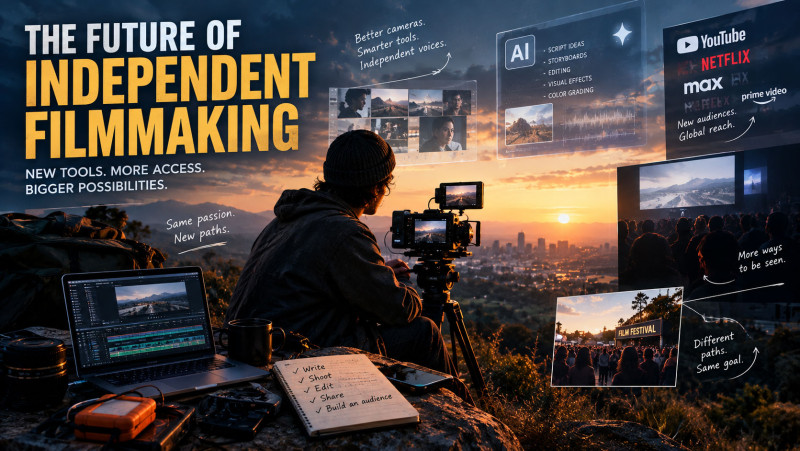
For most of the history of cinema, making a film was an exercise in overcoming limitations. Cameras were expensive, film stock cost money, editing required specialized equipment, distribution depended on theaters or established studios, and reaching an audience could be just as difficult as making the movie itself. A talented filmmaker could have a great idea and still spend years trying to convince someone with money and connections that the idea deserved to exist.
Many of those barriers have weakened.
A filmmaker with a relatively modest budget can now shoot footage that would have been technically impressive by much larger productions a generation ago. Editing software is widely accessible, digital distribution can reach audiences across the world, and social platforms allow filmmakers to build communities before their movies are even finished. Crowdfunding has created another path to financing, while artificial intelligence is beginning to introduce new tools for everything from pre-production and visual development to post-production.
Yet the future of independent filmmaking is not simply a story about technology making movies easier to produce. In some ways, production has become easier while getting attention has become harder. The problem has shifted from Can you make a film? to Can anyone find it?
That distinction may define the next era of independent cinema.
The Camera Is No Longer the Biggest Barrier
The democratization of filmmaking equipment has already changed what independent filmmakers can attempt.
Professional-looking images no longer require a massive camera department. Affordable digital cinema cameras, increasingly capable mirrorless cameras, smartphones, compact lighting equipment, and accessible audio technology have dramatically reduced the technical barriers to production. A small crew can accomplish things that once required a much larger operation.
This does not mean equipment has become irrelevant. Good lenses, lighting, production design, sound recording, color grading, and experienced crews still matter enormously. Technology can make filmmaking more accessible, but it cannot automatically create a compelling performance, a believable world, or a story worth watching.
What has changed is the relationship between resources and possibility.
A filmmaker no longer necessarily needs to wait for a studio to approve a project before discovering what they are capable of making. They can experiment, shoot short films, produce pilots, create proof-of-concept scenes, and build an audience around their work. The first project does not have to be a multimillion-dollar statement. It can be the beginning of a body of work.
That shift gives independent filmmakers something previous generations often lacked: the ability to demonstrate rather than simply promise.
Distribution May Be the Real Revolution
For decades, independent filmmaking faced a particularly cruel problem. Completing a movie did not mean people would see it.
A film might travel through festivals, attract a distributor, secure a limited theatrical release, appear on television, or eventually reach a physical rental or purchase market. Each stage involved gatekeepers, and many worthwhile films disappeared simply because they never found a meaningful path to an audience.
Digital distribution changed the equation.
Streaming platforms, transactional video services, independent rental platforms, YouTube, social media, and direct-to-consumer websites have created more ways for filmmakers to put their work in front of viewers. A film no longer necessarily needs a traditional theatrical release to reach thousands or even millions of people.
But abundance has created a new problem.
There are now so many films, shows, videos, channels, podcasts, and other forms of entertainment competing for attention that distribution alone does not guarantee discovery. The internet removed some gatekeepers while creating others.
The algorithm has become one of them.
The New Gatekeepers Are Algorithms
An independent film can technically be available to anyone with an internet connection and still remain almost invisible.
Recommendation systems determine what appears in feeds, search results influence what people discover, and platform design shapes how long a viewer remains interested. A film competes not only against other films but against every other form of content fighting for the same few minutes of attention.
This changes the economics of independent cinema.
A filmmaker may spend years writing, financing, shooting, editing, and promoting a movie, only to discover that the hardest part is generating enough visibility for people to know the movie exists. A major studio can spend enormous amounts on advertising. An independent filmmaker may have a small promotional budget and a handful of social accounts.
The result is an uncomfortable contradiction: the cost of creating content has fallen while the cost of earning attention has risen.
That may become one of the defining challenges of independent filmmaking.
The filmmaker of the future may need to think not only like a director or screenwriter but also like a publisher, community builder, marketer, and entrepreneur. That does not necessarily mean every filmmaker needs to become an influencer. It does mean that the old assumption that the movie speaks for itself is becoming increasingly difficult to sustain.
Crowdfunding Has Changed the Conversation About Financing
Traditional film financing has always involved a complicated calculation of risk. Investors, producers, studios, and distributors want to know whether an audience exists before committing significant resources.
Crowdfunding offers a different model because the audience can become part of the financing process itself.
Platforms that allow creators to raise money directly from supporters have made it possible for filmmakers to test whether people care enough about a project to help bring it into existence. The money is important, but the validation can be just as valuable.
A successful campaign can demonstrate that a filmmaker has an audience before the finished movie exists.
That changes the pitch.
Instead of approaching a traditional financier with nothing more than a screenplay and a concept, a filmmaker may be able to show a community, previous work, campaign supporters, mailing-list subscribers, social engagement, or an established niche audience. The audience itself becomes evidence that the project has potential.
This will not eliminate traditional financing. Large productions will continue to require substantial capital, insurance, crews, locations, post-production, marketing, and distribution. But crowdfunding can create a middle ground between making something entirely alone and waiting for a studio to finance it.
AI Will Change Filmmaking, But Not in the Simplest Way
Artificial intelligence is likely to become one of the most consequential technologies in filmmaking, although perhaps not for the reasons most people initially imagine.
The most immediate impact may come from using AI to reduce repetitive or expensive tasks. Filmmakers can already experiment with tools for brainstorming, script development, storyboarding, concept visualization, transcription, editing assistance, translation, sound work, and other parts of the production process.
For an independent filmmaker working with limited resources, saving hours on a technical task can have meaningful financial consequences.
But there is a deeper question surrounding AI-generated imagery, voices, performances, and eventually entire sequences: if the technology makes production dramatically cheaper, what happens to the value of human filmmaking?
The answer may not be that audiences stop caring about human creativity.
It may be the opposite.
As synthetic content becomes easier to generate, the things that feel unmistakably human could become more valuable. A distinctive directorial perspective, an unusual performance, a personal story, a real location, a physical performance, or a filmmaker's specific relationship with their subject can provide something that technically impressive generated content may struggle to reproduce.
The challenge will be distinguishing technological assistance from creative substitution.
AI could give independent filmmakers capabilities that previously belonged almost exclusively to larger productions. Used thoughtfully, that could expand creative freedom rather than replace it. But audiences will still decide whether the final work feels meaningful.
Technology can generate possibilities. It cannot guarantee significance.
The Rise of the Filmmaker-Owned Audience
Perhaps the most important long-term change has little to do with cameras or AI.
It is the possibility that filmmakers may begin building audiences they actually own relationships with.
For decades, filmmakers largely depended on intermediaries to connect their work with viewers. Studios, distributors, broadcasters, theaters, retailers, and later streaming platforms controlled significant parts of that relationship.
The internet offers another possibility.
A filmmaker can build a mailing list, membership community, website, social following, crowdfunding network, or subscription audience around their work. None of these guarantees financial sustainability, but together they create something extremely valuable: direct knowledge of who is interested.
That information can influence future projects.
A filmmaker who knows that several thousand people consistently follow their work has a very different starting position from someone presenting an unknown screenplay to a studio executive. The audience becomes part of an ongoing creative relationship rather than a group that only appears at the end of the production process.
This is where independent filmmaking begins to overlap with the broader creator economy.
The filmmaker may no longer make one movie, sell it, and start over from zero. They may build a creative identity that carries from one project to the next.
Niche Audiences Could Become More Important
Hollywood has historically depended on mass appeal because large productions require enormous amounts of money to recover their costs. Independent filmmakers have more room to operate in smaller spaces.
That could become a significant advantage.
A film does not necessarily need to appeal to everyone if it can become deeply important to a specific audience. Horror, documentaries, experimental cinema, regional stories, niche science fiction, cultural films, unconventional dramas, and countless other categories can thrive when creators understand precisely who they are making something for.
The internet makes these audiences easier to find.
A filmmaker in one country can potentially reach viewers across the world who share a particular interest, aesthetic, cultural background, or obsession. That kind of fragmented global audience was much harder to assemble before digital distribution.
The future may therefore belong partly to films that are not trying to be universally popular.
Instead, they may be intensely relevant to the people who discover them.
Theaters Will Not Simply Disappear
Whenever new technology changes distribution, predictions about the death of theaters tend to follow.
Cinema has already survived television, home video, DVDs, cable, piracy, streaming, and social media. The theatrical experience has changed, but it has not disappeared.
For independent filmmakers, theaters may actually become more valuable precisely because they are no longer the only destination.
A limited theatrical run can create cultural momentum around a film. Festivals can generate credibility. Community screenings can turn a movie into an event. Special presentations, filmmaker discussions, and local screenings can offer something that watching a film alone at home cannot.
The future is therefore unlikely to be a simple choice between theaters and streaming.
Instead, independent films may move fluidly between multiple environments. A festival premiere can lead to a theatrical run, which can lead to digital distribution, which can lead to a community screening or educational licensing opportunity. Each stage can serve a different purpose.
The movie becomes part of a broader ecosystem rather than a single product with one release date.
The Independent Film Festival May Become More Important
Film festivals have always provided independent filmmakers with something difficult to purchase: attention from people actively looking for new work.
As digital platforms become increasingly crowded, that function could become even more important.
A festival can provide context. It can place an unknown film alongside other carefully selected work, create conversations around it, and give filmmakers an opportunity to meet audiences, critics, distributors, producers, and other creators.
In an environment where algorithms struggle to distinguish meaningful work from endless content, human curation becomes valuable.
A festival selection can tell an audience that someone considered the film worth watching.
That does not make festivals immune to the problems of access, cost, geography, or industry politics. Independent cinema will still need broader pathways for discovery. But curated spaces may become increasingly important as the amount of available content continues to grow.
The Biggest Opportunity May Be Creative Freedom
There is a tendency to describe independent filmmaking primarily through its limitations: smaller budgets, fewer resources, smaller crews, limited marketing, and difficult distribution.
Those limitations are real, but independence also creates a different kind of freedom.
A filmmaker outside the traditional studio system may not need to satisfy the same collection of commercial expectations. They may be able to take a strange premise seriously, tell a story about an unfamiliar community, experiment with structure, work with nontraditional actors, or explore subjects that would be considered too risky for a major production.
Not every experiment will work.
That is part of the point.
A healthy independent film culture gives filmmakers room to fail without every failure threatening a massive corporate investment. Some of the most interesting creative movements in cinema have emerged precisely because filmmakers were willing to work outside conventional formulas.
The danger is that independent filmmakers may eventually reproduce the same formulas they were trying to escape.
If creators become obsessed with optimizing thumbnails, engagement rates, trends, audience retention, and algorithmic recommendations, independence can gradually become another form of conformity.
The tools may be different, but the pressure can remain the same.
Making a Movie May Become Easier. Making a Meaningful One Will Not.
That may be the most important distinction in the future of independent cinema.
Technology will continue reducing the technical barriers to filmmaking. Cameras will become more capable, software will become more intelligent, visual effects will become more accessible, distribution will become more fragmented, and AI will almost certainly accelerate parts of the production process.
None of this solves the fundamental creative problem.
A film still needs something to say.
It needs characters audiences care about, performances that feel alive, images that serve a purpose, a story with emotional weight, or an idea that stays in someone's mind after the credits. The ability to generate an impressive image does not automatically produce a compelling scene. The ability to edit quickly does not create better storytelling.
If anything, the abundance of inexpensive production tools could make genuine creative identity more important.
When everyone can produce something polished, polish becomes less distinctive.
Voice becomes distinctive.
A More Open Cinema
The future of independent filmmaking will probably not look like a complete replacement of Hollywood. Large studios will continue making enormous productions, major stars will continue attracting audiences, and theatrical blockbusters will remain part of the cultural landscape.
But the space around that system could become dramatically larger.
More filmmakers will be able to make their first projects without institutional permission. More niche audiences will be able to find work created specifically for them. More creators will experiment with direct financing and distribution. Artificial intelligence may allow tiny teams to achieve production capabilities that once required much larger organizations.
The central challenge will be turning access into sustainability.
It is one thing to make a film. It is another to make enough money to continue making films. It is one thing to build an audience around a single project. It is another to create a career from that audience.
That is where the next chapter of independent filmmaking will be decided.
The filmmakers who thrive may not necessarily be those with the biggest budgets or the most advanced technology. They may be the ones who understand how to combine accessible tools with distinctive creative voices, direct relationships with audiences, and a willingness to build patiently rather than chase every new platform trend.
Independent filmmaking has spent much of its history trying to get through the door.
The interesting possibility now is that there may be fewer doors to wait behind.
There may simply be more ways to build the room yourself.