



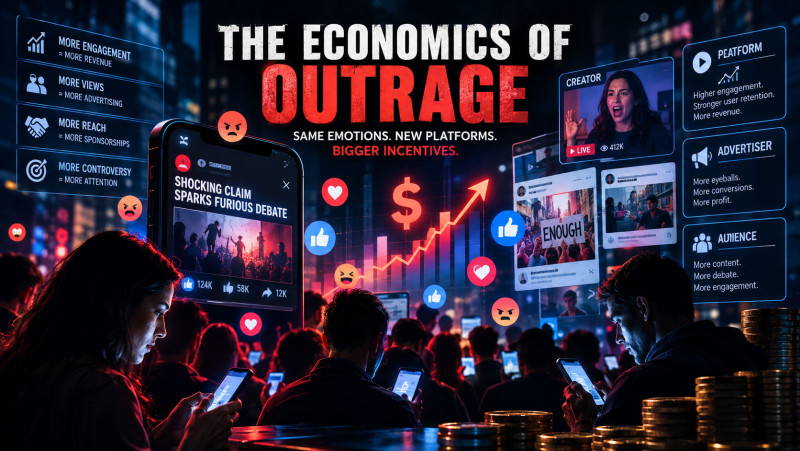
Outrage has always been part of public life. People have argued over politics, religion, culture, celebrities, sports, and morality for centuries. What has changed is the scale, speed, and economic machinery surrounding those arguments.
Today, anger is not simply something that happens online. It is something that can be measured, optimized, distributed, monetized, and repeated.
A controversial post can travel across the world within minutes. A misleading headline can generate thousands of reactions before anyone checks whether it is true. A creator who understands exactly which subjects make an audience furious can turn that knowledge into a business model. Meanwhile, platforms can benefit from the increased attention generated by all of it.
This creates an uncomfortable possibility: the internet does not merely contain outrage. In many places, it has developed an economy around it.
The more attention anger produces, the more valuable anger can become.
Anger Has Always Been Valuable
There is nothing uniquely modern about exploiting outrage.
Newspapers discovered long ago that dramatic stories could sell more copies. Political movements have always used fear and indignation to motivate supporters. Advertisers have understood that strong emotions can make messages more memorable. Television news learned that conflict could keep viewers watching.
The digital environment did not invent these techniques.
It removed many of the limitations.
A newspaper had a finite number of pages. A television network had a limited number of hours. A magazine could only publish so many stories in a week.
The internet has almost no practical limit on how much content can be produced and distributed. Social platforms can continuously test what captures attention and promote the material that performs best.
That creates an environment in which emotional intensity can become a competitive advantage.
A calm explanation might be useful.
An angry argument may be irresistible.
Attention Is the Currency
The modern internet runs largely on attention.
People may not hand a platform money every time they open an application, but their time, clicks, views, interactions, and behavioral data have economic value. Advertising systems depend on reaching audiences, and platforms have strong incentives to keep those audiences engaged.
This creates an important distinction between content that is valuable to a person and content that is effective at holding that person's attention.
Those are not always the same thing.
A thoughtful article may leave a reader feeling informed and satisfied after ten minutes. A furious argument between strangers might keep someone scrolling for an hour because every new response creates another reason to look.
From the perspective of an attention-based system, both interactions are measurable.
The emotional one may simply produce more of them.
Outrage Is Particularly Efficient
Anger has several characteristics that make it powerful in digital environments.
It creates urgency. It encourages people to respond immediately rather than think carefully. It can make users feel that sharing something is a form of participation. Most importantly, anger tends to spread through social networks because people do not always share content they agree with. They also share things they want to criticize.
That creates a strange situation in which a piece of content can benefit from being hated.
Someone sees an outrageous claim and reposts it to condemn the person who made it. Their followers see the repost, become angry, and respond. Someone else quotes the argument with their own criticism, generating another round of discussion.
The original creator may receive even more visibility as a result.
The content did not have to persuade anyone.
It only had to provoke them.
The Algorithm Does Not Need to Hate You
It is tempting to imagine that social platforms deliberately promote outrage because they want people to become angry.
The reality is usually more complicated.
Recommendation systems are designed to predict what users are likely to engage with. If certain forms of content consistently produce comments, shares, replies, or prolonged viewing, those signals can influence distribution.
The system does not necessarily understand outrage in the same way a human does.
It sees behavior.
If anger reliably produces behavior that the platform measures as engagement, the system can learn that emotionally intense material is effective at keeping users active.
That distinction matters because it changes the conversation from intentional manipulation to something potentially more difficult to control.
A system does not need to be programmed to make people angry if anger happens to perform well under the objectives it is given.
Creators Learn the Market
Once creators recognize what generates attention, many naturally adapt.
This does not require a conspiracy or malicious intent. It is a basic economic response.
A creator publishes several types of content and notices that one category consistently receives more views. They produce more of it. If posts criticizing a particular group outperform neutral analysis, criticism becomes more attractive. If dramatic predictions outperform cautious ones, predictions become more dramatic.
Over time, the creator learns what the audience rewards.
The audience, meanwhile, learns what the creator produces.
A feedback loop develops.
Creators discover which emotions generate attention, and audiences become accustomed to consuming increasingly emotional material.
Eventually, outrage can become part of a creator's identity.
The Outrage Entrepreneur
Some online personalities have turned this process into something resembling a profession.
Their business may involve commentary, political content, entertainment, newsletters, podcasts, livestreams, merchandise, memberships, sponsorships, or advertising. Across these formats, controversy can serve as the engine that keeps the audience engaged.
A creator does not necessarily need millions of loyal fans.
They may only need a relatively small audience that is highly active and emotionally invested.
If every controversy generates thousands of comments, clips, reactions, and secondary discussions, the original subject can become a renewable source of attention.
This is where outrage begins to resemble an economic resource.
The controversy itself becomes productive.
Being Reasonable Can Be a Disadvantage
One of the less obvious consequences of this environment is that moderation can become economically difficult.
Suppose two commentators discuss the same complicated political issue.
One spends twenty minutes explaining the competing arguments, acknowledging uncertainty, and discussing evidence.
The other declares that the situation is an absolute disaster and blames a clearly defined enemy.
The second approach may produce more immediate reactions.
People may feel compelled to agree, argue, correct, criticize, or share the statement.
The first commentator may provide more useful information.
The second may generate more measurable engagement.
That does not mean sensational content always wins. But when attention is the scarce resource, emotional simplicity can have an advantage over intellectual complexity.
Nuance Does Not Travel as Easily
Real-world problems are usually complicated.
Economic policy involves tradeoffs. Historical events have multiple causes. Social issues contain competing interests. Technology produces both benefits and unintended consequences.
Outrage tends to simplify these complexities.
There is a villain.
There is a victim.
There is an obvious explanation.
There is an urgent reason to react.
That structure is emotionally satisfying because it turns uncertainty into certainty.
The problem is that the world rarely behaves so neatly.
A complicated issue can be reduced to a sentence that fits perfectly into a social media post, but reducing complexity does not make the underlying problem simpler.
It only makes it easier to consume.
Controversy Has a Longer Life Than Information
A useful piece of information often has a natural endpoint.
You learn something.
You understand it.
You move on.
Outrage behaves differently.
A controversy can generate an almost endless sequence of responses. There is the original claim, the reaction, the reaction to the reaction, the response to that response, and eventually commentary about why everyone is still discussing the original controversy.
Each stage can become content.
This helps explain why certain online arguments seem to exist indefinitely.
They are no longer conversations about a subject.
They have become content ecosystems.
The Business of Being Offended
There is also a strange relationship between outrage and identity.
Online communities often form around shared beliefs, and strong opposition to an outside group can reinforce those communities internally.
Being angry together creates a sense of belonging.
A person may not know the other members of their community personally, but they recognize the same targets, use the same language, and respond to the same controversies.
This can turn outrage into a social experience.
The emotional reward is not only the satisfaction of criticizing something. It is the feeling of being surrounded by people who understand why you are angry.
That makes outrage particularly difficult to disengage from.
Leaving the cycle can feel like leaving the community.
Anger Can Become a Habit
Repeated exposure to emotionally intense content can change what feels normal.
If every day brings another scandal, betrayal, crisis, controversy, or cultural battle, ordinary life can begin to seem unusually quiet by comparison.
Users may start expecting constant stimulation.
Creators respond by producing more of it.
Platforms distribute what performs.
The cycle reinforces itself.
This does not mean everyone who consumes controversial content becomes permanently angry. Human behavior is more complicated than that.
But there is a meaningful difference between occasionally encountering an outrageous story and building an information diet around outrage.
One informs you about something that happened.
The other can begin shaping how you see everything that happens.
Outrage Can Distort Perception
One of the biggest problems with the economics of outrage is that highly visible events can appear more common than they actually are.
Social platforms are not neutral representations of reality.
They show what receives attention.
A strange incident that would have remained local twenty years ago can now be viewed by millions of people. A small dispute can become an international controversy. An unusual statement can dominate public discussion for an entire day.
Repeated exposure can create the impression that society is constantly collapsing into conflict.
In reality, millions of ordinary interactions may be taking place without generating any content at all.
Peace is difficult to monetize when nobody feels compelled to post about it.
The Business Model Rewards What Interrupts
Attention is scarce because people have limited time.
That means content competes for interruption.
A notification interrupts dinner. A headline interrupts browsing. A video interrupts a conversation. A recommendation appears immediately after another video finishes.
In this environment, content needs to overcome the user's natural tendency to move on.
Outrage is exceptionally good at creating that interruption.
A calm headline can wait.
A headline suggesting that something terrible has happened demands attention now.
Urgency is therefore not merely a rhetorical device. It is economically useful.
The Headline Can Become the Product
The economics become even more obvious when content is consumed primarily through feeds.
Many users never read the full article behind a headline. They may encounter a short clip, a screenshot, a quote, or a post summarizing an event.
The emotional reaction happens before the underlying information is investigated.
That changes what publishers and creators are competing for.
They are not necessarily competing to explain the story.
They are competing to earn the first reaction.
Once the reaction has happened, the user may never need to consume the original material.
The headline has already done its job.
Rage Is Cheap to Produce
Another reason outrage is economically powerful is that it can be produced quickly.
A carefully researched investigation can take weeks or months.
A thoughtful documentary can require an enormous amount of work.
An angry reaction to someone else's content can be produced in minutes.
This creates a significant imbalance.
High-quality information can be expensive.
Reaction is cheap.
When the market rewards volume and engagement, cheap reactions can overwhelm slower forms of content.
The internet can therefore produce an enormous amount of commentary without necessarily producing an equivalent amount of understanding.
The Reaction Economy
This has contributed to the rise of a broader reaction economy.
Instead of creating entirely new information, people respond to existing information. A creator reacts to a video. Another creator reacts to that reaction. A podcast discusses the controversy. A news site reports on the podcast. Someone clips the discussion and posts it to another platform.
Each layer can generate additional attention.
The original event becomes almost secondary.
What matters is the chain of reactions surrounding it.
This is one reason seemingly minor incidents can become enormous online stories. Their economic value does not depend entirely on the importance of the original event.
It depends on how many reactions the event can generate.
Brands Are Caught in the Middle
Businesses have also become part of the outrage economy.
Companies now operate in an environment where almost any public statement can become controversial. A marketing campaign can trigger criticism. A product decision can become a political argument. An executive comment can spread across social media within hours.
Brands therefore face a difficult calculation.
Responding to outrage can amplify it.
Ignoring outrage can allow it to grow.
Apologizing can satisfy one audience while angering another.
Taking a position can strengthen loyalty among some customers while alienating others.
The problem is that social media collapses the distance between a company's internal decisions and the public's immediate reaction.
There is very little time to think.
Outrage Can Be Good for Business and Bad for Society
This is where the economics become particularly uncomfortable.
What is good for an individual creator may not necessarily be good for the broader information environment.
A creator who gains followers through outrage has a clear incentive to continue producing it.
A platform that benefits from increased engagement has an incentive to keep distributing content that performs.
An advertiser wants access to large audiences.
Users continue clicking because the content is emotionally compelling.
Every participant can behave rationally within the system.
The combined result can still be unhealthy.
That is one of the defining challenges of modern digital markets: harmful outcomes do not always require malicious actors.
Sometimes they emerge from individually rational decisions interacting at enormous scale.
Not All Outrage Is Manufactured
It is important not to take the argument too far.
People have legitimate reasons to be angry.
Governments make serious mistakes. Companies exploit customers. Institutions fail. Individuals commit terrible acts. Communities experience genuine injustice.
Not every angry reaction is manipulation.
Sometimes outrage is exactly the appropriate response.
The problem is not anger itself.
The problem arises when anger becomes the default economic fuel of the information environment, regardless of whether the underlying issue deserves that level of emotional intensity.
A healthy society needs the ability to become outraged when something genuinely matters.
It also needs the ability to stop being outraged when the subject no longer deserves attention.
The Algorithm Has No Sense of Proportion
Humans naturally think in terms of importance.
A serious event deserves more attention than a trivial disagreement.
A major public issue deserves more consideration than an individual's embarrassing post.
But recommendation systems do not necessarily operate according to human ideas of proportion.
If a minor controversy generates ten times more engagement than an important but complicated issue, the smaller controversy can receive greater distribution.
The system is not making a moral judgment.
It is optimizing signals.
That creates one of the strangest characteristics of the modern information environment: importance and visibility can become disconnected.
Something can be extremely visible without being particularly important.
Something can be deeply important without becoming visible at all.
The Audience Is Part of the System
It would be easy to blame platforms or creators for everything.
But users participate in the economics too.
Every click is a signal.
Every share tells a system that something deserves more distribution.
Every comment can increase the visibility of a post.
Even criticism can become engagement.
That does not mean individual users are responsible for the structure of the internet. The systems are much larger than any one person.
But it does mean that collective behavior helps determine what becomes profitable.
The market responds to demand.
Sometimes the demand is for information.
Sometimes it is for entertainment.
And sometimes it is simply for something to be angry about.
What Happens When Everyone Knows the Game?
The system becomes particularly interesting when creators and audiences understand how it works.
Creators know controversy generates attention.
Audiences know creators are using controversy to generate attention.
Platforms know that users understand engagement mechanics.
Yet everyone continues participating.
This creates a kind of mutual awareness in which the performance becomes part of the entertainment.
A creator exaggerates.
The audience recognizes the exaggeration.
People respond anyway.
The controversy becomes almost theatrical.
At that point, the question is no longer whether everyone believes the outrage.
The question is whether belief is even necessary for the business model to work.
It may not be.
The Economics of Outrage Can Outlive the Outrage
A controversy can disappear from public attention while the incentives that produced it remain.
The creator still needs content.
The platform still needs engagement.
The audience still expects stimulation.
Advertisers still want attention.
The next controversy is therefore waiting to replace the previous one.
This helps explain why the internet can feel permanently angry even though individual controversies move incredibly quickly.
The subjects change.
The economic incentives remain.
There Is a Market for Calm
The obvious response is to demand that platforms remove everything controversial.
That would create its own problems.
People should be able to disagree. Journalism sometimes needs to provoke. Political criticism is necessary. Cultural debate is healthy. Strong opinions are not inherently harmful.
The better question is whether there is enough room in the information economy for content that does not depend on constant emotional escalation.
There may be a growing market for it.
People are increasingly exhausted by endless notifications, arguments, and manufactured urgency. Long-form journalism, thoughtful podcasts, specialized newsletters, independent publications, and slower forms of media continue to attract audiences precisely because they offer something different from the constant feed.
The desire for information has not disappeared.
People may simply be getting tired of being emotionally manipulated in order to receive it.
The Challenge Is Not Eliminating Anger
Outrage is not going away.
It should not.
A society without anger would also be a society without much capacity for moral reaction. Anger can expose wrongdoing, motivate political action, and force institutions to confront problems they would rather ignore.
The challenge is separating meaningful outrage from profitable outrage.
That distinction is becoming harder because both can look identical when they appear in a feed.
A serious injustice and a trivial celebrity dispute can receive the same visual treatment. Both can generate thousands of comments. Both can be surrounded by advertisements. Both can be pushed through the same recommendation systems.
The economics do not necessarily care which one matters more.
They care which one keeps people watching.
We May Need to Become Better Consumers of Attention
There is no simple technological fix for this problem.
Regulation can change incentives. Platforms can redesign recommendation systems. Advertisers can reconsider where they place their money. Publishers can choose different editorial strategies.
But users still have an important role.
The ability to recognize when something is trying to make us angry is becoming a form of digital literacy.
Before sharing an outrageous claim, it is worth asking whether the goal is to inform or provoke. Before spending an hour following an online argument, it is worth considering whether anything meaningful is actually being learned. Before assuming that the internet accurately reflects society, it is useful to remember that the most visible parts of the internet are not necessarily the most representative.
Attention is valuable.
Giving it away automatically is not.
The Future of the Attention Economy
The internet has spent years learning what makes people click.
It has become exceptionally good at identifying emotional triggers, anticipating interests, and delivering content designed to keep users engaged.
The next stage may depend on whether the industry learns to optimize for something beyond engagement.
Could platforms reward usefulness rather than simply interaction? Could recommendation systems consider whether users actually benefited from what they consumed? Could publishers build sustainable businesses around trust instead of constant controversy?
None of these questions has an easy answer.
The economic incentives are powerful, and outrage is remarkably effective at generating attention.
But markets can change when consumer preferences change.
If people begin valuing calm, accuracy, depth, and credibility as much as immediacy and emotional intensity, businesses will eventually notice.
We Are Not Just Consuming the Outrage
The deeper problem with the outrage economy is that it does more than sell content.
It can influence what people believe is important.
When anger is consistently rewarded with visibility, subjects that generate anger can become disproportionately prominent. When creators build businesses around conflict, audiences can become accustomed to viewing every disagreement as a battle. When platforms measure success primarily through engagement, emotional intensity can become embedded in the architecture of communication itself.
That is more consequential than a few sensational headlines.
It means the economics of the system can gradually shape the culture of the system.
The internet does not simply reflect what people care about.
It also influences what people are encouraged to care about.
The Most Valuable Reaction May Be No Reaction
There is a certain irony at the heart of the outrage economy.
The easiest way to participate is to react immediately.
The more difficult choice is sometimes to pause.
Read the entire story. Check the source. Look for context. Consider whether the issue will still matter tomorrow. Decide whether sharing it contributes anything beyond making the controversy larger.
That pause has no obvious economic value.
There is no engagement metric for deciding not to click.
No creator receives a notification saying that thousands of people quietly chose not to participate.
Yet those decisions matter.
Because the economics of outrage depend on a simple assumption: that provocation will reliably produce attention.
The moment enough people become comfortable withholding that attention, the equation begins to change.
The internet will probably never become a calm place. Human beings are too curious, competitive, emotional, and opinionated for that. Nor should it. Conflict and disagreement are part of public life, and some of the most important social changes in history began with people becoming genuinely angry about something that was wrong.
But there is a difference between outrage that demands attention and outrage that exists because attention is profitable.
Understanding that difference may be one of the most important forms of media literacy in the digital age.
Because when anger becomes a business model, the question is no longer simply whether something deserves to make us angry.
It is worth asking who benefits when we are.