



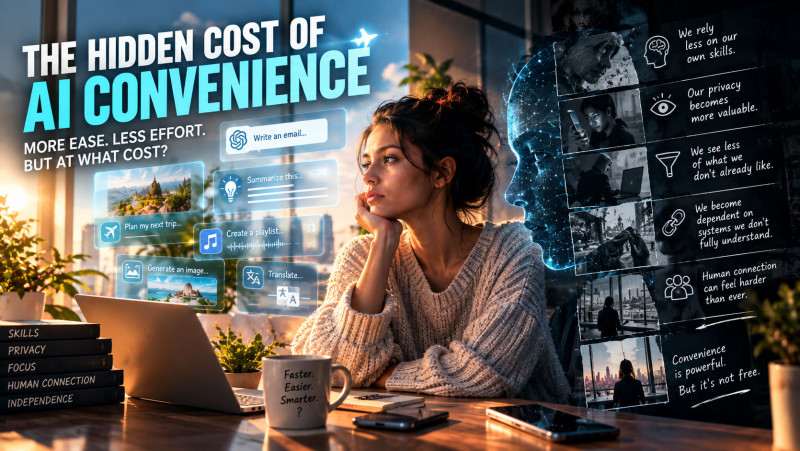
Convenience has always been one of technology's most powerful promises.
A machine that washes clothes saves time. A car eliminates long journeys on foot. A search engine replaces hours spent looking through books. Smartphones put maps, banking, communication, entertainment, and thousands of other services into a device small enough to fit in a pocket.
Artificial intelligence takes that promise considerably further.
AI can write an email, summarize a document, recommend a restaurant, translate a conversation, organize information, generate an image, explain a difficult concept, write software, plan a trip, analyze data, and increasingly perform tasks that once required specialized knowledge.
The attraction is obvious.
Why spend an hour doing something when a machine can do it in seconds?
But convenience has an unusual characteristic. Once people become accustomed to it, they stop thinking about what it replaced.
A task that once required effort becomes invisible. A skill that once had to be learned becomes unnecessary. A decision that once required judgment becomes something a system can recommend. Information that once had to be sought out arrives automatically.
The benefit is immediate.
The cost can take much longer to notice.
That is the hidden problem with AI convenience. It is not necessarily that artificial intelligence makes life worse. In many cases, it genuinely makes life better. The more difficult question is what happens when convenience becomes so complete that people gradually stop noticing what they are giving up in exchange for it.
Convenience Is Not Free
When people talk about the benefits of AI, the measurement is usually straightforward.
How much time does it save?
How much money can it reduce?
How much work can it automate?
Those are legitimate questions, but they do not capture the entire transaction.
Suppose an AI system writes a first draft of everything you need. You save time, but you also spend less time practicing writing. If an AI assistant always summarizes information for you, you save effort, but you may become less comfortable reading complicated material yourself. If an AI navigation system determines every route, you reach your destination efficiently, but your own ability to understand geography may weaken.
None of these consequences is catastrophic on its own.
The concern emerges when thousands of small substitutions accumulate.
A society can become more efficient while simultaneously becoming less capable of doing things without its technological infrastructure.
That distinction has existed throughout technological history. AI simply accelerates it.
The Skills We Stop Practicing
Human abilities are partly maintained through use.
People become better at remembering because they remember. They become better at writing because they write. They develop spatial awareness by navigating. They learn how to research by searching, comparing, questioning, and organizing information.
Automation can interrupt that process.
When a system consistently performs a task for us, there is less reason to maintain the underlying skill.
This is not necessarily bad. Humans have always delegated difficult tasks to tools. Nobody needs to memorize every telephone number when a phone can store contacts. Few people need to calculate complex arithmetic manually when calculators are available.
The important question is whether the skill being delegated is fundamental enough that losing it creates a vulnerability.
If people become unable to perform basic tasks without assistance, convenience stops being purely convenient.
It becomes dependency.
AI Could Change How People Learn
Education may be one of the areas where this tension becomes most visible.
AI tutors can explain concepts at different levels, provide examples, generate practice questions, identify weaknesses, and help students work through difficult material. These capabilities could make personalized education much more accessible.
But education has never been solely about obtaining correct answers.
The struggle involved in reaching an answer is part of learning.
A student who works through a difficult problem develops persistence, reasoning, pattern recognition, and confidence. A student who immediately asks an AI system to solve everything may complete more assignments while learning less.
The difference can be difficult to detect because the final result may look better.
This creates a challenge for educators.
The question is no longer simply whether students have access to information. They have more information than ever.
The question is whether they are developing the intellectual ability to work without assistance when assistance is unavailable or unreliable.
AI can become an extraordinary teacher.
It can also become an extraordinary shortcut.
Those are not the same thing.
The Disappearing Friction of Thinking
Some forms of inconvenience are productive.
Writing a paragraph without assistance forces a person to decide what they actually mean. Searching for information requires comparing sources. Planning a trip requires making tradeoffs. Solving a technical problem requires understanding why something works rather than simply knowing what answer to enter.
AI can remove much of that friction.
That is precisely why it is useful.
But friction sometimes serves a purpose.
The difficulty of expressing an idea can reveal that the idea is not fully understood. The inconvenience of researching a subject can expose contradictions. The effort involved in making a decision can force people to clarify what they value.
When AI removes every obstacle between a person and an outcome, it may also remove some of the thinking that happened along the way.
The result can be a strange form of intellectual outsourcing.
People still make decisions, but increasingly with machines doing much of the work that leads to those decisions.
Personalization Can Become a Filter
AI convenience is also closely connected to personalization.
Modern systems can learn what users like, what they search for, what they purchase, what they read, where they go, and how they interact with digital services. That information can make technology feel remarkably responsive.
The more a system understands you, the less you have to explain yourself.
That sounds ideal.
But personalization can also narrow experience.
If algorithms constantly predict what you will enjoy, you may encounter fewer things that surprise you. If recommendations are based heavily on previous behavior, the system has an incentive to reinforce existing preferences rather than challenge them.
The result can be a highly comfortable digital environment that gradually becomes less diverse.
You see more of what you already like.
You hear opinions that resemble your own.
You consume information selected according to your previous behavior.
Convenience becomes a form of filtering.
And filtering, even when helpful, always determines what remains outside the frame.
Privacy Is Part of the Exchange
AI systems can provide highly personalized assistance because they can process large amounts of information.
That creates another hidden cost.
The more useful an assistant becomes, the more context it may need.
Your preferences, routines, documents, communications, purchases, professional activities, searches, and interactions can all potentially contribute to a more personalized experience depending on the system and how it is configured.
The convenience is real.
So is the value of the information being processed.
This creates an uncomfortable tradeoff at the heart of modern digital services: the systems that know the most about us can often serve us the best, but knowing more about us also creates greater privacy and security risks.
The problem is not necessarily that every AI system is secretly watching everything.
The broader issue is that people can become comfortable sharing information because the immediate benefit is obvious while the long-term implications are difficult to see.
Convenience happens now.
Privacy consequences may happen later.
The Illusion of Infinite Capacity
AI assistants can create the impression that expertise is always available.
Need a contract explained?
Ask.
Need code?
Generate it.
Need an itinerary?
Create one.
Need to understand a scientific concept?
Get an explanation.
Need help making a decision?
Ask for options.
This accessibility is one of AI's greatest strengths.
It also creates a subtle psychological shift.
If assistance is always available, people may begin assuming that they do not need to retain knowledge themselves.
Why remember something when you can ask?
Why learn a process when software can perform it?
Why understand how something works when a system can provide the result?
The problem becomes obvious when the system is unavailable, wrong, manipulated, or misunderstood.
A person who knows the underlying subject can recognize an incorrect answer.
A person who has completely outsourced their understanding may not.
Accuracy Becomes More Important When Convenience Increases
One of the most dangerous characteristics of convenient systems is that they encourage trust.
When something consistently saves time, people naturally stop checking it as carefully.
This happens with autopilot systems, financial software, navigation tools, search engines, and countless other technologies.
AI introduces a particularly interesting version of the problem because its outputs can sound confident even when they are incorrect.
The more natural and useful an AI assistant becomes, the easier it is to forget that it is still a system producing an output rather than an unquestionable authority.
Convenience can therefore reduce skepticism.
That is a significant risk.
The best AI user may not be the person who asks the system to do everything.
It may be the person who knows when the answer deserves verification.
When Everything Becomes Optimized
AI is increasingly capable of optimizing tasks.
It can find faster routes, generate more efficient schedules, identify patterns, recommend products, improve workflows, and reduce wasted time.
But not everything meaningful can be optimized.
A walk does not have to be the fastest route between two points.
A conversation does not need to be maximally efficient.
A meal does not need to be optimized for nutritional output.
A creative project does not need to be completed as quickly as possible.
Some experiences have value precisely because they are inefficient.
Human life contains exploration, distraction, experimentation, mistakes, detours, boredom, and unexpected discoveries.
An optimization system naturally tries to reduce those things.
A person does not always need to.
Creativity Faces a Similar Tradeoff
AI can make creative work dramatically easier.
A writer can brainstorm ideas. A designer can explore concepts. A filmmaker can visualize scenes. A musician can experiment with arrangements. A developer can generate possible implementations.
For independent creators especially, this can remove barriers that previously required expensive tools or additional people.
But convenience can also encourage creative sameness.
If thousands of people use similar systems to generate ideas, similar prompts, similar references, and similar optimization strategies, certain patterns can become widespread.
The technology makes production easier.
It does not automatically make the result more distinctive.
There is also a difference between having an idea and developing an idea.
The difficult part of creativity is often not generating possibilities. It is deciding which possibility matters, understanding why it matters, and developing it through countless revisions.
If AI handles too much of that process, creators may produce more while developing less of their own creative judgment.
The danger is not that AI eliminates creativity.
It is that convenience can make creative development feel unnecessary.
The Emotional Cost of Artificial Assistance
AI convenience is not limited to practical tasks.
It is increasingly entering emotional territory.
People can ask AI systems for advice, conversation, encouragement, explanations, and companionship. For someone who is lonely or overwhelmed, having an always-available conversational system can feel genuinely helpful.
But human relationships contain forms of complexity that convenience cannot fully reproduce.
Friends misunderstand each other. Families disagree. Colleagues challenge one another. Relationships require patience, compromise, vulnerability, and responsibility.
An AI assistant can be designed to respond helpfully.
That can be comforting.
But a relationship built around an entity that is always available, endlessly patient, and highly responsive to your preferences may create expectations that human relationships cannot satisfy.
Convenience changes what people become accustomed to.
If every digital interaction is frictionless, ordinary human relationships may begin to feel unusually difficult.
That would be an ironic outcome for technology designed to make life easier.
The Economic Cost of Convenience
There is also a larger economic question.
AI can reduce the amount of human labor required for certain tasks. That can increase productivity and lower costs, but it can also change the value of particular skills.
Some workers may benefit enormously because AI amplifies their abilities.
Others may discover that tasks they once performed are increasingly automated.
Consumers may receive cheaper and faster services while workers face greater pressure to produce more.
The economic benefits of AI therefore depend partly on how productivity gains are distributed.
If AI makes a business dramatically more efficient, the resulting value could appear as lower prices, higher wages, larger profits, shorter working hours, better products, or some combination of these.
Technology does not determine the distribution automatically.
Institutions do.
That is why the hidden cost of AI convenience is not only personal.
It is also social.
Dependency Changes the Balance of Power
The more essential a system becomes, the more power its provider can have.
This is true of operating systems, cloud infrastructure, payment networks, search engines, social platforms, and other digital services.
AI could intensify that concentration.
If businesses depend on a small number of AI providers for customer service, software development, research, content production, analytics, and internal operations, switching providers may become increasingly difficult.
Consumers can face similar dependencies.
A person who stores their information, workflows, creative processes, personal history, and daily routines inside an AI ecosystem may eventually find that leaving the service is inconvenient or expensive.
Convenience can therefore create lock-in.
The easiest system to use today can become the hardest system to leave tomorrow.
The More Convenient Technology Becomes, the More Invisible It Gets
The greatest technologies tend to disappear into everyday life.
People do not wake up every morning amazed that electricity works.
They do not marvel at the existence of GPS before driving somewhere.
They do not think about the enormous infrastructure behind sending a message across the world.
Once technology becomes reliable enough, it becomes background.
AI is moving in the same direction.
The danger is that invisible systems can influence important parts of life without receiving much conscious attention.
If an AI system helps determine what information we see, what products we buy, what decisions we make, what work we perform, or what opportunities we receive, its influence may become significant even when we barely notice it.
The more convenient the system becomes, the less likely we may be to question its presence.
We Should Not Reject Convenience
None of this means society should reject AI.
That would misunderstand the issue.
Convenience is valuable. Saving time can improve people's lives. Automation can eliminate dangerous or repetitive work. AI can help people communicate, learn, create, research, and solve problems that would otherwise be difficult or expensive.
The goal should not be to preserve unnecessary difficulty for its own sake.
The goal is to distinguish between friction that wastes our time and friction that develops our capabilities.
Those are very different things.
Nobody needs to manually calculate every spreadsheet formula to prove intelligence. But understanding what the numbers mean still matters.
Nobody needs to navigate every journey using a paper map. But basic spatial awareness remains useful.
Nobody needs to write every first draft without assistance. But developing an independent voice still matters.
The challenge is knowing what should be automated and what should remain human.
Convenience Should Give Us More Time, Not Less Agency
Perhaps that is the most useful standard for judging AI.
Does the technology give us more freedom to pursue meaningful things?
Or does it gradually make us dependent on systems we no longer understand?
There is a profound difference between using technology to expand human agency and using technology to replace it.
The first gives people more options.
The second can quietly remove them.
A healthy relationship with AI therefore requires a degree of intentionality. People should be able to use automation without becoming helpless without it. They should be able to accept recommendations without surrendering judgment. They should be able to use AI for creative assistance without abandoning their own perspective.
Convenience should be a tool.
It should not become the default answer to every problem.
The Future of Convenience
The next generation of AI will make many things even easier.
Systems will become better at remembering context, anticipating needs, completing multi-step tasks, interacting with other software, and adapting to individual users. The distinction between asking a computer to do something and simply expecting it to happen will become increasingly blurred.
That future could be extraordinary.
It could also make the hidden costs harder to see.
The greatest risk may not be a dramatic technological failure. It may be a gradual change in human behavior that happens one convenient shortcut at a time.
We stop remembering because the system remembers.
We stop researching because the system summarizes.
We stop navigating because the system guides.
We stop practicing because the system performs.
We stop questioning because the system sounds confident.
None of those changes is necessarily disastrous on its own. Together, however, they could create a society that is extraordinarily efficient and surprisingly dependent.
The answer is not to make technology deliberately inconvenient.
It is to remain capable of choosing when convenience is worth the tradeoff.
The best future for AI is not one in which machines do everything for us. It is one in which machines handle the work that genuinely benefits from automation while humans remain capable of thinking, questioning, creating, learning, and deciding for themselves.
Convenience becomes valuable when it gives us more time to be human.
It becomes costly when, little by little, it teaches us that we no longer need to be.