



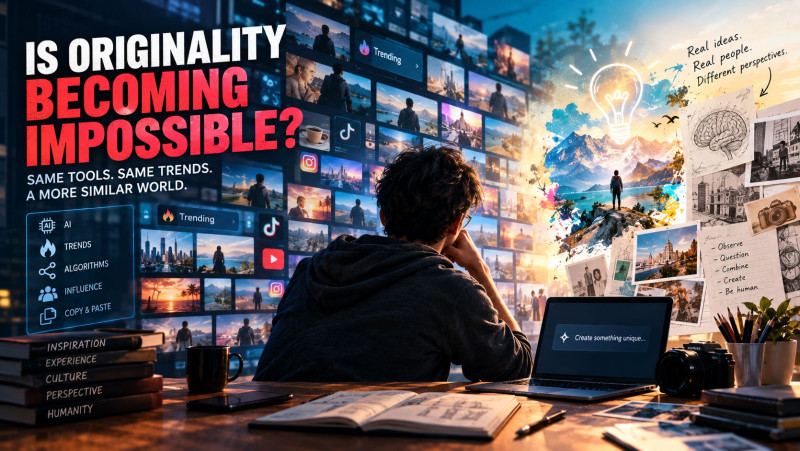
There is a strange contradiction at the center of modern creativity.
We have more tools for creating things than any previous generation. Anyone can publish a book, produce a song, make a film, launch a website, design an image, record a podcast, build software, or distribute an idea to a global audience. Artificial intelligence has expanded those possibilities even further, allowing individuals to produce things that once required teams of specialists.
And yet, originality often feels harder to find.
Open almost any social platform and the same visual styles, jokes, opinions, video formats, song structures, thumbnails, product designs, and storytelling techniques appear again and again. Trends spread globally within hours. Successful creators are copied almost immediately. Algorithms reward familiar formats because audiences already understand them. AI systems can reproduce recognizable styles in seconds.
The result is an increasingly crowded creative environment in which almost everything seems to resemble something else.
That raises a difficult question: are we actually running out of original ideas, or are we simply becoming better at recognizing how ideas are connected?
The answer is more complicated than either possibility suggests.
Originality Has Never Meant Creating From Nothing
The idea of the completely original creator is relatively romantic.
Almost every important work of art, technology, literature, architecture, music, or entertainment has emerged from earlier influences. People absorb what surrounds them and then rearrange, reinterpret, challenge, combine, or transform it.
A filmmaker watches other films. A musician grows up listening to other musicians. A writer reads other writers. An architect studies buildings that already exist. A programmer learns from existing software.
Human creativity has always been cumulative.
Even movements that appear revolutionary usually have predecessors. The people who seem to invent something from nothing are often responding to influences that are less obvious to everyone else.
Originality, therefore, has never required complete separation from the past.
It has usually meant doing something familiar in a way that feels sufficiently different, personal, or meaningful to become its own expression.
That distinction becomes important in an age when almost everything is instantly searchable.
The Internet Made Influence Impossible to Ignore
Before the internet, creative influences were often geographically limited.
A filmmaker might be influenced primarily by the movies available in local theaters. A musician might hear records that circulated through their community. A designer might encounter a relatively small selection of international work through magazines, television, books, or professional networks.
The internet changed the scale completely.
A creator can now encounter thousands of examples within minutes.
This is extraordinarily useful. It gives people access to ideas, cultures, techniques, references, and communities that would have been almost impossible to discover previously.
But abundance has another effect.
When everyone can see what everyone else is doing, creative styles converge more quickly.
A successful visual language can spread from one country to another almost instantly. A popular editing technique can become standard across an entire platform. A particular type of music production can dominate streaming services. A meme can move from a small online community to mainstream culture in a matter of days.
The distance between influence and imitation has become extremely small.
Algorithms Prefer What Already Works
The problem becomes more pronounced when algorithms enter the creative process.
Recommendation systems are designed to identify patterns associated with engagement. If a particular format consistently attracts attention, platforms have an incentive to show more of it.
Creators notice.
They see which thumbnails receive clicks, which opening seconds retain viewers, which subjects generate comments, which headlines perform best, and which styles are rewarded by recommendation systems. They naturally begin adapting their work to those signals.
This does not require anyone to deliberately copy another creator.
The system itself can push thousands of people toward similar decisions.
If a certain video structure performs well, more creators adopt it. If a particular thumbnail style generates clicks, more thumbnails begin to look like it. If controversy consistently produces engagement, more content becomes controversial.
Over time, an ecosystem can develop a recognizable visual and narrative vocabulary.
The creators are still different people.
Their incentives are increasingly similar.
The Success Trap
There is another reason originality becomes difficult: successful creators have something to lose.
An unknown creator can experiment relatively freely because there is no established audience expecting a particular type of work. Once that creator becomes successful, expectations begin to form.
Audiences want more of what they already enjoyed.
Platforms reward consistency.
Advertisers prefer predictable environments.
Publishers want concepts that can be explained quickly.
Studios want projects that can be marketed.
The creator is gradually surrounded by incentives to repeat the thing that worked.
This is one reason creative careers can become strangely repetitive.
The first successful project may have been unconventional precisely because the creator was willing to take risks. After success, repeating that unconventional idea may become safer than attempting another experiment.
Originality can therefore be strongest before the market learns exactly what to expect from you.
Franchises Reveal the Economics of Familiarity
Entertainment provides one of the clearest examples.
Studios invest enormous amounts of money into major productions, which creates pressure to reduce uncertainty. Familiar characters, established intellectual property, recognizable genres, sequels, remakes, and interconnected universes provide audiences with something they already understand.
This does not mean audiences inherently dislike original stories.
It means familiarity can make a commercial decision easier to justify.
A new property requires explanation. A recognizable property already carries cultural awareness.
The same logic exists outside Hollywood.
Publishers favor established authors. Music platforms amplify recognizable artists. Games increasingly rely on proven franchises. Consumer brands repeat visual conventions that customers already associate with particular categories.
Markets naturally reward familiarity because familiarity reduces perceived risk.
Creativity, meanwhile, often depends on accepting uncertainty.
Those two forces are not always compatible.
The Creator Economy Has Its Own Version of the Problem
Independent creators were supposed to escape many traditional gatekeepers.
In some ways, they have.
A person no longer needs a television network to produce a show or a record label to distribute music. A small team can publish directly to a global audience.
But platforms have become new gatekeepers, and they operate according to different incentives.
The creator is constantly exposed to performance data.
Views. Likes. Shares. Watch time. Retention. Followers. Click-through rates.
That information can be extremely useful, but it can also influence creative decisions in ways that are difficult to notice.
A creator may start with the question, "What do I want to make?"
Eventually, the question can become, "What does my audience want?"
Then it can become, "What does the algorithm want?"
By the time the third question dominates, the creator may still be producing content successfully while slowly losing the reason they started creating in the first place.
AI Makes the Question More Complicated
Artificial intelligence introduces a new dimension to the originality debate because it can generate variations at extraordinary speed.
A person can describe an image and receive a visual interpretation in seconds. A writer can generate possible concepts. A musician can experiment with arrangements. A programmer can ask for multiple approaches to a technical problem.
This can be empowering.
It can also accelerate sameness.
If millions of people use similar models, similar prompts, similar references, and similar optimization strategies, certain aesthetic patterns may become increasingly common. The technology can make creation easier without necessarily making the resulting work more distinctive.
But AI does not prove that originality is impossible.
It may instead expose something that was already true.
Tools influence aesthetics.
The camera influenced painting. Photography changed visual art. Synthesizers changed music. Digital editing changed filmmaking. Desktop publishing changed graphic design.
Every new creative technology creates its own period of imitation before people discover what the technology makes possible beyond existing conventions.
The interesting question is not whether AI can reproduce familiar styles.
It clearly can.
The more important question is whether creators will use it to explore ideas that would otherwise remain unexplored.
The Difference Between Novelty and Originality
Something can be new without being original in a meaningful sense.
A strange combination of familiar elements may technically be unprecedented, yet still feel creatively empty. Conversely, an idea that resembles something that already exists can feel deeply original because the creator brings an unusual perspective to it.
Originality is therefore difficult to measure.
A new genre does not automatically produce better art. A familiar story can become extraordinary through execution.
Consider how often the same basic human subjects appear throughout history: love, jealousy, ambition, betrayal, grief, power, identity, loneliness, fear, belonging.
Human experience has not changed enough to provide infinite themes.
What changes is the perspective.
The same subject can feel completely different when viewed through another person's culture, time period, personality, circumstances, or artistic language.
Perhaps originality has always been less about inventing new subjects than discovering new ways of seeing old ones.
Culture Recycles Because Culture Remembers
Popular culture has always been cyclical.
Styles return. Genres revive. Fashion repeats itself. Old songs are sampled. Films reference older films. Designers reinterpret earlier movements. Young creators rediscover things that older generations considered outdated.
This can sometimes feel like cultural stagnation.
But recycling is not necessarily the enemy of creativity.
Every generation receives an enormous inheritance of ideas and then decides what to preserve, reject, combine, or transform.
The danger appears when reinterpretation becomes pure replication.
There is a difference between taking inspiration from the past and reproducing it without understanding why it worked.
One continues a creative conversation.
The other simply repeats the previous sentence.
Globalization Creates Both Diversity and Homogenization
The internet has connected cultures on an unprecedented scale.
A creator in one country can discover artistic traditions from another. Musicians collaborate across continents. Filmmakers influence each other's visual languages. Designers can access historical references from cultures they might never otherwise encounter.
This should produce more diversity.
And in many ways, it does.
But global platforms also create powerful forces toward cultural homogenization. The same handful of platforms distribute enormous amounts of cultural material to billions of people. Trends can spread globally before local alternatives have time to develop independently.
A teenager in one country may consume essentially the same entertainment ecosystem as someone thousands of miles away.
The result is a fascinating contradiction: access to more cultures can sometimes produce more cultural similarity.
The challenge is not simply giving people more things to consume.
It is preserving enough space for local, unusual, slow-growing ideas to develop.
Attention Rewards Familiarity, But Memory Rewards Difference
There is an important distinction between getting attention and becoming memorable.
Familiar formats are often good at attracting immediate attention because audiences recognize them quickly. But recognition does not necessarily create lasting significance.
The things people remember years later are often the things that made them feel something unexpected.
A film that changed how someone understood a subject. A song associated with a particular period of life. A book that introduced an unfamiliar perspective. An image that communicated something impossible to explain in ordinary language.
These experiences may not have been optimized for immediate engagement.
They became valuable because they stayed with people.
That suggests an important limitation in algorithmic approaches to creativity.
The most measurable response is not necessarily the most meaningful one.
Originality Often Requires Being Willing to Be Bad First
One of the least discussed obstacles to originality is embarrassment.
Experimentation means producing things that may not work.
That sounds obvious, but modern platforms make failure unusually visible. An unfinished idea can be posted publicly and judged immediately. A strange design can receive criticism within minutes. A creative experiment can perform badly while a conventional imitation performs extremely well.
This creates pressure to avoid experimentation.
People learn to make things they already know will be accepted.
But originality requires a period in which the creator does not yet know whether the audience will understand the work.
Many genuinely distinctive ideas probably look strange before they become familiar.
If creators are unwilling to tolerate that period, they may never discover what they are capable of doing.
Constraints Can Actually Produce Originality
Unlimited creative freedom sounds ideal, but too many possibilities can become paralyzing.
Constraints force decisions.
A filmmaker working with a tiny budget may invent visual techniques that a large production would never consider. A musician limited to basic equipment may develop a distinctive sound. A writer working within strict structural limitations may discover unexpected ways to tell a story.
Constraints remove options.
Removing options can force creativity.
This is particularly relevant in an age of abundant digital tools.
When almost anything can be generated, edited, modified, or replaced, the difficult decision may no longer be how to create something.
It may be deciding what not to create.
Taste becomes more important.
The Human Perspective May Become More Valuable
As creative tools become increasingly capable of producing polished output, human perspective may become a stronger differentiator.
The important question may shift from "Can you make this?" to "Why did you choose to make this?"
Anyone can potentially generate a technically impressive image.
Why this image?
Anyone can produce a piece of music.
Why this sound?
Anyone can create a video.
Why this story?
The answers matter because creativity is not only about the artifact. It is also about intention.
A personal experience, cultural background, unusual obsession, contradiction, memory, or deeply held question can give creative work a context that cannot be reduced to surface aesthetics.
This may become particularly important as synthetic content becomes abundant.
When polished content becomes cheap, meaning becomes harder to fake.
Originality May Be More About Selection Than Creation
There is another way to think about the future.
Perhaps the creator of tomorrow will not be defined primarily by their ability to produce more content. They will be defined by their ability to choose the right ideas from an enormous field of possibilities.
AI can generate hundreds of possibilities.
A human still needs to decide which one matters.
That makes judgment increasingly important.
Taste, curiosity, cultural understanding, emotional intelligence, skepticism, and personal experience become forms of creative value.
The creator is no longer necessarily the person who produces every component manually.
They may be the person who knows what deserves to exist.
That is not a lesser form of creativity.
It is a different one.
We Are Not Running Out of Ideas
The world is not running out of ideas.
There are still billions of people experiencing life from different perspectives, living through different cultures, facing new problems, discovering new technologies, and interpreting the same world in different ways.
What may be becoming scarce is the willingness to develop ideas that do not immediately resemble something successful.
That is a different problem.
The challenge is not a shortage of creativity. It is a shortage of space for creativity to develop before it is judged, optimized, copied, categorized, and commercialized.
Originality needs time.
It needs experimentation.
It needs influences, but also distance from them.
It needs the freedom to produce something that might not work.
And increasingly, it may need the ability to resist the systems that constantly tell creators what has already worked.
The Future of Originality
Originality will probably never disappear because human beings cannot stop interpreting the world through individual experience.
Every generation encounters circumstances that previous generations did not. Every person combines influences in ways that cannot be perfectly replicated. Even when people use the same tools, they bring different memories, priorities, cultures, personalities, and questions to them.
What may disappear is the illusion that originality means creating something completely untouched by the past.
That standard was never realistic.
The more useful definition is simpler: take what already exists and make the connection only you would have made.
The future of creativity will contain more imitation, more recycled culture, more algorithmically optimized content, and more AI-generated material than ever before. But it will also contain an extraordinary number of people with access to tools and audiences that previous generations could barely imagine.
That is not the end of originality.
It is a new test for it.
When everyone has access to the same tools, the difference will increasingly come from what they notice, what they question, what they combine, what they refuse to imitate, and what they have the patience to develop.
The world may become noisier and more repetitive.
That does not mean genuinely original voices will disappear.
It may simply mean that finding them, and having the courage to become one, will matter more than ever.