



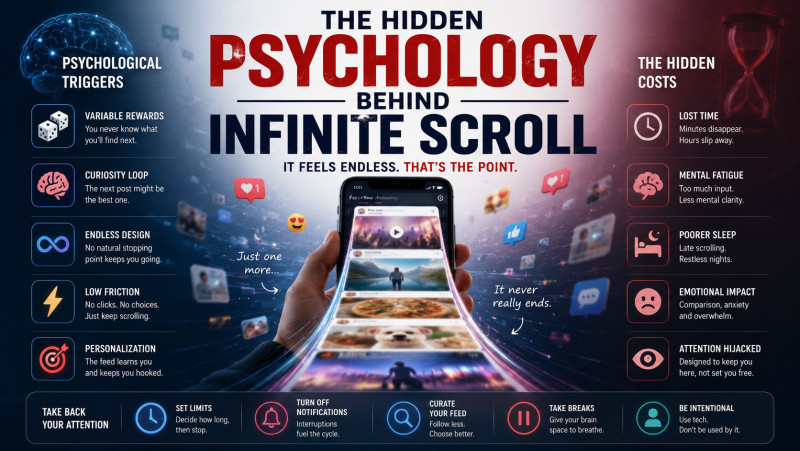
There was a time when finishing a page meant reaching the bottom.
You read an article, reached the final paragraph, closed the newspaper, and moved on. A magazine had a final page. A television program eventually ended. Even browsing the early internet often involved clicking from one page to another with a clear sense of where you were going.
Then the feed changed everything.
Today, many of the world's most popular digital platforms have no obvious ending. Content simply continues.
Scroll down and another video appears.
Scroll again and another post loads.
There is always something new waiting.
This simple interface decision has transformed how billions of people consume information. It has also created one of the most powerful attention mechanisms in modern technology.
Infinite scroll feels effortless.
That is precisely why it works.
There Is No Natural Stopping Point
Traditional media contains built-in endings.
A newspaper has a final page.
A television episode has credits.
A book has a last chapter.
Infinite scroll removes that boundary.
There is no signal telling your brain that the activity is complete.
Instead, every piece of content becomes a transition to the next one.
This creates a continuous loop:
See → Scroll → Discover → Repeat
The user does not need to make a conscious decision to continue.
They simply keep moving.
The Psychology of Variable Rewards
One of the strongest psychological mechanisms behind infinite scroll is the variable reward.
The next piece of content might be boring.
It might be funny.
It might be fascinating.
It might be emotionally powerful.
It might be exactly what you were hoping to find.
You do not know until you scroll.
That uncertainty makes the next interaction more compelling.
The same basic principle appears in many other forms of behavior where rewards are unpredictable. When people cannot predict when something interesting will appear, they may become more motivated to keep checking.
Infinite scroll turns every swipe into a small possibility.
Maybe the next post will be better.
The Next Item Might Be the Best One
This creates a subtle psychological trap.
Imagine scrolling through ten uninteresting posts.
You might reasonably decide to stop.
But then you see something fascinating.
That experience reinforces the idea that continuing was worthwhile.
The brain learns:
"Something good might be coming."
So you continue.
The next post might be disappointing.
But that does not necessarily end the behavior.
You simply look for the next reward.
The cycle continues.
Friction Has Been Removed
Technology companies spend enormous amounts of effort reducing friction.
A button that takes two seconds to load can feel slow.
A checkout process with too many steps can lose customers.
A video that requires another click can lose viewers.
Infinite scroll applies the same philosophy to content consumption.
There is no need to:
- Click the next page
- Choose another article
- Return to a homepage
- Search for something new
- Decide what to consume next
The platform makes the decision for you.
Your only job is to continue.
Autoplay Makes the Loop Stronger
Infinite scroll becomes even more powerful when combined with autoplay.
A video begins before you consciously decide to watch it.
By the time you realize what is happening, another video may already be loading.
The transition between pieces of content becomes almost invisible.
There is no meaningful pause.
No moment where the brain naturally asks:
"Do I actually want to keep doing this?"
The system simply moves forward.
Notifications Bring the Feed Into Daily Life
The psychology does not stop when the app is closed.
Notifications create reminders that something is waiting.
A message.
A reaction.
A new follower.
A trending story.
A recommendation.
A breaking update.
These interruptions can bring users back to the platform repeatedly throughout the day.
Eventually, checking the feed can become an automatic response to boredom, uncertainty, or even a moment of silence.
Boredom Has Become Difficult to Experience
One of the less obvious consequences of infinite content is the shrinking space for boredom.
Waiting in line once meant looking around.
Riding public transportation might mean staring out the window.
Sitting quietly could mean thinking.
Today, a smartphone can eliminate almost every empty moment.
Whenever there is a few seconds of inactivity, content is immediately available.
That feels convenient.
But boredom has a purpose.
It can create space for reflection, imagination, and mental rest.
Constant stimulation leaves less room for those experiences.
Infinite Scroll Changes Our Sense of Time
Many people have experienced the same phenomenon.
"I'll scroll for five minutes."
Then they look at the clock.
Forty minutes have passed.
The problem is not simply a lack of self-control.
The interface itself removes many of the cues that normally help people estimate how long they have been engaged.
There is no clear beginning.
There is no clear ending.
There are simply more pieces of content.
Time becomes difficult to perceive.
Emotional Content Is Especially Powerful
Not all content receives equal attention.
Posts that generate strong emotions can be particularly effective at capturing users.
Anger.
Fear.
Surprise.
Humor.
Controversy.
Excitement.
These emotions can encourage people to stop scrolling and pay attention.
That creates an important dynamic for platforms whose business models depend on engagement.
The content that keeps people watching is often the content that creates the strongest reaction.
Attention becomes the currency.
Personalization Makes the Experience Harder to Leave
Infinite scroll would be less effective if the content were completely random.
Modern recommendation systems change that.
Platforms learn from:
- What you watch
- What you skip
- What you like
- What you share
- How long you stay
- Who you follow
- What you search for
The feed gradually becomes personalized.
Instead of showing you random content, it tries to predict what you are most likely to consume.
The better the predictions become, the harder the feed can be to abandon.
The Feed Learns Your Weaknesses
Personalization is not necessarily malicious.
It can make platforms genuinely useful.
But it also means recommendation systems can discover which topics, emotions, and formats are most effective at holding your attention.
If controversy keeps you engaged, more controversy may appear.
If short videos keep you watching, more short videos may appear.
If certain topics consistently trigger a reaction, the system can learn that pattern.
The result is a digital environment increasingly optimized around your behavior.
Creators Are Adapting to the System
Infinite scroll has also changed how creators produce content.
Creators increasingly compete for the first few seconds of attention.
This has encouraged:
- Stronger hooks
- Faster editing
- Shorter introductions
- More dramatic headlines
- Constant visual changes
- Emotional storytelling
Content is increasingly designed not only to communicate an idea, but to prevent the user from scrolling away.
The attention economy influences the creative process itself.
The Cost of Constant Consumption
The consequences of infinite scrolling vary from person to person.
For some users, it is simply entertainment.
For others, constant consumption can contribute to:
- Reduced concentration
- Sleep disruption
- Mental fatigue
- Information overload
- Increased comparison
- Difficulty being offline
- Lost time
The important point is not that every user experiences these effects equally.
It is that digital environments can shape behavior even when we are not consciously thinking about them.
The Solution Is Not Necessarily Deleting Everything
Social media and digital feeds can provide real value.
They help people discover:
- News
- Education
- Communities
- Creative work
- Businesses
- Friends
- New ideas
The problem is not content itself.
The problem is losing control over when consumption ends.
Small changes can help restore that control.
Users can:
- Disable unnecessary notifications
- Set intentional usage limits
- Take regular screen breaks
- Avoid feeds before sleeping
- Use search instead of endless recommendations
- Curate the accounts they follow
- Keep phones away during focused work
The goal is not to eliminate technology.
It is to use technology deliberately.
We Need Better Digital Boundaries
Infinite scroll is unlikely to disappear.
It is too effective, too familiar, and too deeply integrated into modern digital platforms.
But understanding how it works changes the relationship we have with it.
Once users recognize that the feed is designed without a natural stopping point, they can become more intentional about creating their own stopping points.
That might mean deciding beforehand how long to browse.
It might mean closing the app after a specific number of posts.
It might simply mean asking a question before continuing:
"Am I still choosing to do this?"
That small moment of awareness can be surprisingly powerful.
The Real Product Is Attention
Infinite scroll looks like a feature.
But underneath it is a much larger business model.
Platforms compete for human attention because attention can be converted into advertising, subscriptions, purchases, influence, and data.
The longer people remain engaged, the more valuable the platform can become.
That does not make every digital platform inherently harmful.
It does mean users should understand what the interface is optimized to achieve.
The feed is not designed to reach a natural conclusion.
It is designed to continue.
Knowing When to Stop May Become a Digital Superpower
The internet has given humanity access to more information than any previous generation could imagine.
But unlimited access creates a new challenge.
We must learn how to stop consuming.
The ability to disconnect, tolerate boredom, focus without constant stimulation, and choose when enough is enough may become increasingly important in an attention-driven world.
Infinite scroll changed the way we interact with information.
The next challenge is learning how to interact with it without allowing the feed to decide when our attention ends.