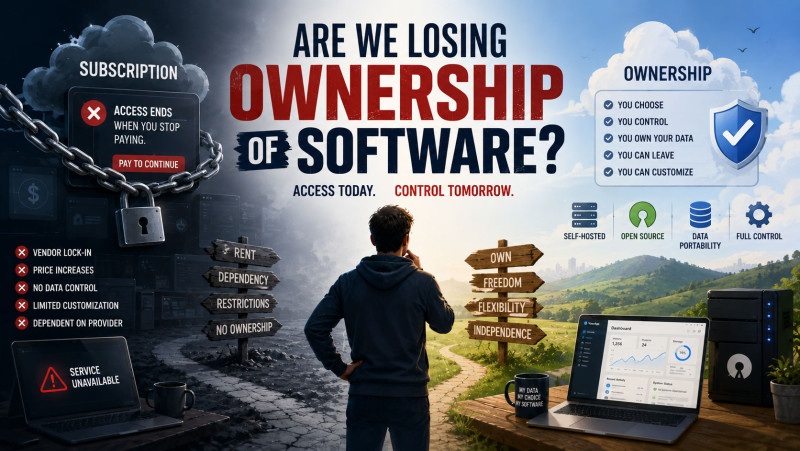
There was a time when buying software meant buying a product.
You purchased a license, installed the application on your computer, entered a product key, and continued using it for years. You might have upgraded later, but the software you purchased remained yours to use.
That model is becoming increasingly uncommon.
Today, many software companies operate on subscriptions. Instead of purchasing a permanent license, customers pay monthly or annually for continued access. If the payments stop, the software may stop working.
This shift has created a broader question about the future of digital ownership.
Are we still buying software?
Or are we simply renting access to it?
The Shift From Licenses to Subscriptions
Software subscriptions have become the dominant business model for many modern applications.
Customers now commonly pay recurring fees for:
- Design software
- Productivity tools
- Accounting platforms
- Project management systems
- Security applications
- Cloud storage
- AI services
- Developer tools
- Business platforms
From the company's perspective, the advantages are obvious.
Recurring revenue creates predictable income and allows businesses to continuously fund development, infrastructure, security, and customer support.
For customers, however, the relationship has changed.
The software is no longer necessarily something they permanently own.
It is something they continuously access.
Why Companies Prefer Subscriptions
The traditional software license model presented a challenge for vendors.
A customer could purchase an application once and potentially use it for years without generating additional revenue.
Subscriptions changed that equation.
Recurring payments allow companies to generate revenue throughout the customer's relationship with the product.
This can fund:
- Continuous updates
- Security improvements
- Cloud infrastructure
- Technical support
- New features
- Research and development
- Ongoing maintenance
For businesses, subscriptions can create a healthier and more predictable economic model.
The question is whether customers receive enough continuing value in return.
Ownership Used to Mean Permanence
Physical products generally have a clear relationship with ownership.
If you buy a chair, you own the chair.
If you buy a book, you own the book.
If you buy a computer, you own the computer.
Software is different because it is intellectual property.
Customers traditionally purchased a license that granted them the right to use the software, rather than owning the underlying code itself.
Even then, permanent licenses gave users something valuable: continued access.
Modern subscriptions can remove that permanence.
When the subscription ends, access may disappear.
What Happens When You Stop Paying?
Consider a business that relies on subscription software for years.
Its employees become familiar with the platform.
Its workflows are built around it.
Its documents may depend on its file formats.
Its customer data may be stored within the service.
Its processes may be integrated with the platform's APIs.
Then the subscription price increases.
The company may have little practical choice but to continue paying.
This creates a form of digital dependency.
The customer may technically be free to leave, but switching can become extremely expensive.
Software Lock-In Is Becoming More Important
Vendor lock-in occurs when moving away from a particular platform becomes difficult or costly.
This can happen through:
- Proprietary file formats
- Closed APIs
- Complicated migrations
- Stored customer data
- Custom integrations
- Employee training
- Workflow dependencies
- Long-term contracts
The longer an organization uses a platform, the more deeply it may become embedded in its operations.
The software becomes infrastructure.
At that point, changing providers is no longer simply a purchasing decision.
It becomes a business transformation project.
Cloud Software Changed the Equation
Cloud computing accelerated the transition.
Instead of installing software locally, customers increasingly access applications through web browsers.
The benefits are significant.
Cloud applications can provide:
- Automatic updates
- Cross-device access
- Centralized data
- Easier collaboration
- Remote access
- Automatic backups
- Scalable infrastructure
But there is a trade-off.
The software may depend entirely on the provider's servers.
If the company shuts down the service, changes its pricing, or restricts access, customers may have limited control over what happens next.
Convenience can come at the expense of independence.
What About AI Software?
Artificial intelligence is pushing the subscription model even further.
Modern AI systems require significant computing resources.
Running sophisticated models can involve expensive hardware, electricity, storage, and infrastructure.
As a result, many AI products are naturally designed around recurring payments.
Customers pay for continued access to computational capabilities rather than purchasing a traditional application.
This may represent the future of software.
But it also raises a new question.
If AI becomes deeply integrated into writing, programming, design, research, and business operations, how much control should users have over the tools they depend on?
Self-Hosted Software Offers Another Model
Not all software has followed the subscription-only path.
Self-hosted applications provide an alternative.
Instead of relying entirely on a vendor's infrastructure, users can deploy software on their own servers or hosting environments.
This can provide greater control over:
- Data
- Infrastructure
- Updates
- Access
- Customization
- Integrations
- Long-term availability
Self-hosted software does require more responsibility.
Users may need to manage hosting, security, backups, and maintenance.
But that responsibility can also provide something increasingly valuable in the digital economy: independence.
Open Source Challenges the Ownership Problem
Open-source software offers another perspective.
Instead of simply receiving access to an application, users can often inspect, modify, and redistribute the underlying code according to its license.
This creates a fundamentally different relationship between software and its users.
Even if the original developer disappears, the software can potentially continue to exist as long as the community maintains it.
Open source does not eliminate every dependency.
But it can reduce the risk of a single company becoming the permanent gatekeeper.
The Real Issue Is Control
The debate about software ownership is ultimately not just about whether users technically own an application.
It is about control.
Can users continue accessing the software?
Can they export their data?
Can they migrate to another platform?
Can they keep using an older version?
Can they host it themselves?
Can they repair or modify it?
Can they continue using it if the original company disappears?
These questions become increasingly important as software becomes embedded in everyday life.
Subscriptions Are Not Necessarily Bad
It would be unfair to suggest that subscriptions are always harmful.
For many products, they provide genuine advantages.
A constantly evolving service may require ongoing infrastructure and development.
Customers may prefer predictable payments over expensive upfront purchases.
Automatic updates can improve security.
Cloud services can make collaboration dramatically easier.
The problem is not recurring payment itself.
The problem occurs when customers have little control and no realistic alternative.
Businesses Need to Think Beyond Monthly Cost
For companies, software pricing should not be evaluated solely by the monthly subscription fee.
The larger cost may include:
- Migration difficulty
- Data portability
- Vendor dependency
- Integration costs
- Employee training
- Price increases
- Service interruptions
- Contract restrictions
A cheap platform can become expensive if leaving it is nearly impossible.
Long-term software strategy increasingly requires evaluating ownership, portability, and control.
A More Balanced Future
The future does not have to be a battle between subscriptions and permanent licenses.
A healthier software ecosystem could offer multiple models.
Customers could choose between:
- Subscription access
- Perpetual licenses
- Lifetime licenses
- Self-hosted versions
- Open-source alternatives
- Usage-based pricing
- Hybrid models
Different customers have different needs.
A freelancer may prefer a simple subscription.
A large organization may need a self-hosted deployment.
A developer may value source-code access.
Giving customers meaningful choices creates healthier competition.
What Should Software Ownership Look Like?
The software industry has transformed dramatically.
Applications have evolved from boxed products into continuously updated services.
That transformation has created extraordinary convenience and innovation.
But convenience should not eliminate control.
As software becomes more important to personal and professional life, users should increasingly ask what happens when they stop paying, when a company changes direction, or when a service disappears.
The future of software should not simply be about who can collect the most recurring payments.
It should also be about who gives users the greatest control over the tools they depend on.
Perhaps the most important form of digital ownership is not owning the code itself.
It is having the freedom to keep using, moving, managing, and controlling the software that has become part of your life.