



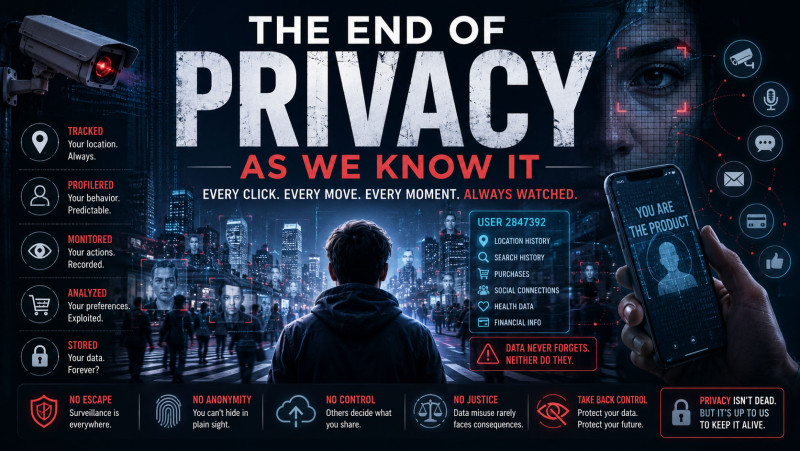
Privacy used to be something people could largely take for granted.
You could walk outside without carrying a device that recorded your location. You could have a conversation without wondering whether an algorithm was analyzing it. You could browse a store without every interaction becoming part of a permanent digital profile.
That world is disappearing.
Modern life increasingly depends on connected devices, online services, digital payments, social platforms, smart homes, cameras, and artificial intelligence. These technologies provide extraordinary convenience, but they also create an unprecedented amount of information about the people using them.
The issue is no longer simply whether companies know what we buy.
They can potentially know where we go, what we search for, what we watch, who we communicate with, what we are interested in, and how our behavior changes over time.
Privacy is becoming less about hiding something and more about controlling who knows what about us.
Privacy Has Become a Trade
Most digital services appear free.
Search engines are free.
Social networks are free.
Email services are often free.
Many mobile applications cost nothing to download.
But these services still need to generate revenue.
One of the most valuable resources in the digital economy is information.
User activity can help companies understand interests, predict behavior, personalize experiences, improve products, and deliver targeted advertising.
The exchange is often presented as convenience for information.
But most people do not fully understand the scale of that exchange.
They click "accept" because there is little practical alternative.
We Generate Data Constantly
Modern life produces an enormous digital trail.
Consider an ordinary day.
You wake up and check your phone.
You search for something.
You open a navigation application.
You send messages.
You purchase coffee with a card.
You browse social media.
You stream music.
You shop online.
You watch a video.
You unlock your home with a connected device.
None of these actions may feel particularly important.
Together, however, they can reveal a remarkably detailed picture of your life.
Your routines can become predictable.
Your interests can become measurable.
Your movements can become traceable.
Your preferences can become increasingly easy to infer.
Location May Be More Revealing Than People Realize
Location data can reveal far more than where someone happens to be.
Repeated location patterns can indicate where a person lives.
They can reveal where they work.
They can show which places they visit regularly.
They can identify travel habits and daily routines.
Over time, location becomes a behavioral map.
Even when a person never explicitly tells a company where they live or work, repeated movements can provide strong clues.
The important issue is not one individual location.
It is the pattern created by thousands of locations.
Your Digital Profile Can Become More Detailed Than Your Real Identity
Companies do not necessarily need to know everything about you directly.
They can make predictions.
A system may infer what products you are likely to purchase.
It may estimate your interests.
It may predict when you are most likely to engage.
It may identify the types of content most likely to capture your attention.
Artificial intelligence makes these predictions increasingly sophisticated.
The result is a strange transformation.
Your digital profile can become a statistical version of you.
It may know things about your behavior that you have never consciously considered.
Artificial Intelligence Changes the Privacy Equation
AI creates new possibilities because it can process enormous amounts of information.
Previously, collecting large amounts of data did not necessarily mean understanding it.
Now, algorithms can analyze relationships between seemingly unrelated pieces of information.
A collection of ordinary interactions can become meaningful when analyzed together.
This creates a major privacy challenge.
The information people voluntarily provide may be only part of the story.
The more powerful systems become at inference, the more important questions of consent become.
Do people consent to information they never explicitly provided but that can be predicted about them?
That question does not have an easy answer.
Smart Homes Make Privacy Physical
Privacy concerns are no longer limited to computers and phones.
Smart homes can contain:
- Cameras
- Doorbells
- Speakers
- Thermostats
- Security systems
- Connected appliances
- Voice assistants
- Smart locks
These devices can make homes more convenient and secure.
They can also create detailed records of activity inside and around private spaces.
The traditional idea of a home as a private environment becomes more complicated when the home itself is connected to external platforms.
Cars Are Becoming Data Platforms
Modern vehicles increasingly contain sophisticated software and connectivity.
They can potentially collect information about:
- Location
- Driving behavior
- Vehicle usage
- Connected devices
- Navigation
- Maintenance
- User preferences
Cars are becoming computers on wheels.
That creates opportunities for better safety and personalization.
It also means transportation is becoming another source of behavioral data.
The question of who controls that information will become increasingly important.
Cameras Are Everywhere
Public surveillance is another major part of the changing privacy landscape.
Security cameras are common in businesses, neighborhoods, transportation systems, and public spaces.
The technology itself is not new.
What has changed is the ability to analyze images automatically.
Artificial intelligence can potentially identify objects, recognize patterns, and process enormous quantities of video.
A camera that simply records is different from a system that continuously analyzes what it sees.
The distinction matters.
Facial Recognition Raises Difficult Questions
Facial recognition technology can make authentication faster and improve security.
But faces are also permanent identifiers.
A password can be changed.
A credit card can be replaced.
A face cannot.
If biometric information is compromised, the consequences can be fundamentally different from losing a conventional password.
This makes biometric data particularly sensitive.
The convenience of unlocking a device with your face must be balanced against the long-term implications of creating systems that can identify people automatically.
Privacy Is Also About Power
Privacy is sometimes treated as a personal preference.
Some people care deeply about it.
Others are comfortable sharing large amounts of information.
But privacy has a broader societal dimension.
Information creates power.
An organization that knows a great deal about individuals may be able to influence them, categorize them, predict them, or treat them differently.
That can affect everything from advertising to employment to financial services.
The issue is not simply whether someone has "nothing to hide."
It is whether people should have meaningful control over information that can be used to make decisions about them.
Personalization Can Become Manipulation
Personalization is one of the major benefits of modern technology.
The right recommendation can save time.
A personalized service can be easier to use.
Relevant advertising can be less annoying than irrelevant advertising.
But personalization can cross into manipulation when systems know enough about a person to exploit their vulnerabilities.
An algorithm may learn what makes someone anxious.
It may discover what keeps them engaged.
It may understand which messages are most likely to influence their decisions.
The more personalized technology becomes, the more important ethical boundaries become.
Privacy Is Becoming a Luxury
One of the most troubling possibilities is that privacy could become something people with money can purchase.
Wealthier individuals may be able to afford:
- Private services
- Secure communication systems
- Personal cybersecurity
- Physical security
- Privacy-focused technology
- Greater control over personal data
Meanwhile, people with fewer resources may depend on services that collect extensive information in exchange for convenience.
If that pattern continues, privacy could become another form of inequality.
Those who can afford it get greater control over their information.
Everyone else becomes increasingly transparent.
Children Are Growing Up in a Different World
Previous generations had childhood memories that largely disappeared into the past.
Today's children may grow up with digital records from an early age.
Photos.
School systems.
Medical portals.
Social accounts.
Location records.
Online searches.
Videos.
Messages.
Parents can unintentionally create a permanent digital history for their children before those children are old enough to understand what privacy means.
This raises an important question:
Should children have the right to grow up without their entire childhood being permanently documented online?
The Right to Be Forgotten Becomes More Complicated
Digital information is remarkably persistent.
A photograph can be copied.
A message can be archived.
A post can be screenshotted.
A database can be replicated.
Even when information is deleted from one system, copies may exist elsewhere.
This creates a fundamental difference between the digital world and the physical world.
Human memory naturally fades.
Digital memory does not.
The ability to move forward without every past mistake remaining permanently searchable may become an increasingly important part of digital rights.
Convenience Is Powerful
The uncomfortable truth is that privacy often loses against convenience.
People accept location tracking because navigation is useful.
They accept personalization because recommendations save time.
They accept connected devices because smart homes are convenient.
They accept online payments because carrying cash is inconvenient.
They accept data collection because refusing can make modern life difficult.
This does not mean people do not care about privacy.
It means convenience is an extremely powerful incentive.
The Problem Is Not Technology Itself
Technology has enormous benefits.
Digital services can improve communication.
Online banking can make financial services more accessible.
Connected devices can improve safety.
AI can help people work and learn.
Data can improve healthcare, transportation, and scientific research.
The problem is not collecting information under every circumstance.
The problem is collecting information without meaningful limits, transparency, or user control.
A healthy digital society should be able to benefit from data without treating every human activity as something that must be recorded.
Privacy May Need to Be Designed In
Privacy cannot depend entirely on users reading hundreds of pages of terms and conditions.
Most people will not.
Privacy needs to become a design principle.
That means services should minimize unnecessary data collection.
They should make important privacy choices understandable.
They should provide meaningful controls.
They should protect sensitive information.
They should avoid retaining data indefinitely without a legitimate reason.
And they should clearly explain what happens to information after it is collected.
We Need to Decide What Should Remain Private
The most important privacy debate may not be about whether technology should collect data.
It is about where society draws boundaries.
Should a company know where you go every day?
Should an AI system remember every personal conversation?
Should advertisers know what makes you emotionally vulnerable?
Should employers have access to behavioral information unrelated to your job?
Should governments be able to identify everyone passing through a public space?
These questions will become more important as technology becomes more capable.
The answers cannot be left entirely to the companies building the systems.
Privacy Is About Freedom
Privacy is not simply secrecy.
It is the ability to have parts of your life that are not constantly observed, analyzed, categorized, or judged.
People behave differently when they believe they are being watched.
They may hesitate to explore unpopular ideas.
They may avoid certain conversations.
They may become more cautious about what they search for or read.
A society without meaningful privacy could therefore become a society where people gradually become less willing to experiment, disagree, or simply be themselves.
The Future Is Not Necessarily Privacy-Free
The end of privacy as we know it does not have to mean the end of privacy entirely.
Technology can be designed differently.
Encryption can protect communications.
Privacy-preserving systems can reduce unnecessary exposure.
Decentralized technologies can give users greater control.
Clear regulations can establish boundaries.
Companies can collect less information.
Users can demand better practices.
Most importantly, society can decide that some forms of privacy are worth protecting even when technology makes surveillance easier.
The future will probably contain more data than the past.
That is unavoidable.
But more data does not have to mean less freedom.
The real challenge is ensuring that technological progress does not quietly turn every aspect of human life into a permanent record.
Privacy may never look exactly the way it did before the digital age.
But the idea behind it remains remarkably simple.
Not everything about a person needs to be known.
Not everything that can be measured needs to be collected.
And not everything that is collected should belong to someone else.