



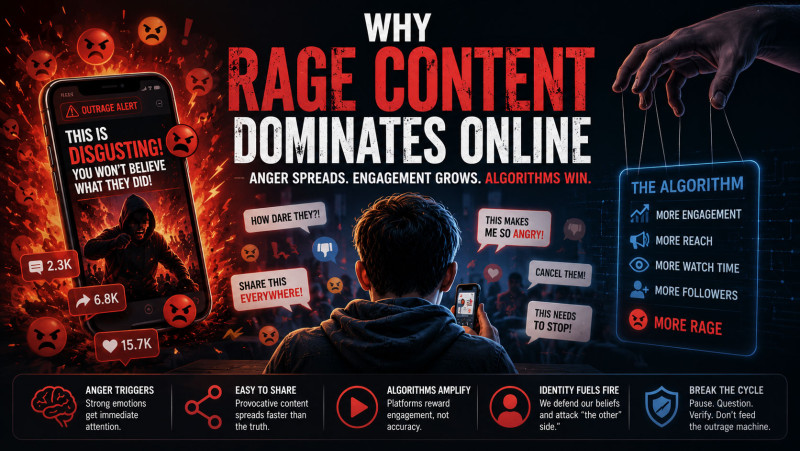
The internet was supposed to bring people closer together.
Instead, it has also become remarkably good at making people angry.
Open almost any major social platform and the pattern is familiar. A controversial opinion appears. Someone responds. Another person becomes outraged. Screenshots spread. Arguments multiply. More people join the conversation, often without seeing the original context.
Within hours, a relatively ordinary disagreement can become a massive online event.
This is not necessarily because people have suddenly become angrier than previous generations.
The digital environment itself has changed the economics of attention.
Content that makes people furious often performs exceptionally well.
And when platforms reward engagement, rage can become a surprisingly effective product.
Anger Is an Attention Magnet
Most people scroll through social media quickly.
They may ignore a photograph.
They may pass an ordinary headline.
They may skip a routine update.
But something that makes them angry can stop them immediately.
A provocative statement creates an emotional reaction.
That reaction creates attention.
Attention creates interaction.
Interaction creates more distribution.
The process can happen incredibly quickly.
This is one reason outrage is so powerful online. It does not require someone to agree with the content.
They only need to care enough to react.
You Don't Have to Like Something to Boost It
This is one of the most important differences between traditional media and modern social platforms.
In the past, disliking a piece of content often meant ignoring it.
Online, disagreement can become a form of promotion.
Someone sees an offensive or ridiculous post and shares it with the caption:
"Look at this."
Thousands of other people do the same.
The original creator receives more visibility.
The platform sees increased activity.
The controversial post reaches even more people.
The audience may believe it is fighting the content while simultaneously helping distribute it.
Outrage can therefore become an accidental marketing strategy.
Algorithms Don't Understand Morality
Recommendation systems are generally not designed to determine whether something is good for society.
They are designed to predict behavior.
Will you click?
Will you watch?
Will you comment?
Will you share?
Will you return?
If angry content consistently produces those behaviors, the system has a reason to continue distributing it.
That does not necessarily mean an algorithm is intentionally trying to make people angry.
It means anger can become a measurable form of engagement.
The system does not need to understand why you are reacting.
It only needs to recognize that you are.
Emotion Beats Information
A complicated policy discussion may require several minutes of attention.
A detailed explanation of an economic issue may require context.
A thoughtful historical analysis may require patience.
A provocative sentence can create an emotional response in seconds.
That creates a structural advantage for emotionally charged content.
The shorter the attention window becomes, the more valuable immediate emotional reactions can become.
This does not mean informative content cannot succeed.
It means information often has to compete against content specifically designed to trigger an instant response.
Anger Creates a Sense of Urgency
Rage content rarely says:
"Here is something interesting you can think about later."
It says:
"This is happening right now."
"Someone needs to respond."
"This is unacceptable."
"They are trying to take something away from you."
"This person must be stopped."
Urgency changes behavior.
People are more likely to comment immediately.
They are more likely to share.
They are more likely to tag friends.
They may even return repeatedly to see how the argument develops.
The emotional clock starts ticking.
The Outrage Cycle
A typical online outrage cycle can be surprisingly predictable.
First, someone publishes something provocative.
Second, an audience discovers it.
Third, people criticize the post.
Fourth, the criticism attracts even more attention.
Fifth, the creator responds.
Sixth, another group reacts to the response.
Then media accounts, influencers, and other creators begin discussing the controversy.
Eventually, people who have no connection to the original issue become involved.
The original post may have taken thirty seconds to create.
The resulting controversy can last for days.
The internet has become exceptionally efficient at turning small conflicts into large attention events.
Context Is Often the First Casualty
Rage content works best when people react quickly.
Context slows that process down.
A full interview might reveal that a controversial quote was taken out of context.
A complete study might complicate a dramatic claim.
A long conversation might show that two people actually agree on most of the underlying issue.
But context requires time.
Short clips and screenshots are easier to share.
This creates an uncomfortable incentive.
The more complicated reality becomes, the more tempting it is to reduce it to a simple conflict.
One person is right.
One person is wrong.
One side is good.
The other side is terrible.
Complexity rarely produces the same immediate emotional reaction.
Creators Learn What Works
Creators are not immune to these incentives.
If a calm, balanced video receives modest attention while an angry video generates enormous engagement, the lesson can be difficult to ignore.
The creator may begin adjusting.
The headlines become stronger.
The thumbnails become more dramatic.
The opinions become more extreme.
The language becomes more confrontational.
Eventually, the creator may not even realize how much the platform has influenced their style.
They are simply following the feedback.
The audience responds to outrage.
The creator produces more outrage.
The algorithm distributes it.
The audience grows.
The cycle reinforces itself.
Rage Can Become a Business Model
Once an audience has been built around outrage, abandoning it can be difficult.
A creator who becomes known for aggressive commentary may discover that followers expect increasingly extreme opinions.
A moderate position may receive less engagement.
A nuanced explanation may perform poorly.
A dramatic accusation may generate enormous traffic.
Over time, the creator can become trapped by the audience they built.
The content becomes less about what they genuinely think and more about what keeps people watching.
At that point, outrage is no longer simply an emotional response.
It becomes an economic strategy.
Political Content Makes the Problem Larger
Politics naturally involves disagreement.
Online platforms amplify that disagreement because political content can generate unusually strong emotional reactions.
A political post may trigger anger, fear, loyalty, or moral outrage.
These emotions encourage engagement.
But political arguments are rarely isolated.
They connect to identity.
When people believe an issue threatens their group, community, values, or way of life, disagreement can become personal.
The result is an environment where political content can generate enormous attention even when it provides little useful information.
Identity Makes Rage More Powerful
People do not only defend ideas online.
They defend identities.
A criticism of a favorite sports team can feel personal.
A criticism of a musician can feel like an attack on someone's taste.
A criticism of a political movement can feel like an attack on someone's values.
Once an issue becomes connected to identity, people have stronger incentives to respond.
This is why online arguments can escalate so quickly.
The person on the other side is no longer simply disagreeing with an opinion.
They can begin to feel like an opponent.
Social Media Removes Many Normal Boundaries
In ordinary life, arguments have natural limits.
You might disagree with someone at work and then return to your responsibilities.
You might argue with a friend and eventually change the subject.
Online, the argument can continue indefinitely.
There are always more people to respond.
There are always more notifications.
There are always more screenshots.
There is always another comment.
The conversation has no natural ending.
This can turn a temporary disagreement into a continuous emotional experience.
Rage Is Easy to Manufacture
Another reason rage content dominates is that it does not always require a genuinely important controversy.
A creator can manufacture outrage through framing.
Take an ordinary event.
Present it in the most extreme possible way.
Remove context.
Add an emotionally charged headline.
Then wait for people to react.
The underlying event may be relatively insignificant.
The reaction can be enormous.
This is one reason users should be cautious when encountering content that seems specifically designed to make them furious within seconds.
The emotional reaction may be part of the product.
The Audience Becomes Part of the Content
Online outrage does not end with the original creator.
The audience becomes part of the story.
Comments become content.
Reaction videos become content.
Response posts become content.
Memes become content.
Screenshots become content.
Even criticism of the controversy becomes another form of distribution.
A single piece of rage content can therefore produce dozens or hundreds of secondary pieces of content.
The original controversy becomes an ecosystem.
Anger Can Be Useful
None of this means anger is always bad.
Anger can draw attention to genuine injustice.
It can motivate people to demand accountability.
It can expose misconduct.
It can encourage political participation.
It can help communities organize around important causes.
The problem is not anger itself.
The problem is when anger becomes the default method of communication.
If everything is presented as an emergency, nothing feels proportionate anymore.
When Everything Is Outrage, Nothing Is
If users are constantly exposed to claims that something is outrageous, disgusting, dangerous, corrupt, or unacceptable, emotional sensitivity can begin to change.
Yesterday's controversy becomes today's forgotten story.
The audience needs something stronger to produce the same reaction.
This can create an escalation cycle.
A creator becomes more provocative.
Competitors become more provocative.
Audiences become accustomed to stronger language.
Eventually, ordinary disagreement can be presented as a crisis.
The result is an internet where emotional intensity keeps increasing while meaningful attention becomes harder to sustain.
Rage Creates the Illusion of Participation
Commenting can feel like taking action.
Sharing a post can feel like making a statement.
Arguing with strangers can feel like defending a principle.
Sometimes these actions genuinely matter.
But often, they simply create more engagement.
A person may spend an hour arguing online about an issue without changing anything outside the platform.
The platform benefits from the activity regardless of who wins.
This creates an important distinction between being engaged and being effective.
They are not always the same thing.
How to Avoid Becoming Part of the Cycle
The easiest way to reduce the influence of rage content is surprisingly simple.
Slow down.
Before sharing something that makes you angry, ask:
What exactly am I reacting to?
Then consider:
Have I seen the full context?
And perhaps most importantly:
Who benefits if I share this?
Sometimes the answer will still be that the information deserves attention.
But sometimes the realization that your anger is being converted into engagement is enough to break the cycle.
Follow Information, Not Just Emotion
One useful habit is to separate emotional reaction from information gathering.
If something appears outrageous, investigate it before deciding what it means.
Look for the original source.
Read beyond the headline.
Watch the complete interview.
Check whether independent sources report the same thing.
Ask whether important context is missing.
This does not guarantee that you will reach the "correct" conclusion.
It simply gives you a better chance of reaching your own conclusion rather than inheriting someone else's emotional framing.
The Internet Does Not Need to Become Less Emotional
Human beings will always experience strong emotions.
The internet does not need to become emotionless.
What needs to change is the assumption that the strongest possible reaction is always the most valuable one.
Curiosity can create engagement.
Humor can create engagement.
Wonder can create engagement.
Discovery can create engagement.
Thoughtful disagreement can create engagement.
The internet is capable of more than outrage.
It simply happens that outrage is particularly efficient.
The Attention Economy Rewards What We Give It
Platforms respond to user behavior.
Creators respond to audience behavior.
Audiences respond to platform design.
The result is a feedback loop involving everyone.
If outrage consistently receives the most attention, more outrage will be produced.
If thoughtful content receives meaningful attention, creators have greater incentive to produce it.
Users therefore have more influence over the online environment than they might realize.
Every click, comment, share, and watch contributes to the system.
The Future of Online Conversation Is Not Predetermined
Rage content dominates because the internet has created an environment where anger is exceptionally effective at capturing attention.
But effectiveness does not make it inevitable.
Platforms can change recommendation systems.
Creators can choose different incentives.
Audiences can become more conscious of manipulation.
Users can learn to pause before reacting.
Most importantly, people can remember that attention is valuable.
Every minute spent arguing with a stranger is a minute that cannot be spent somewhere else.
The internet will probably never stop producing things designed to make us angry.
There will always be someone who benefits from the reaction.
The real question is whether we continue giving them that reaction automatically.
In an online world built around capturing attention, one of the most powerful forms of resistance may be surprisingly simple:
You do not have to react just because something was designed to make you angry.