



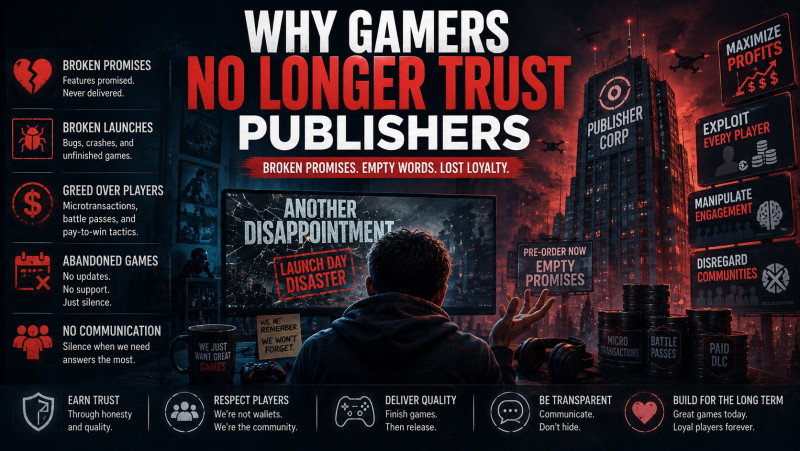
The relationship between gamers and game publishers has changed dramatically.
There was a time when buying a game was relatively simple. A player purchased a physical copy, installed it, and expected the product to represent a finished experience.
Today, buying a game can involve launch-day patches, downloadable content, season passes, subscriptions, cosmetic stores, battle passes, online requirements, aggressive monetization, and long-term service commitments.
None of these things are automatically bad.
Live-service games can create communities that last for years. Downloadable content can expand excellent games. Digital distribution can make games more accessible than ever.
The problem is trust.
When players begin to feel that publishers consistently prioritize revenue strategies over the quality of the experience, every new announcement is viewed with suspicion.
The question is no longer simply:
"Is this game good?"
It becomes:
"What are they trying to sell me this time?"
Trust Takes Years to Build
Gaming communities remember.
A publisher can release several excellent games and build enormous goodwill.
But a few major disappointments can change the relationship quickly.
A broken launch.
An abandoned game.
An aggressive monetization system.
A misleading trailer.
A sudden studio closure.
A promised feature that never arrives.
A game that receives years of updates only to be shut down.
Each event contributes to a broader perception.
Players rarely evaluate every release in isolation.
They evaluate it through the history of the company behind it.
That history matters.
The Launch-Day Problem
One of the biggest sources of frustration is the modern expectation that games can be released before they are completely ready.
Large games have become extraordinarily complicated.
Thousands of developers may work across different systems, platforms, languages, and technologies.
Bugs are inevitable.
But players have increasingly encountered launches where technical problems are severe enough to undermine the entire experience.
When someone spends $70 or more on a game and discovers that it performs poorly, crashes frequently, or lacks promised features, the frustration goes beyond the technical issue.
It creates a question of responsibility.
Why was the game released in this condition?
Patches Changed Expectations
Post-launch updates were once an exception.
Now they are standard.
That can be positive.
Developers can fix bugs, improve performance, add features, and respond to feedback.
But the existence of patches has also created an uncomfortable incentive.
If a game can be repaired after release, publishers may have less pressure to ensure that everything is perfect on day one.
Players increasingly expect a game to improve over time.
That sounds reasonable until the "future version" becomes more important than the product customers actually purchased.
Monetization Has Become More Complicated
Games have evolved from one-time purchases into ongoing businesses.
A single title can generate revenue through:
- Base game sales
- Expansion packs
- Cosmetic items
- Battle passes
- Premium currencies
- Subscriptions
- Season passes
- Limited-time events
- Paid upgrades
Again, none of these models are inherently wrong.
Players are willing to spend money when they believe the value is fair.
The problem appears when monetization begins interfering with the design of the game itself.
If a game seems designed around encouraging purchases rather than delivering an enjoyable experience, players notice.
When the Store Becomes Part of the Game
A cosmetic store is easy to ignore when it feels optional.
But the relationship changes when game mechanics appear designed to push players toward spending.
Artificial scarcity can create urgency.
Premium currencies can obscure real prices.
Limited-time items can encourage impulse purchases.
Progression systems can be structured around frustration followed by a shortcut.
Players may begin feeling that the game is constantly trying to sell something.
At that point, the commercial layer becomes part of the gameplay experience.
The Battle Pass Fatigue
Battle passes were introduced as a way to provide ongoing rewards while giving players reasons to return.
For some games, the model works well.
But as more titles adopt similar systems, players can feel overwhelmed.
Instead of simply playing a game, they may feel as though they are managing a schedule.
Complete these challenges.
Reach this level.
Unlock these rewards.
Finish before the season ends.
Start again next month.
Gaming is supposed to be entertainment.
When every game begins demanding regular commitment, players may start experiencing it as another obligation.
Live-Service Games Changed the Industry
Publishers increasingly want games that generate revenue for years rather than weeks.
The appeal is obvious.
A successful live-service game can create recurring revenue while building a large and loyal community.
But the model is difficult.
Players have limited time.
There are only so many games they can actively maintain.
As more publishers attempt to create the next massive ongoing franchise, many projects compete for the same attention.
When a live-service game fails, the consequences can be enormous.
Years of development may disappear almost overnight.
Players Notice When Games Feel Designed by Committees
Large publishers often operate through complicated organizational structures.
A major game can involve hundreds or thousands of people.
That scale can produce remarkable results.
It can also create creative compromises.
A game may contain familiar mechanics because they tested well.
A monetization system may exist because it performed well in another title.
A trend may be included because competitors are doing it.
A feature may survive because removing it would create internal problems.
Eventually, players can sense when a game feels assembled from business requirements rather than built around a clear creative vision.
The Problem With Chasing Trends
The games industry is constantly looking for the next successful formula.
When one genre succeeds, competitors appear.
When one monetization system works, others adopt it.
When one game creates a new social experience, publishers attempt to reproduce it.
This is understandable from a business perspective.
But players are not necessarily looking for ten versions of the same idea.
They want experiences that feel distinctive.
When every publisher appears to be chasing the same market opportunity, confidence decreases.
Players begin asking whether the company actually understands what makes its games special.
Announcements Create Expectations
Trust can also be damaged before a game is released.
Trailers create expectations.
Developer presentations create expectations.
Marketing campaigns create expectations.
Statements from executives create expectations.
The larger the promise, the greater the potential disappointment.
If the final product differs significantly from what players thought they were getting, the issue is not simply that the game changed during development.
Players may feel misled.
That feeling can last long after the initial disappointment.
Review Copies and Early Access Create Another Tension
Modern games often receive extensive coverage before release.
Influencers may play early versions.
Reviewers may receive advance copies.
Marketing campaigns can create enormous anticipation.
This creates a difficult environment when technical problems appear after launch.
A player may purchase a game based on promotional material and early coverage, only to discover a substantially different experience once the broader audience arrives.
The growing importance of influencers makes transparency increasingly important.
Players want to know what they are actually buying.
Studio Closures Damage Trust Too
Players often develop relationships with developers, not just publishers.
They recognize studio names.
They follow developers on social platforms.
They become invested in creative teams.
When a studio suddenly closes after releasing a successful game, players can feel disconnected from the business decisions behind the industry.
The people who created the experience may have little control over what happens to the company.
Repeated layoffs and closures also create uncertainty about the future of franchises.
If a publisher closes the team behind a game, why should players assume the next project will receive long-term support?
Abandoned Games Leave a Lasting Impression
Few things damage trust more than abandonment.
Players may invest hundreds of hours into a game.
They may purchase expansions or cosmetic items.
They may build communities around it.
Then support ends.
Servers may eventually shut down.
Content may disappear.
The game may become difficult or impossible to access.
For players, this creates an uncomfortable realization.
They did not necessarily purchase ownership of a lasting product.
They purchased access to a service that could disappear.
That distinction is becoming increasingly important.
Digital Ownership Is Complicated
Physical games created a stronger psychological sense of ownership.
You had a disc.
You had a box.
You could lend it to someone.
You could sell it.
You could keep it on a shelf.
Digital distribution offers enormous convenience, but ownership can be less straightforward.
Licenses, account restrictions, online requirements, platform policies, and server dependencies can all affect what players actually control.
This does not mean digital games have no value.
It means the traditional idea of ownership has changed.
Players are increasingly aware of that difference.
Subscription Services Add Another Layer
Game subscriptions can provide tremendous value.
For a monthly fee, players can access large libraries without purchasing every game individually.
But subscriptions can also reinforce the idea that games are temporary access rather than permanent purchases.
A game can enter a catalog and later disappear.
Players may become reluctant to invest emotionally in a title they cannot be sure will remain available.
The model is convenient.
It also changes the relationship between players and publishers.
Gamers Have More Alternatives Than Ever
One reason player expectations have increased is that there are simply more games available.
Independent developers can create sophisticated experiences with relatively small teams.
Older games remain accessible.
Digital storefronts provide enormous libraries.
Free-to-play games compete with premium releases.
Players no longer have to tolerate a disappointing product simply because there are few alternatives.
If a game frustrates them, they can move on.
That gives consumers significant power.
Communities Can Turn Against a Publisher Quickly
Gaming communities are highly connected.
A problem that might once have affected a relatively small number of players can now become visible worldwide within hours.
A screenshot can spread across social platforms.
A technical issue can become a viral video.
A controversial monetization decision can dominate gaming discussions.
This transparency can be healthy.
Publishers can no longer assume that negative experiences will remain isolated.
But it also means mistakes can escalate quickly.
Players Are Not Anti-Business
It is important to recognize that gamers generally understand that companies need to make money.
Developers need salaries.
Studios need funding.
Servers need to operate.
Publishers need profitable products to continue investing in new projects.
The problem is not that games are commercial products.
The problem is when players believe commercial interests are being prioritized at the expense of the experience.
Most players are willing to spend money.
They simply want to feel that the transaction is fair.
What Rebuilds Trust?
Trust can be rebuilt.
But it requires consistency.
Publishers can improve relationships with players by:
- Being honest about development
- Setting realistic expectations
- Launching games in stable condition
- Explaining major changes
- Avoiding manipulative monetization
- Supporting successful games responsibly
- Respecting player feedback
- Communicating during difficult situations
- Treating communities as partners rather than targets
The most powerful strategy is simple:
Deliver what you promise.
Then keep supporting it when you say you will.
Transparency Matters More Than Marketing
Players are becoming increasingly skeptical of polished marketing.
A cinematic trailer can create excitement.
But players ultimately want evidence.
Show the gameplay.
Explain the systems.
Demonstrate progression.
Discuss monetization.
Be clear about online requirements.
Explain what is included at launch.
Tell players what may change.
Honesty may create fewer dramatic marketing moments.
But it can produce something more valuable.
Credibility.
The Best Publishers Understand Their Communities
A strong relationship between publisher and player should not feel like an adversarial negotiation.
Players should not feel that every update is an attempt to extract more money.
Publishers should not treat every complaint as hostility.
There is room for disagreement.
There is room for experimentation.
There is room for business decisions that some players will dislike.
But communication matters.
When players believe that a publisher respects them, they are often more willing to accept changes.
Trust creates flexibility.
Without trust, even reasonable decisions can be interpreted negatively.
The Industry Has a Trust Problem, Not a Gaming Problem
People still love games.
They continue to spend billions on them.
They build communities around them.
They create mods, fan art, videos, tournaments, and entire careers around gaming.
The passion has not disappeared.
If anything, it has become stronger.
What has changed is the relationship between audiences and the companies responsible for many of their favorite experiences.
Players have become more informed.
They understand monetization.
They understand development cycles.
They compare business practices.
They remember failures.
They communicate instantly with one another.
Publishers are no longer speaking to isolated customers.
They are speaking to communities with long memories.
Trust May Become a Competitive Advantage
In an industry where technology is increasingly accessible, trust can become one of the most valuable differentiators.
Players may choose a game because they believe the publisher will support it.
They may preorder because previous releases earned their confidence.
They may spend more on expansions because they know the company delivers quality.
They may forgive mistakes because the relationship feels genuine.
That kind of loyalty cannot be purchased through advertising.
It has to be earned.
The future of gaming may therefore depend on more than graphics, technology, and massive budgets.
It may depend on whether publishers remember why players trusted them in the first place.
Gamers are not asking for perfection.
They understand that games are complicated.
They understand that development can go wrong.
They understand that businesses need to make money.
What they increasingly reject is feeling manipulated, misled, or forgotten.
The companies that recognize this may discover something important.
Trust is not simply a public-relations benefit.
It is part of the product.