



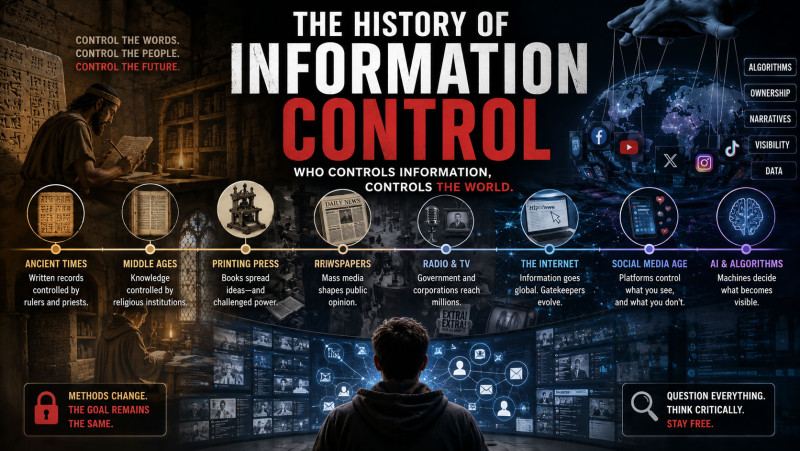
Control over information has always been a form of power.
Long before the internet, governments, religious institutions, rulers, and powerful organizations understood that controlling what people could read, hear, and discuss could influence how they understood the world.
The tools have changed dramatically.
Ancient rulers controlled written records.
Medieval institutions controlled access to books.
Governments later regulated newspapers, radio, and television.
Today, information flows through search engines, social platforms, recommendation systems, private messaging networks, and artificial intelligence.
The technology is different.
The underlying struggle is not.
Who gets to decide what people know?
Information Has Always Been Political
Information is rarely neutral in the hands of institutions.
A government deciding which documents become public is making a political choice.
A publisher deciding which books receive distribution is making a cultural choice.
A newspaper deciding which stories deserve the front page is making an editorial choice.
A platform deciding which posts appear in someone's feed is making a technological choice.
None of these decisions necessarily represent censorship.
But all of them influence visibility.
And visibility determines what becomes part of public conversation.
Ancient Civilizations Understood the Power of Records
Early civilizations relied heavily on written records to organize society.
Governments recorded taxes, laws, property, trade, military activities, and religious practices.
Writing allowed states to preserve knowledge across generations.
It also created opportunities for control.
When literacy was limited to relatively small groups, access to written information could become a source of authority.
Those who could read and write were often responsible for maintaining the records upon which governments and institutions depended.
Information was not simply knowledge.
It was infrastructure.
Libraries Became Centers of Power
Libraries represented another major development.
Large collections of written material allowed civilizations to preserve knowledge and make it available to scholars.
But libraries were never simply warehouses of books.
Someone had to decide what was collected.
Someone had to decide what was preserved.
Someone had to decide who could access it.
The preservation of knowledge and the control of knowledge could therefore exist side by side.
The more valuable information became, the more important access became.
Religious Institutions Shaped What Could Be Read
For centuries, religious institutions played a central role in education, publishing, and the preservation of written works.
In parts of Europe, monasteries helped preserve ancient texts through generations of copying.
Religious institutions also influenced which ideas were considered acceptable.
This was not unique to any one religion or civilization.
Whenever an institution becomes responsible for education and publishing, it gains influence over the boundaries of legitimate knowledge.
That influence can preserve important ideas.
It can also suppress others.
The Printing Press Changed Everything
The printing press transformed information control.
Before mass printing, reproducing a book was slow and expensive.
Printing dramatically reduced the cost and increased the speed of reproduction.
Ideas could travel farther.
Books could reach more people.
Pamphlets could challenge established institutions.
Political movements could organize around shared texts.
Religious debates could spread across borders.
The printing revolution therefore created a problem for authorities.
Information could move faster than institutions could control it.
Censorship Became More Difficult
The printing press did not eliminate censorship.
Governments and religious authorities attempted to regulate printers, publications, and books.
Licensing systems could determine who was permitted to publish.
Certain texts could be prohibited.
Authors could face punishment.
Printers could be pressured.
But once information became easier to reproduce, controlling every copy became increasingly difficult.
This established a pattern that would repeat throughout history.
Every new communication technology creates new opportunities for information control.
It also creates new opportunities to escape it.
Newspapers Created Mass Public Opinion
The growth of newspapers introduced another major transformation.
For the first time, large populations could receive relatively similar information on a regular basis.
Newspapers could influence public priorities.
They could shape political debates.
They could expose scandals.
They could support political movements.
They could also serve the interests of owners, governments, or advertisers.
Mass media created a new kind of power.
Instead of controlling access to individual books, influential institutions could influence what millions of people discussed each day.
Propaganda Became Industrialized
The twentieth century demonstrated how powerful mass communication could become.
Radio, newspapers, posters, cinema, and later television gave governments unprecedented ways to communicate directly with populations.
During wartime, propaganda became a sophisticated tool.
Governments could shape narratives, influence morale, demonize opponents, and present selective versions of events.
The most effective propaganda was not always an obvious lie.
Sometimes it consisted of carefully selected truths.
What was emphasized.
What was omitted.
Which images were shown.
Which words were repeated.
Information control can be powerful even when every individual statement is technically accurate.
Radio Changed the Relationship Between Leaders and Citizens
Radio allowed political leaders to speak directly into people's homes.
The distance between government and citizen became smaller.
A leader no longer needed a newspaper editor to reach a mass audience.
This created opportunities for connection.
It also created opportunities for manipulation.
The same technology that allowed governments to communicate important information could be used to create highly controlled narratives.
The medium itself was neither democratic nor authoritarian.
Its effect depended on who controlled access to it and how it was used.
Television Added Images to the Equation
Television transformed information once again.
People could now see events as well as hear about them.
Images became enormously influential.
A speech could be evaluated not only by its words but by the speaker's appearance and behavior.
A war could be experienced through footage.
A protest could become a national event because cameras captured it.
Television reduced some forms of distance between audiences and major events.
But television also introduced another layer of editorial control.
Someone still decided which cameras were present.
Someone decided which footage was broadcast.
Someone decided what appeared on the evening news.
The Internet Appeared to Break the System
The early internet created a radically different information environment.
Publishing became accessible to ordinary people.
A person with a computer and an internet connection could potentially reach an audience without owning a newspaper, television station, or printing press.
Blogs, forums, independent websites, and later social networks expanded the number of voices participating in public conversation.
The traditional gatekeepers lost some of their power.
But new gatekeepers eventually emerged.
Platforms Became the New Gatekeepers
Modern social platforms do not usually decide what people can publish in the same way traditional publishers did.
Instead, they increasingly influence what people see.
This distinction is crucial.
A post can exist without becoming visible.
A video can be uploaded without being recommended.
An article can be published without appearing in search results.
A creator can have millions of followers while reaching only a fraction of them.
Information control has therefore shifted from controlling publication to controlling distribution.
Algorithms Changed the Meaning of Visibility
Traditional editors could choose which stories appeared on a front page.
Algorithms can make millions of such decisions automatically.
They determine which posts appear first.
Which videos are recommended.
Which search results are prominent.
Which accounts receive attention.
Which stories become trends.
The scale is unprecedented.
One editorial decision can affect thousands of readers.
An algorithmic decision can potentially affect millions of people simultaneously.
Personalization Creates Separate Realities
The internet once promised a shared information environment.
Today, two people can use the same platform and encounter completely different versions of it.
One person may see political news.
Another may see sports.
Another may see entertainment.
Another may see conspiracy theories.
Another may see financial content.
Personalization makes services more relevant.
But it also creates a new information problem.
People may no longer disagree simply about what something means.
They may disagree about what happened in the first place.
Search Engines Became Powerful Information Brokers
Search engines transformed how people find knowledge.
Instead of browsing libraries or physical directories, users could type a question and receive ranked results.
This created enormous convenience.
It also created enormous influence.
The order of results matters.
Most users do not examine hundreds of pages.
They typically focus on the first few results.
That means ranking determines visibility.
Search engines therefore became important intermediaries between people and information.
Artificial Intelligence Adds Another Layer
AI is beginning to change information access again.
Instead of receiving a list of links, users can ask a system to summarize, explain, compare, or answer questions directly.
This can make information dramatically easier to consume.
But it introduces a new question.
If an AI system becomes the interface between people and the world's information, who determines what it presents?
What sources does it prioritize?
How does it resolve disagreement?
What does it leave out?
How does it handle uncertainty?
The traditional information gatekeeper may eventually become something very different.
A conversational system.
Information Control Does Not Always Look Like Censorship
This may be the most important lesson from history.
Information can be controlled without being completely banned.
It can be buried.
Delayed.
Demonetized.
De-ranked.
Ignored.
Overwhelmed by competing information.
Presented without context.
Or simply made difficult to find.
In a world with unlimited information, visibility can become more important than availability.
If something technically exists but almost nobody encounters it, its practical influence may be very limited.
Too Much Information Can Also Become a Form of Control
Information abundance sounds like the opposite of information control.
But overwhelming people can produce a similar effect.
Imagine thousands of contradictory claims appearing every day.
People may become exhausted.
They may stop investigating.
They may decide that nobody can be trusted.
They may retreat into familiar communities.
They may conclude that the truth is impossible to know.
At that point, information overload can produce disengagement.
The problem is no longer a lack of information.
It is an inability to distinguish useful information from noise.
Trust Becomes the Scarce Resource
As information becomes abundant, trust becomes increasingly valuable.
People need ways to determine:
Who created this?
Where did it come from?
When was it published?
What evidence supports it?
What might be missing?
Who benefits from people believing it?
These questions have always mattered.
Digital technology simply makes them harder because the volume and speed of information have increased dramatically.
The Rise of Citizen Journalism
The internet also created opportunities for ordinary people to document events.
A smartphone can capture an event before professional journalists arrive.
A person can publish firsthand observations instantly.
Communities can document incidents that might otherwise receive little attention.
This can challenge traditional narratives.
It can also introduce new problems.
Firsthand footage can be powerful, but it may lack context.
A short clip can be authentic and still misleading.
Citizen journalism expands the number of witnesses.
It does not eliminate the need for verification.
Information Control Is Becoming Decentralized
One of the most interesting developments is that information control is no longer concentrated entirely in governments or major media organizations.
Influencers can shape millions of opinions.
Online communities can determine what becomes popular.
Platforms can influence visibility.
Search engines can determine discovery.
AI systems can summarize information.
Ordinary users can make content viral.
Power has become more distributed.
But distributed power is not necessarily equal power.
A small number of accounts can still dominate attention.
A small number of platforms can still control distribution.
The Future May Be About Information Literacy
The solution to information control is not simply producing more information.
It is developing better ways to evaluate it.
People need to understand how sources work.
They need to recognize emotional manipulation.
They need to distinguish evidence from assertion.
They need to understand that algorithms influence what they see.
They need to be comfortable saying:
"I do not know."
That last ability may be particularly important.
In an environment where everyone appears certain, uncertainty can be a sign of intellectual discipline.
The Struggle Has Never Really Been About Technology
The printing press did not create propaganda.
Radio did not create political manipulation.
Television did not create bias.
The internet did not create misinformation.
AI did not create information control.
Technology amplifies existing human capabilities.
It makes communication faster.
It makes distribution cheaper.
It increases reach.
It gives more people the ability to influence others.
The fundamental struggle remains the same.
Who controls the channels through which information travels?
Who decides what deserves attention?
Who has the power to define reality for others?
The Information Environment Will Keep Changing
The history of information control is a history of technological disruption.
Every generation develops new ways to communicate.
Every new communication system changes who can speak.
New gatekeepers emerge.
Old gatekeepers lose influence.
Then another technology changes the balance again.
The internet weakened some traditional institutions.
Social media created new ones.
Artificial intelligence may transform the system again.
The future may not be a world where information is controlled by a single authority.
It may be a world where information is filtered by countless systems, platforms, algorithms, communities, and artificial intelligence models.
That could create more freedom.
It could also create more complexity.
The Most Important Skill May Be Knowing How to Look
No technology can completely solve the problem of information control.
There will always be incentives to persuade.
There will always be institutions protecting their interests.
There will always be people trying to shape public opinion.
The difference is that individuals now have unprecedented access to information from around the world.
That access is powerful.
But access alone is not enough.
People need the ability to question what they see, investigate what they hear, compare sources, recognize missing context, and understand why a particular piece of information reached them.
Information control has evolved for thousands of years.
It will continue evolving.
The tools will change.
The platforms will change.
The gatekeepers will change.
But one principle will remain constant:
Those who control information rarely control only what people know. They influence what people believe is possible, important, and true.
Understanding that power may be the first step toward using information without allowing information to use us.