



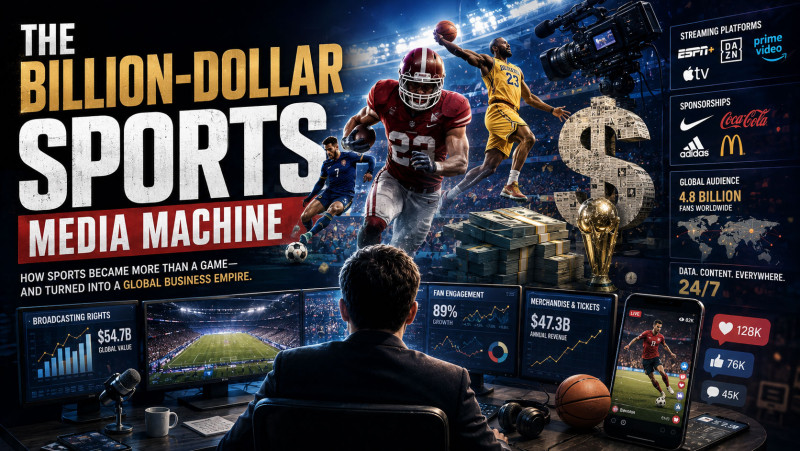
Sports have always been about competition.
But modern sports are also about something much larger.
They are entertainment products, media properties, advertising platforms, social communities, subscription businesses, and global brands.
A major sporting event can attract millions of viewers, generate enormous advertising revenue, sell thousands of tickets, drive merchandise sales, and create weeks of online conversation.
The athletes may be the stars, but behind them sits a vast commercial machine.
Television networks.
Streaming platforms.
Advertisers.
Leagues.
Teams.
Sponsors.
Media companies.
Social platforms.
And increasingly, technology companies.
Together, they have transformed professional sports into one of the most powerful media industries in the world.
Sports Are No Longer Just Games
For fans, a sporting event may last two or three hours.
For the businesses surrounding it, the event can generate value before, during, and long after the final whistle.
Weeks before a major game, media organizations begin promoting it.
Analysts debate the matchup.
Players appear in interviews.
Social media accounts publish highlights.
Brands release advertisements.
Fans discuss predictions.
After the game, the conversation continues.
Highlights circulate.
Players are interviewed.
Analysts debate key moments.
Clips spread across social platforms.
The event becomes more than a game.
It becomes a content ecosystem.
Television Built the Modern Sports Economy
Television changed sports permanently.
Before mass television coverage, professional sports were primarily consumed by people who could attend games or follow them through newspapers and radio.
Television expanded the audience dramatically.
A game no longer needed to be played in front of tens of thousands of people to have enormous commercial value.
It could reach millions.
That audience attracted advertisers.
Advertisers attracted broadcasters.
Broadcasters competed for rights.
Sports leagues gained negotiating power.
The cycle created an entirely new economy.
Broadcasting Rights Became Gold
One of the most valuable assets in professional sports is not the stadium.
It is the right to broadcast the games.
Networks and streaming platforms are willing to pay enormous amounts for exclusive access to major competitions because live sports provide something increasingly rare in modern media.
People still want to watch them at the same time.
A scripted television series can be watched tomorrow.
A movie can be streamed next month.
But when a championship game is happening, fans want to know what is happening now.
That makes live sports extremely valuable.
Scarcity Makes Sports Different
The number of major games is limited.
There are only so many championship events.
Only so many regular-season games that attract enormous audiences.
Only so many nationally important matchups.
That scarcity gives leagues significant leverage.
A streaming platform cannot simply create another championship game to compete with the one everyone wants to watch.
There is one event.
Millions of people want access.
That creates extraordinary economic value.
Streaming Changed the Competition
For decades, television networks dominated sports broadcasting.
Then streaming platforms entered the market.
Companies that previously had little connection to sports began competing for broadcasting rights.
The reason is straightforward.
Live sports can attract large audiences and encourage people to remain subscribed.
A streaming service may have thousands of movies and television episodes, but subscribers can cancel whenever they want.
A major sports package gives them another reason to stay.
Sports therefore became part of the larger battle for recurring digital subscriptions.
The Streaming Wars Reached the Stadium
Fans now face an increasingly fragmented sports landscape.
One league may be available through one service.
Another competition may require a different subscription.
A particular game may appear exclusively on another platform.
Some events may require traditional television.
Others may be available through a digital package.
The result is a strange contradiction.
Technology has made sports easier to distribute.
But watching everything a fan wants can become more complicated.
The Fan Is Becoming a Subscriber
The traditional sports consumer might buy a ticket, watch television, and purchase merchandise.
The modern fan can become part of a much larger commercial relationship.
A fan may subscribe to multiple services.
Follow official team accounts.
Purchase digital memberships.
Buy merchandise online.
Watch premium content.
Participate in fantasy leagues.
Purchase tickets through mobile platforms.
Interact with sponsors.
The relationship between sports organizations and fans has become increasingly direct and continuous.
Advertising Is Everywhere
Sports have always attracted advertising.
But modern sports media has expanded the number of places where brands can appear.
There are stadium advertisements.
Jersey sponsorships.
Television commercials.
Digital banners.
Social media campaigns.
Sponsored segments.
Branded content.
Influencer partnerships.
Athlete endorsements.
The game itself has become surrounded by commercial messaging.
For advertisers, the appeal is obvious.
Sports audiences are emotionally invested.
Fans care about what happens.
That emotional connection makes advertising more powerful.
Athletes Became Media Companies
The biggest athletes no longer depend entirely on traditional media for visibility.
They can communicate directly with millions of followers.
An athlete can announce news on social media.
Publish behind-the-scenes content.
Launch a product.
Promote a sponsor.
Share personal opinions.
Build a personal brand.
In some cases, the athlete's social audience can rival or exceed the audience of traditional media outlets.
This changes the balance of power.
Athletes are no longer simply participants in sports media.
Many have become media platforms themselves.
Personal Brands Can Become More Valuable Than Team Brands
Fans may support a team for decades.
But individual athletes can attract global audiences regardless of where they play.
A superstar can move between teams while maintaining millions of followers.
Their personal identity travels with them.
That creates an interesting shift in professional sports.
Teams own the competitive environment.
Athletes increasingly own their personal attention.
The relationship can be mutually beneficial.
It can also create tension.
The athlete's commercial interests may not always perfectly align with the organization's.
Social Media Made Every Moment Content
A game used to end when the final score was recorded.
Now every moment can become content.
A spectacular goal becomes a clip.
A controversial referee decision becomes a debate.
A player's reaction becomes a meme.
A press conference becomes a viral video.
A mistake becomes a social media headline.
A single moment can generate millions of impressions.
Sports organizations have learned to capitalize on this.
The game is no longer the only product.
Every moment surrounding the game can become one.
Highlights Are Becoming a Currency
Short-form video has changed how people consume sports.
Many fans discover players through short clips rather than full games.
A spectacular play can travel across the internet within minutes.
This creates enormous promotional value.
A single highlight can introduce an athlete to audiences who may never watch an entire game.
But it also changes perception.
A player can become famous for moments rather than complete performances.
A dramatic clip can sometimes matter more online than a statistically important but visually ordinary contribution.
The Attention Economy Loves Sports
Sports are almost perfectly designed for the attention economy.
There is uncertainty.
There is competition.
There are winners and losers.
There are emotional highs and lows.
There are recognizable personalities.
There are constant opportunities for debate.
Most importantly, there is an outcome.
Audiences want to know what happens next.
That creates a natural engagement loop.
Who will win?
Who will score?
Will the comeback happen?
Was the decision fair?
What happens next season?
The questions never really end.
Fantasy Sports Added Another Layer
Fantasy sports transformed passive viewers into active participants.
Fans can follow individual players across multiple teams.
A game becomes more interesting because a particular athlete is part of someone's fantasy lineup.
That increases engagement.
A viewer may watch a game they would otherwise ignore because a player on their fantasy team is participating.
Sports media companies understand this connection.
The more reasons people have to pay attention, the more valuable the audience becomes.
Data Turned Athletes Into Numbers
Modern sports generate enormous amounts of data.
Performance statistics.
Movement tracking.
Speed.
Distance.
Shot locations.
Possession.
Reaction times.
Historical comparisons.
Data can improve coaching and performance.
It can also create new forms of sports media.
Fans can analyze players in unprecedented detail.
Broadcasters can display advanced statistics during games.
Teams can identify patterns that were previously invisible.
The athlete becomes both a performer and a data source.
Betting Increased Commercial Attention
Sports betting has become another major part of the sports media ecosystem in many markets.
It creates additional reasons for viewers to follow games closely.
A viewer may care about a match not because they support either team, but because of a particular outcome or statistic.
That can increase engagement.
It also introduces serious responsibilities.
The more deeply betting becomes integrated into sports media, the more important it becomes to protect vulnerable audiences and maintain the integrity of competitions.
The commercial opportunity is enormous.
So are the potential consequences.
The Business Wants More Attention
Every part of the sports media machine ultimately depends on attention.
More viewers mean more valuable advertising.
More engagement means more valuable sponsorships.
More subscribers mean more recurring revenue.
More followers create stronger athlete brands.
More content creates more opportunities for monetization.
This creates a powerful incentive to keep fans engaged between games.
There is always another story.
Another controversy.
Another ranking.
Another transfer.
Another injury.
Another prediction.
Another debate.
The season may end.
The content never does.
Controversy Is Also Content
Sports have always involved arguments.
Modern media has turned those arguments into products.
Was the referee correct?
Is the coach overrated?
Should the player be traded?
Who is the greatest of all time?
Which team is cheating?
Who deserves the award?
These questions can generate enormous engagement.
The actual answer is sometimes less important than the debate itself.
A controversial opinion can generate thousands of comments.
A calm explanation may generate far fewer.
Once again, the attention economy rewards emotion.
The Rise of Sports Influencers
Traditional sports journalism is no longer the only source of analysis.
Independent creators can build large audiences by discussing teams, players, tactics, rumors, and controversies.
Some operate as analysts.
Others operate as entertainers.
Some simply react to news.
The result is a much larger sports media ecosystem.
Fans can choose from newspapers, television networks, podcasts, YouTube channels, social accounts, newsletters, and independent websites.
The barrier to becoming a sports commentator has never been lower.
But More Voices Do Not Always Mean Better Information
The growth of independent sports media has advantages.
It creates competition.
It gives fans different perspectives.
It allows niche communities to flourish.
But it also creates incentives for speculation.
A rumor can generate enormous traffic.
A cautious statement may not.
The result is an environment where confidence can sometimes outperform accuracy.
Fans need to distinguish between reporting, analysis, speculation, and entertainment.
They may look similar on a social feed.
They are not the same thing.
The Globalization of Sports
Modern sports media has made leagues global.
A team can have supporters thousands of miles away from its home city.
A player can become a worldwide celebrity.
A championship can attract audiences across continents.
Streaming has accelerated this process.
A game no longer needs to be limited by geography.
This creates enormous opportunities for leagues and sponsors.
It also creates a new challenge.
Global audiences have different languages, cultures, viewing habits, and expectations.
Sports organizations must increasingly operate as global entertainment brands.
The Stadium Is Only One Part of the Business
The physical stadium remains important.
It creates atmosphere.
It sells tickets.
It provides premium experiences.
It generates food, merchandise, hospitality, and sponsorship revenue.
But the stadium is now only one piece of a much larger ecosystem.
Millions of people can experience a game without ever entering the building.
Their attention still has economic value.
In many cases, the audience outside the stadium is dramatically larger than the audience inside it.
Technology Is Making Sports More Immersive
The next phase could make sports even more interactive.
Augmented reality could provide additional statistics during live games.
Virtual reality could create new ways to experience stadiums.
AI could personalize commentary.
Real-time data could generate customized viewing experiences.
Fans may eventually choose exactly how they want to experience a game.
Follow one player.
See advanced tactical information.
Listen to customized commentary.
Watch from different camera angles.
Receive personalized analysis.
The traditional broadcast could become only one version of the experience.
Sports May Become More Personalized
The future of sports media may be less about broadcasting one experience to everyone and more about creating individualized experiences.
One fan might want pure entertainment.
Another might want detailed statistics.
Another might follow only one athlete.
Another might care about fantasy performance.
Another might want tactical analysis.
Technology can potentially deliver all of these simultaneously.
The challenge is maintaining the shared cultural experience that makes major sporting events so powerful.
Part of the magic of sports is knowing millions of other people are watching the same moment.
The Commercial Machine Has a Limit
There is a danger in monetizing every possible aspect of sports.
If every moment becomes an advertisement, every interaction becomes a subscription opportunity, and every statistic becomes a betting prompt, fans can eventually feel overwhelmed.
Sports are valuable because people care about them.
That emotional connection cannot be taken for granted.
The business can extract value from fandom.
But extracting too much can weaken the very relationship that creates the value.
Fans Are Still the Foundation
Despite all the technology, broadcasting deals, sponsors, subscriptions, and analytics, the entire sports media machine depends on one thing.
People caring about the game.
Fans create the audience.
The audience creates the commercial opportunity.
Without genuine interest, there is nothing to sell.
That is why the strongest sports brands understand that fans are not simply consumers.
They are participants in a culture.
They carry traditions.
They create rivalries.
They pass teams down through generations.
They turn athletes into icons.
They make ordinary games meaningful.
The Future Will Be Bigger Than the Game
Professional sports are becoming increasingly sophisticated media businesses.
The competition is no longer limited to teams on the field.
It also exists between broadcasters, streaming platforms, social networks, advertisers, creators, betting companies, sponsors, and technology companies competing for the same audience.
The game is the foundation.
Everything around it is the machine.
And that machine is becoming enormous.
But its future will depend on maintaining a delicate balance.
Give fans more access without making the experience impossible to follow.
Create more content without turning every moment into noise.
Build new revenue streams without making supporters feel exploited.
Use technology without losing the emotional simplicity of competition.
Because despite everything surrounding modern sports, the fundamental appeal has not changed.
A ball is still thrown.
A race is still run.
A game is still won or lost.
Millions of people still watch because they want to know what happens.
That uncertainty is what makes sports powerful.
The billion-dollar media machine exists because, at its core, people still care about the result.