



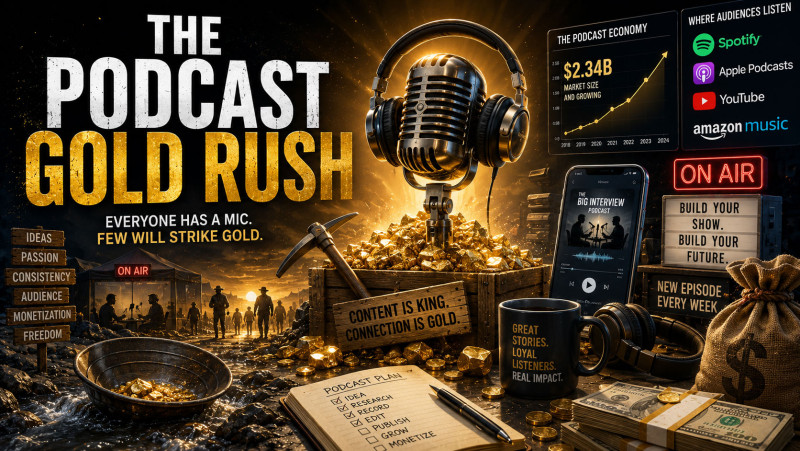
Podcasting was once considered a niche corner of the internet.
A person with a microphone, a laptop, and something interesting to say could publish an episode and reach an audience without needing a radio station, television network, or traditional publisher.
That simplicity helped podcasting grow.
Today, the industry looks very different.
Major media companies are investing in podcasts. Celebrities are launching shows. Advertisers are spending heavily on audio. Streaming platforms are competing for exclusive programs. Independent creators are building businesses around loyal audiences.
Podcasting has become an industry.
And wherever there is a rapidly growing audience, there is a gold rush.
From Hobby to Business
Early podcasting was driven largely by enthusiasts.
People created shows because they were passionate about technology, politics, comedy, sports, storytelling, or virtually anything else.
Production quality varied.
Audiences were often small.
Many creators earned little or nothing.
But the barrier to entry was remarkably low.
That remains one of podcasting's greatest strengths.
A creator does not need a television studio to start a show.
They need an idea, a microphone, recording software, and somewhere to publish the finished episode.
The technology became easier.
The audiences became larger.
Eventually, businesses noticed.
Why Companies Want Podcasts
Podcasts offer something that many forms of digital advertising struggle to provide.
Attention.
A listener may spend thirty minutes, an hour, or even several hours with the same host.
That creates an unusually intimate relationship.
Listeners hear a host's voice repeatedly.
They become familiar with their personality.
They learn their opinions.
They develop routines around particular shows.
For advertisers, this relationship can be valuable.
A recommendation from a trusted host can feel more personal than a conventional advertisement.
The Host Became the Brand
One of the most important characteristics of podcasting is the importance of personality.
The audience may not simply be listening to a topic.
They may be listening because they like the person talking about it.
This makes podcasting different from many traditional media formats.
A newspaper can replace one writer with another.
A television network can replace an anchor.
A podcast built around a particular personality can be much harder to separate from its host.
The host is often the product.
The relationship with the audience is the asset.
Long-Form Content Has Become Valuable Again
The internet spent years moving toward shorter content.
Short videos.
Short posts.
Short headlines.
Short attention spans.
Podcasting went in another direction.
Long conversations became popular.
Two people could talk for two hours.
An interview could continue without being forced into a five-minute segment.
A complicated subject could receive sustained attention.
That does not mean listeners always want long episodes.
It means there is clearly an audience for depth.
Podcasting demonstrated that people are still willing to spend significant amounts of time with content when they find it valuable.
The Rise of Video Podcasts
Podcasting is increasingly visual.
Many shows now record full video versions for platforms that specialize in video.
The audio remains important, but the recording can also become a visual product.
That creates more opportunities for clips.
A single conversation can produce:
A full audio episode.
A full video episode.
Short clips.
Social media posts.
Quote graphics.
News stories.
Behind-the-scenes content.
This dramatically increases the value of a single recording session.
Creators are no longer producing one piece of content.
They are producing a content ecosystem.
One Conversation Can Become Twenty Pieces of Content
The economics are attractive.
A two-hour interview can be divided into dozens of shorter moments.
One controversial statement can become a clip.
A funny exchange can become a social post.
A useful explanation can become a short video.
A memorable quote can become an image.
The full conversation remains available for people who want depth.
This creates a powerful production model.
Create once.
Distribute many times.
Social Media Became the Discovery Engine
Podcast platforms are not always where people discover new shows.
Social media increasingly performs that role.
A listener may encounter a thirty-second clip before ever hearing the full episode.
If the clip is interesting enough, they may search for the show.
This has changed how podcasts are produced.
Creators now have to think about moments that work outside the context of the full conversation.
The podcast is no longer only an audio experience.
It is also a source of social content.
The Competition for Attention Is Intense
Podcasting has grown dramatically, but the audience's time has not grown at the same rate.
People have limited hours.
They can listen while driving.
While exercising.
While cooking.
While working.
While commuting.
But they still have to choose.
A new show is competing against thousands of established programs.
It is also competing against music, audiobooks, video, social media, gaming, television, and everything else demanding attention.
Creating a podcast has become easier.
Getting people to care about it has not.
The Celebrity Podcast Explosion
Celebrities recognized the opportunity quickly.
Actors, athletes, musicians, comedians, journalists, entrepreneurs, and internet personalities began launching podcasts.
They already had something most new creators desperately need.
An audience.
A celebrity can announce a podcast and potentially attract millions of listeners immediately.
This creates a major advantage.
But celebrity does not automatically produce a successful podcast.
Podcast audiences often develop strong relationships with hosts.
A famous person who appears disconnected or overly scripted may struggle to create the intimacy that makes the format work.
Authenticity Became a Selling Point
Podcasting became popular partly because it often feels less polished than traditional media.
Hosts can speak casually.
Guests can tell longer stories.
Mistakes can remain in the final recording.
Conversations can wander.
That imperfection can create authenticity.
But as podcasting becomes more commercial, authenticity itself can become a marketing strategy.
A highly produced show may intentionally appear informal.
A carefully planned conversation may be presented as spontaneous.
The more valuable authenticity becomes, the more difficult it becomes to determine when it is genuine.
Advertising Is Becoming More Sophisticated
Podcast advertising has evolved beyond simple commercial breaks.
Hosts may personally recommend products.
Companies may sponsor entire shows.
Brands may partner with creators.
Advertisements can be targeted based on audience characteristics.
Some programs integrate sponsors into the conversation itself.
This can make advertising feel natural.
It can also create a challenge.
The closer an advertisement gets to the host's personal identity, the more important transparency becomes.
Listeners should be able to distinguish between genuine recommendations and paid promotions.
The Subscription Opportunity
Advertising is not the only business model.
Many creators offer premium memberships.
Subscribers may receive:
Bonus episodes.
Ad-free listening.
Exclusive interviews.
Early access.
Private communities.
Behind-the-scenes content.
The model allows creators to earn directly from their most dedicated listeners.
It can also strengthen the relationship between creator and audience.
But subscriptions introduce another challenge.
Every creator is competing for the same monthly budget.
As more digital services become subscription-based, consumers become increasingly selective.
Exclusive Deals Changed the Industry
Streaming companies recognized that exclusive podcasts could attract and retain subscribers.
This led to major investments in prominent creators and shows.
For platforms, exclusivity can create differentiation.
If a particular program is available only through one service, fans have a reason to subscribe.
For creators, large deals can provide financial security.
But exclusivity can also fragment the podcast ecosystem.
Listeners may not want another subscription.
They may not want to change platforms.
They may simply abandon a show rather than follow it somewhere else.
The Independent Creator Still Has an Advantage
Despite the rise of large media companies, independent podcasters remain important.
They can move quickly.
They can experiment.
They can serve niche audiences.
They do not need approval from executives.
They can change formats based on listener feedback.
A show with a few thousand highly engaged listeners can sometimes become a sustainable business.
This is one of podcasting's most interesting characteristics.
Massive audiences are not always necessary.
A loyal audience can be enough.
Niche Audiences Can Be Extremely Valuable
Traditional media often needed broad audiences.
A television program had to attract enough viewers to justify its production and distribution costs.
Podcasting can operate differently.
A show about a highly specific profession, hobby, interest, or community may attract a relatively small audience.
But if those listeners are deeply engaged, the audience can still have substantial value.
Niche podcasting demonstrates an important principle of the internet.
A small audience is not necessarily an insignificant audience.
Podcasting Is Becoming More Professional
As money enters the industry, production standards rise.
Professional studios are becoming more common.
Audio engineering is more sophisticated.
Video production is increasingly important.
Research teams help prepare interviews.
Producers coordinate guests.
Marketing campaigns promote major releases.
The casual podcast still exists.
But successful shows increasingly resemble professional media operations.
The difference is that the professional studio can now be built around a creator rather than a traditional broadcasting institution.
The Problem With Too Much Investment
The gold rush has a downside.
When an industry appears to be growing rapidly, companies can overestimate how much money is available.
They may sign expensive deals.
Build large production teams.
Launch numerous shows.
Spend heavily on promotion.
Then discover that audience growth is slower than expected.
Podcasting is not immune to the same cycles that affect other media industries.
Investment can create growth.
Too much investment can create unrealistic expectations.
The Podcast Bubble Question
The industry has experienced periods of intense optimism.
Podcasting was described as the future of audio.
Then the focus shifted toward video.
Then toward creator businesses.
Then toward subscriptions.
Then toward exclusive content.
The underlying medium remains strong.
But individual business models can change quickly.
The danger is assuming that every podcast can become a huge commercial success.
Most cannot.
There are simply too many shows competing for attention.
Discoverability Is the Biggest Challenge
Creating a podcast is easy.
Finding it is difficult.
A listener may never discover an excellent show because it is buried beneath thousands of alternatives.
This creates a growing importance for recommendation systems.
Platforms decide which shows are promoted.
Search results determine which programs are visible.
Social algorithms influence which clips spread.
Influencers can introduce audiences to new creators.
Podcasting may have begun as a decentralized publishing system.
Its discovery layer is becoming increasingly concentrated.
Artificial Intelligence Will Change Podcasting
AI is likely to affect almost every part of podcast production.
Creators can use AI to generate transcripts.
Translate episodes.
Create summaries.
Find interesting moments.
Produce clips.
Improve audio.
Generate captions.
Analyze audience behavior.
Create multiple language versions.
These tools can dramatically reduce production costs.
But they also create new questions.
If AI can generate endless audio content, how much content will listeners actually want?
And how will audiences distinguish human conversations from synthetic ones?
Synthetic Voices Could Change the Medium
Voice generation technology is becoming increasingly sophisticated.
That creates useful possibilities.
Podcasts could become available in multiple languages.
Creators could make content more accessible.
Listeners could customize how information is presented.
But voice cloning introduces serious concerns.
A person's voice can become part of their identity.
Using it without permission could create confusion and abuse.
The more realistic synthetic audio becomes, the more important authenticity and disclosure will become.
The Future May Be About Trust
Podcasting's greatest advantage is also its greatest vulnerability.
People trust hosts.
They listen because they believe they know the person behind the microphone.
If that relationship becomes filled with undisclosed sponsorships, manipulated clips, synthetic voices, fabricated guests, or misleading information, trust can disappear quickly.
The successful podcast of the future may therefore be the one that protects its relationship with the audience.
Not necessarily the one with the largest production budget.
Podcasts Can Influence Culture
Podcasts are no longer simply entertainment.
They influence political discussions.
Shape cultural conversations.
Launch books.
Promote businesses.
Create celebrities.
Introduce new ideas.
Give experts direct access to audiences.
A long-form conversation can sometimes reach people more effectively than a traditional interview because listeners have time to develop familiarity with the speaker.
That makes podcasting culturally significant.
It is becoming part of the infrastructure through which people understand the world.
The Risk of Endless Commentary
As podcasting grows, there is also a danger of producing too much commentary.
Every event can generate reactions.
Every controversy can produce multiple episodes.
Every news story can become a discussion.
The result can be an endless cycle of people talking about other people talking.
Information does not necessarily increase simply because the number of conversations increases.
Sometimes the audience needs original reporting.
Sometimes it needs analysis.
Sometimes it needs entertainment.
The distinction matters.
The Creator Economy Is Expanding
Podcasting fits naturally into the broader creator economy.
Creators can combine:
Podcasts.
Newsletters.
Videos.
Courses.
Books.
Events.
Merchandise.
Memberships.
Sponsorships.
Communities.
The podcast can become the central hub connecting all of these activities.
This is one reason businesses are interested in the medium.
A successful podcast can be more than a show.
It can become an entire brand.
The Gold Rush Will Not Last Forever
Every media boom eventually matures.
The number of podcasts may continue growing.
But the number of shows capable of attracting enormous audiences will remain limited.
Some creators will become major media personalities.
Some shows will disappear.
Some companies will make profitable investments.
Others will spend too much chasing audiences that never arrive.
That is not necessarily a sign that podcasting is failing.
It is a sign that the industry is becoming more mature.
The Best Podcasts Still Do Something Simple
Despite all the technology and business strategies surrounding the industry, successful podcasting often comes down to a simple idea.
Give people a reason to listen.
Make them laugh.
Teach them something.
Tell them a story.
Introduce them to someone fascinating.
Help them understand an issue.
Give them a conversation they cannot get elsewhere.
The format may change.
The platforms may change.
The advertising models may change.
AI may transform production.
But the fundamental relationship remains between a voice and a listener.
The Real Value Is the Relationship
The podcast gold rush is ultimately not about microphones, platforms, advertising deals, or celebrity names.
It is about attention.
More specifically, sustained attention.
A listener who spends an hour with the same creator is giving that creator something extremely valuable.
Trust.
Time.
Habit.
That relationship cannot be manufactured indefinitely through algorithms or marketing budgets.
It has to be earned.
The podcast industry may become more corporate.
It may become more automated.
It may become more visual.
It may become increasingly integrated with streaming platforms.
But the strongest shows will probably remain those that make listeners feel like they are part of something rather than simply consuming another piece of content.
The gold may not be in the podcast itself.
It may be in the relationship built around it.