



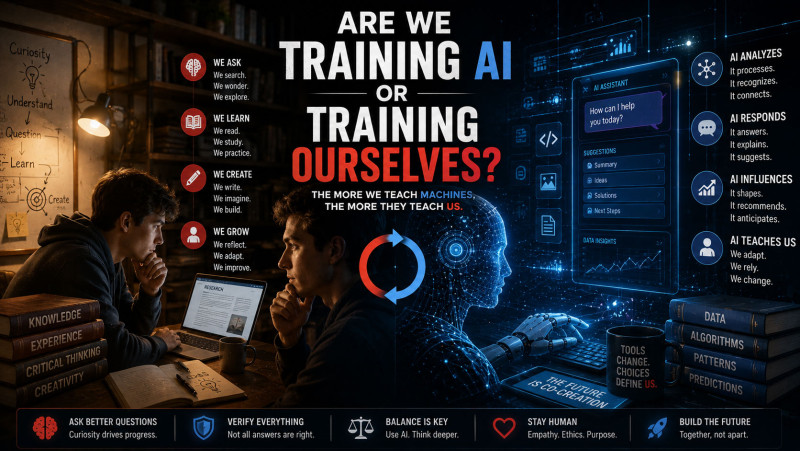
Artificial intelligence is usually described as something humans are training.
We feed models enormous amounts of information, give them examples, correct their mistakes, evaluate their responses, and continually improve the systems that sit behind them. The basic idea seems straightforward: humans teach machines how to recognize patterns, solve problems, communicate, and increasingly perform tasks that once required human intelligence.
But there is another side to the relationship that receives much less attention.
While we are training artificial intelligence, artificial intelligence is quietly training us.
It is changing how we search for information, how we write, how we learn, how we make decisions, how we solve problems, and even how much effort we are willing to tolerate before asking a machine to do something for us. The more capable these systems become, the more likely we are to adapt our own behavior around them.
That creates a much more interesting question than whether AI will replace particular jobs.
What happens when the tools we build begin changing the people who use them?
We Have Always Built Tools That Change Us
Technology has never been completely separate from human behavior.
The invention of writing changed how people remembered information. Printed books changed how knowledge was preserved and distributed. The calculator changed how people approached arithmetic. Search engines changed how people found information. Smartphones changed how people communicated and navigated the world.
Each of these technologies removed certain forms of effort while creating new habits.
Most people no longer memorize phone numbers because their devices remember them. Few people need to memorize an entire road network because navigation software can provide directions. Students can look up facts in seconds that previous generations might have needed to remember.
None of this is necessarily bad.
In many cases, technology allows us to spend less time on mechanical tasks and more time on things that require judgment or creativity. The important question is what happens when the technology becomes capable of handling increasingly complex forms of mental work.
AI is different because it is moving beyond storing or retrieving information. It can generate, interpret, summarize, explain, compare, and recommend.
That brings the relationship much closer to thinking itself.
Search Changed What It Meant to Know
The rise of search engines already changed our relationship with knowledge.
You did not necessarily need to remember a fact if you knew how to find it. Instead of carrying an encyclopedia around in your head, you could remember the question and trust the internet to provide the answer.
That was a major shift.
AI assistants take the same idea further. You no longer necessarily need to know where to look, which website to visit, or even exactly what words to type into a search engine. You can describe a problem in ordinary language and ask the system to organize the information for you.
This is enormously convenient.
But convenience changes behavior.
When finding an answer becomes almost effortless, people may spend less time learning how the answer was discovered. They may also become less comfortable sitting with uncertainty or working through a difficult problem before asking for help.
The distinction between knowing something and knowing how to obtain something becomes increasingly important.
Easy Answers Can Create an Illusion of Understanding
One of AI's greatest strengths is its ability to make complicated information feel simple.
Ask about a historical event and it can provide a readable explanation. Ask about a programming concept and it can break the subject into manageable pieces. Give it a technical document and it can summarize the main points in seconds.
That accessibility is valuable, particularly for people who might otherwise struggle to understand difficult material.
But there is a subtle danger.
Understanding an explanation is not always the same as understanding the subject.
A student may read an AI-generated explanation of a mathematical concept and feel that it makes sense, yet struggle when asked to solve a new problem without assistance. A developer may receive a working piece of code without developing a deeper understanding of why the code works. Someone researching a complex issue may receive a polished summary without ever examining the evidence behind it.
AI can dramatically shorten the distance between a question and an explanation.
It cannot automatically shorten the distance between an explanation and genuine understanding.
That part still requires the human mind to do some work.
Education Is Where the Difference Becomes Obvious
This tension is particularly visible in education.
AI can be an extraordinary tutor. A student can ask the same question in several different ways, request simpler explanations, receive examples, practice with generated exercises, and get immediate feedback. A teacher can use AI to create materials, identify areas where students are struggling, or develop alternative ways of explaining difficult concepts.
Used this way, AI can make learning more accessible.
The problem begins when assistance replaces the learning process itself.
If a student asks AI to write an essay, solve every problem, or complete every assignment, the final product may look impressive while the student's actual knowledge remains unchanged. The technology has completed the task, but the student has missed the experience of struggling through it.
That struggle matters more than we sometimes admit.
Learning often happens when an answer does not immediately appear. You make a mistake, try another approach, discover why the first one failed, and gradually develop an instinct for solving similar problems in the future.
AI can remove unnecessary frustration.
It can also remove useful frustration.
The challenge for education will be learning the difference.
The Future of Expertise Could Change
Professional expertise is usually built through repetition.
A young programmer encounters bugs and learns how to diagnose them. A lawyer reads difficult cases and gradually develops legal intuition. A designer produces hundreds of imperfect concepts and slowly develops a sense of proportion, hierarchy, and taste. A writer produces terrible first drafts and eventually learns what makes a paragraph work.
Much of this development comes from doing the work repeatedly.
AI can accelerate productivity by handling some of these tasks.
That is the obvious benefit.
But it raises a less obvious problem: how do people develop expertise if the machine handles the beginner-level work that once gave them practice?
A junior employee who uses AI to solve every problem may become productive quickly. They may also reach a difficult situation later without having developed the instincts that normally come from years of working through smaller problems.
This does not mean people should stop using AI.
It means organizations and educators may need to rethink how expertise is developed in an AI-assisted world.
We May Start Writing for Machines
AI is also changing the way people communicate.
Users are learning how to phrase prompts more effectively, provide context, structure requests, and specify constraints. In other words, humans are adapting their communication to the way machines process language.
That is not necessarily a bad thing.
Learning to communicate clearly is useful regardless of whether the audience is a person or an AI system.
But as AI-generated writing becomes more common, another transformation may occur. People may gradually begin adopting the patterns that AI systems produce well. Certain phrases, structures, tones, and styles could become increasingly standardized.
The result could be a strange paradox.
AI may help everyone write more clearly while also making everyone's writing sound a little more alike.
Professional communication could become smoother, more polished, and more efficient, while some of the imperfections that make human writing distinctive become less common.
The question is whether we will value originality enough to preserve it.
Creativity Could Become Faster — and More Predictable
AI can generate ideas at extraordinary speed.
A writer can request dozens of possible concepts. A designer can explore multiple directions. A business owner can ask for different strategies. A filmmaker can brainstorm story premises. A developer can ask for several approaches to solving the same technical problem.
This abundance can be incredibly useful.
But creativity has historically involved more than generating options. It also involves boredom, experimentation, failure, curiosity, and unexpected connections.
Some ideas appear because someone spends an afternoon exploring a problem without knowing exactly where they are going. Others emerge from a mistake that initially seemed useless.
AI is extremely good at producing possibilities.
Humans still have to decide which possibilities are worth pursuing.
That distinction may become increasingly important as generated content becomes abundant.
When everyone can produce ten acceptable ideas in seconds, the valuable skill may no longer be generating ideas. It may be recognizing the one idea that deserves attention.
What Happens to Boredom?
There is another human experience that technology has gradually reduced: boredom.
People once spent considerable amounts of time doing nothing.
They waited.
They walked.
They stared out windows.
They sat in cars.
They traveled without constant entertainment.
Those empty moments sometimes produced nothing at all. But sometimes they produced thoughts, questions, memories, and ideas that would never have appeared in a constantly stimulated environment.
AI gives us another way to fill those moments.
If we are curious, we can ask a question. If we are stuck, we can ask for ideas. If we are unsure what to do next, we can ask for recommendations.
That can make life more productive.
It may also make it harder to experience the kind of mental quiet in which completely unplanned thoughts emerge.
We do not yet know how significant that tradeoff will be.
AI Can Make Us Better Thinkers
The story does not have to be pessimistic.
AI can also be used to strengthen human reasoning.
Instead of asking it to make every decision, a person can ask it to challenge an idea. Instead of requesting a conclusion, they can ask for competing explanations. Instead of accepting the first answer, they can ask what evidence would prove that answer wrong.
That changes the role of AI.
It becomes less like an answer machine and more like an intellectual sparring partner.
A person preparing for an important decision could ask AI to identify weaknesses in their reasoning. A writer could ask it to critique an argument. A student could ask for increasingly difficult questions rather than simply requesting the answers.
Used this way, AI can expose people to perspectives they might not have considered on their own.
The difference is not the technology.
It is the relationship between the person and the technology.
The Greatest Risk May Be Automatic Agreement
One of the easiest mistakes to make with AI is assuming that confidence equals correctness.
AI systems can produce remarkably polished explanations. They can organize information clearly and communicate with an authority that makes uncertainty difficult to notice.
That creates a new challenge.
In the past, finding information often required enough effort that people naturally encountered multiple sources. With AI, a single question can produce a complete-looking answer almost instantly.
The convenience is extraordinary.
So is the temptation to stop there.
As AI becomes better at sounding convincing, humans may need to become better at questioning what they receive. Verification, source awareness, context, and intellectual humility could become more important rather than less.
The easier information becomes to obtain, the more important it may become to know when not to trust it immediately.
Work Is Changing in the Same Way
The workplace is already becoming an environment where humans and AI work together.
Employees use AI to draft emails, summarize meetings, analyze documents, write code, prepare presentations, research markets, generate ideas, and automate repetitive processes.
For experienced professionals, these tools can be powerful amplifiers.
For inexperienced workers, the effects are more complicated.
Many traditional career paths involved learning through relatively simple tasks before gradually taking on more difficult responsibilities. If AI handles many of those early tasks, organizations may need to find new ways for employees to develop judgment.
The problem is not that AI makes people less capable.
The problem is that capability still has to be developed somehow.
If machines perform the practice, humans may need new forms of practice.
The Question of Human Judgment
This may be where the future of work becomes especially interesting.
As AI becomes better at generating answers, humans may spend more time deciding whether those answers are actually useful.
That requires context.
A machine might produce a technically correct recommendation that makes no sense for a particular customer. It might generate a beautiful marketing campaign that conflicts with a company's reputation. It might suggest a solution that works in theory but is impossible to implement within real-world constraints.
Judgment exists precisely because reality is more complicated than a prompt.
The more capable AI becomes, the more valuable contextual judgment may become.
AI Could Change What We Consider a Skill
When technology makes a task easy, society tends to stop treating that task as a special skill.
Few people are impressed by someone who can perform complicated arithmetic without a calculator.
Being able to navigate a city without a map is no longer considered essential knowledge.
Something similar may happen with certain forms of writing, coding, research, and analysis.
Skills that once required years of practice may become partially automated.
That does not necessarily make them worthless.
It changes what we expect humans to contribute.
If AI can produce the first draft, perhaps the human contribution becomes direction, judgment, editing, originality, and accountability.
If AI can analyze thousands of documents, perhaps the human role becomes deciding which question is worth asking.
Technology changes the division of labor.
AI may simply move that boundary deeper into intellectual work.
We Are Creating a Feedback Loop
The relationship becomes even more complicated when we consider how AI systems learn.
Humans create information.
AI systems learn patterns from information.
AI generates new information.
Humans read, watch, share, and modify that information.
Some of it then becomes part of the broader information environment from which future systems may learn.
At the same time, humans change their behavior because AI exists.
They write differently.
Search differently.
Work differently.
Learn differently.
That means future AI systems may be trained on information created by people who were themselves influenced by earlier AI systems.
The line between human-generated and machine-influenced culture could become increasingly difficult to draw.
What Happens When the Internet Becomes More Synthetic?
The internet was originally built largely from human-created material.
That assumption is becoming less reliable.
AI can now produce enormous quantities of text, images, audio, video, and software.
Some of that material is useful.
Some is low quality.
Some is created primarily to attract attention.
And some may eventually be consumed by other AI systems rather than humans.
This raises an important challenge for the future of digital knowledge.
If generated material becomes a large part of the information environment, maintaining reliable connections to original sources and real-world evidence will become increasingly important.
The question will not simply be whether information exists.
It will be whether we can still determine where it came from.
Human Taste May Become More Valuable
AI can generate an enormous amount of competent material.
That could make competence cheaper.
If almost anyone can produce a decent article, image, presentation, advertisement, or software prototype, then producing something merely acceptable may no longer provide much competitive advantage.
Taste becomes more important.
Knowing what to remove.
Knowing what feels unnecessary.
Knowing what is genuinely interesting.
Knowing what fits a particular audience.
Knowing when something technically impressive is actually boring.
These are difficult qualities to reduce to simple instructions.
AI can generate possibilities.
Humans still have to decide what deserves to exist.
We Should Not Romanticize Human Effort
There is an understandable reaction to AI that says people should continue doing everything manually because the struggle itself is valuable.
That is not realistic.
Technology has always removed unnecessary work.
We did not lose something essential when spreadsheets replaced manual calculations. We did not become less intelligent because GPS made navigation easier. We did not abandon creativity because digital editing tools replaced physical film processing.
The goal should not be to preserve every form of human effort.
The goal should be to preserve meaningful human capability.
There is a difference.
If a machine can remove an exhausting, repetitive task, that is usually a benefit. If it removes the opportunity to develop a skill that humans still need, the tradeoff deserves more thought.
We May Need to Decide What Not to Automate
This could become one of the most important conversations of the AI era.
Some activities are valuable not only because of their outcomes but because of the experience of doing them.
Writing a personal letter can matter even when AI could write a better one.
Learning to play an instrument can be meaningful even when a computer can generate perfect music.
Drawing something badly can still be valuable because the person is learning to see and express.
Working through a difficult problem can build confidence in a way that simply receiving the solution cannot.
Efficiency is not the only measure of value.
Sometimes the process matters.
AI Could Give Humans More Room to Think
There is also a much more optimistic possibility.
If AI handles enough routine cognitive work, people may have more time to focus on the parts of their work that require deeper thought.
Researchers could explore more ideas.
Developers could spend less time on repetitive implementation and more time designing systems.
Writers could experiment with more ambitious projects.
Small businesses could access analytical capabilities that were previously available only to large organizations.
Students could receive personalized help whenever they need it.
Used carefully, AI could expand access to capabilities that were once expensive or difficult to obtain.
That would be a meaningful technological achievement.
But it depends on whether humans remain actively involved.
The Best Future May Be Collaborative
The most useful way to think about AI may not be as a replacement for human intelligence or as a magical extension of it.
It may be better understood as a collaborator.
The machine can generate possibilities, process enormous quantities of information, identify patterns, and perform repetitive tasks at incredible speed.
The human can provide context, values, judgment, experience, responsibility, and purpose.
Neither side needs to do everything.
The goal is to combine their strengths.
That requires knowing when to trust the machine, when to challenge it, and when to put it aside completely.
We Are Training Each Other
This brings us back to the original question.
Are we training AI or training ourselves?
The uncomfortable answer is both.
We train AI with human knowledge, language, creativity, and behavior. At the same time, AI influences how humans work, communicate, learn, search, create, and make decisions.
The relationship is becoming a feedback loop.
Machines learn from us.
We adapt to machines.
Those adaptations influence the information environment.
And that environment shapes the next generation of AI.
The consequences will extend far beyond productivity.
They will affect education, culture, creativity, professional development, communication, and the way people understand their own capabilities.
The Real Question Is What We Continue to Practice
AI will continue becoming more capable. That part is difficult to stop.
The more interesting question is what humans choose to do with that capability.
We could use AI to avoid every difficult task and gradually become dependent on systems that think on our behalf. Or we could use it to explore ideas more deeply, challenge our assumptions, learn faster, and spend more time on problems that genuinely require human judgment.
The difference may not be visible in the technology itself.
It will be visible in our habits.
If we use AI to replace curiosity, we may become less curious. If we use it to replace learning, we may become less knowledgeable. If we use it to replace every creative decision, we may eventually forget what our own creative instincts feel like.
But if we use it as a tool for exploration, criticism, experimentation, and deeper thinking, the outcome could be very different.
AI is learning from humanity.
At the same time, humanity is learning how to live with AI.
That second process may ultimately matter even more.
Because the future will not be determined only by how intelligent our machines become. It will also be determined by what happens to human curiosity, judgment, creativity, independence, and responsibility as those machines become part of everyday life.
The question, then, is not simply whether we are training AI.
We are.
The more important question is whether, while teaching machines to become more capable, we are also teaching ourselves how to remain capable without them — and how to become better because of them rather than merely more dependent on them.