



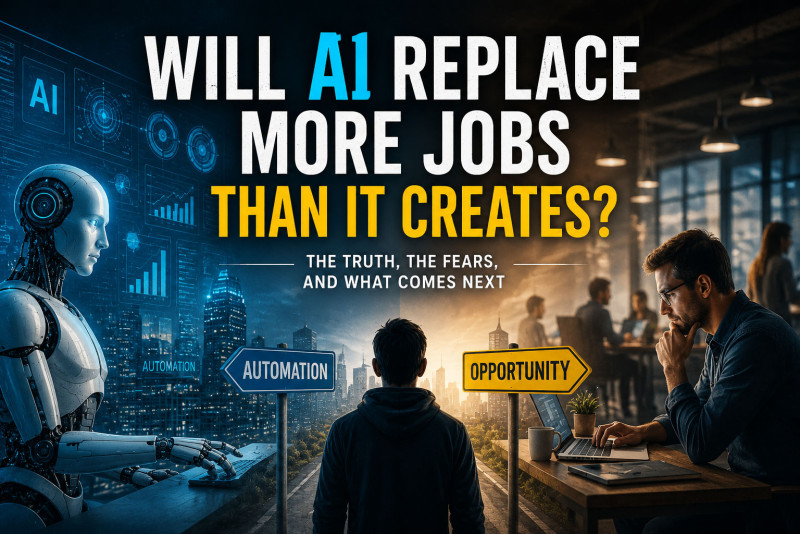
For every technological revolution in history, one question has appeared before all others:
Will this innovation create prosperity, or will it eliminate livelihoods?
Artificial intelligence is no exception.
From boardrooms to classrooms, factories to software companies, AI has become the defining technology of our generation. Companies are investing billions, governments are drafting regulations, and workers across nearly every industry are wondering what the future holds.
Supporters argue that AI will unlock unprecedented productivity and create entirely new industries.
Critics warn that automation is advancing faster than society can adapt, threatening millions of jobs that once seemed secure.
The truth may lie somewhere in between.
Why People Are Worried
Previous waves of automation primarily affected physical labor.
Machines transformed agriculture.
Robots reshaped manufacturing.
Software automated repetitive office tasks.
AI is different because it targets something previously thought to be uniquely human:
- Writing
- Research
- Design
- Programming
- Customer service
- Data analysis
- Decision support
- Content creation
For the first time, knowledge workers are experiencing the same uncertainty factory workers faced decades ago.
Jobs once considered safe are now being partially or fully automated.
Examples include:
- Customer support representatives being replaced by AI assistants.
- Junior copywriters competing with AI-generated content.
- Graphic designers facing AI image generation tools.
- Software developers using AI coding assistants that dramatically increase productivity.
- Researchers relying on AI to summarize information that once required hours of manual work.
The concern isn't whether AI can perform these tasks.
The concern is how many people will still be needed to perform them.
The Optimistic View
Supporters of AI point to history.
They argue that every major technological disruption has ultimately created more opportunities than it destroyed.
Consider a few examples:
The Industrial Revolution
Machines replaced countless manual labor jobs.
At the same time, entirely new industries emerged, creating millions of positions that had never existed before.
The Computer Revolution
Computers automated bookkeeping, calculations, and administrative work.
Yet they also created:
- Software development
- Cybersecurity
- Digital marketing
- E-commerce
- Cloud computing
- Mobile application development
Millions of modern careers would not exist without computers.
The Internet Era
The internet disrupted newspapers, retail stores, and traditional media.
However, it also created:
- Social media management
- Content creation
- Search marketing
- Influencer businesses
- Streaming platforms
- Online education
Supporters believe AI represents another chapter in this pattern.
They expect entirely new professions to emerge, including:
- AI trainers
- AI auditors
- Prompt engineers
- Human-AI collaboration specialists
- AI ethics consultants
- Synthetic media producers
- AI infrastructure operators
According to this perspective, AI is not eliminating work.
It is changing the nature of work.
The Pessimistic View
Critics argue that AI is fundamentally different from previous technologies.
Unlike earlier innovations, AI can affect both manual and intellectual labor simultaneously.
This creates several concerns.
The Speed Problem
Historically, societies had decades to adapt to technological change.
AI improvements now occur within months.
Workers may lose jobs faster than they can retrain for new ones.
The Scale Problem
A single AI system can perform work previously handled by hundreds or thousands of people.
Businesses naturally seek efficiency.
If fewer employees are required to achieve the same results, many positions may disappear permanently.
The Entry-Level Problem
Every profession relies on beginners.
Junior employees gain experience before becoming experts.
If AI increasingly handles entry-level tasks, future generations may struggle to gain the skills needed for advanced roles.
This concern is especially visible in:
- Software development
- Content creation
- Marketing
- Research
- Customer support
The Concentration Problem
The companies building advanced AI systems are among the largest corporations in history.
Critics worry that AI could concentrate wealth and influence into fewer hands than ever before.
If productivity rises while employment falls, the economic benefits may not be distributed evenly.
What the Data Currently Shows
The reality today is more nuanced than either extreme.
Across many industries, AI is not fully replacing workers.
Instead, it is changing how work is performed.
Many organizations are using AI to:
- Increase employee productivity.
- Reduce repetitive tasks.
- Improve decision-making.
- Accelerate research.
- Generate first drafts and prototypes.
In these environments, workers are becoming supervisors and editors rather than creators of every output.
However, there are already signs of workforce reductions in some sectors.
Companies increasingly cite AI-driven efficiencies when discussing hiring plans, restructuring efforts, and productivity targets.
The long-term impact remains uncertain because AI adoption is still in its early stages.
The Real Question Few People Are Asking
The debate often focuses on whether AI will replace jobs.
A more important question may be:
Will AI replace tasks faster than it replaces entire professions?
Most jobs consist of many responsibilities.
AI may automate some tasks while leaving others untouched.
For example:
- A lawyer does more than review documents.
- A teacher does more than deliver information.
- A doctor does more than analyze symptoms.
- A developer does more than write code.
In many cases, AI is eliminating portions of jobs rather than entire occupations.
This distinction could determine whether AI becomes a tool that empowers workers or a force that replaces them.
Preparing for an AI-Driven Future
Regardless of which side proves correct, several trends appear increasingly likely.
Workers who adapt to AI will have advantages over those who ignore it.
Skills that may become more valuable include:
- Critical thinking
- Creativity
- Communication
- Leadership
- Problem-solving
- Strategic decision-making
- Human relationship management
Meanwhile, highly repetitive tasks are likely to face increasing automation pressure.
The future may belong to professionals who learn how to work alongside AI rather than compete against it.
The Bigger Picture
History teaches us that technological revolutions rarely unfold exactly as predicted.
Some jobs disappear.
Others evolve.
Entirely new industries emerge.
Artificial intelligence will almost certainly replace certain roles and tasks.
It will almost certainly create new opportunities as well.
The unanswered question is whether those opportunities will arrive quickly enough, at sufficient scale, and in the right places to offset the disruption.
For now, no one knows the final outcome.
What is clear is that AI is no longer a future technology.
It is already reshaping the way people work, create, learn, and earn.
The future of employment may not be determined by whether AI replaces humans.
It may be determined by how effectively humans learn to work with AI.