



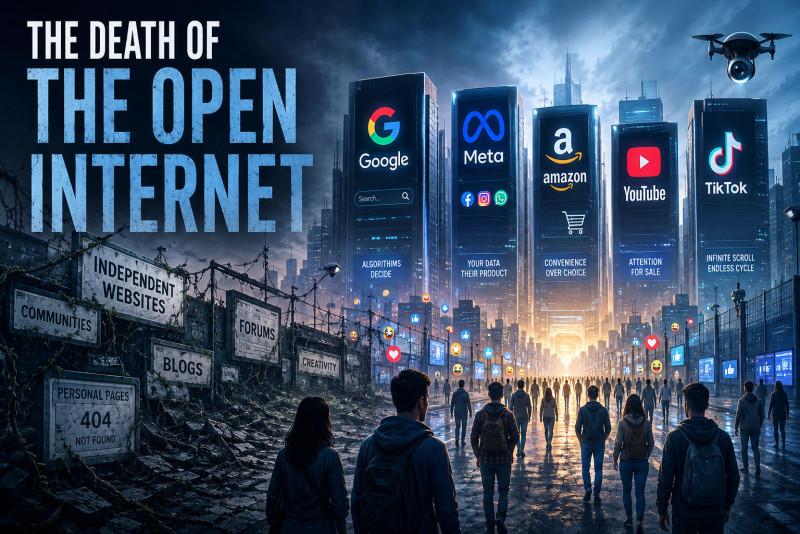
For decades, the internet was celebrated as one of humanity's greatest equalizers.
A student in a dorm room could launch a website and compete with established corporations. Independent creators could build audiences without needing permission from media companies. Small businesses could reach global markets without massive advertising budgets.
The internet was messy, decentralized, and unpredictable.
That was precisely what made it powerful.
Today, many people are beginning to ask a difficult question:
Is the open internet disappearing?
While the web still appears vast and diverse on the surface, a growing number of users, creators, and developers believe the internet is becoming increasingly centralized, controlled, and dependent on a handful of powerful platforms.
The internet has not disappeared.
But the internet many people grew up with is rapidly changing.
What Was the Open Internet?
The early internet was built around a simple idea:
Anyone could create something and publish it.
Success was never guaranteed, but the barriers to entry were remarkably low.
The open internet encouraged:
- Independent websites.
- Personal blogs.
- Discussion forums.
- Open-source communities.
- Small online businesses.
- Niche communities.
- User-owned content.
People moved freely between websites rather than spending most of their time inside a few platforms.
The web felt like a collection of interconnected destinations rather than a handful of digital megacities.
The Rise of Platform Dominance
Over time, convenience began to replace openness.
Large technology companies created platforms that made publishing, sharing, and discovering content easier than ever.
Users embraced these services because they offered:
- Simplicity.
- Speed.
- Large audiences.
- Built-in communities.
- Mobile accessibility.
The result was a dramatic shift.
Instead of building websites, people created social media profiles.
Instead of owning audiences, creators rented access to them.
Instead of visiting independent websites, users increasingly consumed information through centralized feeds.
Today, a significant portion of online activity occurs inside a relatively small number of platforms.
For many users, the internet has effectively become:
- Social media apps.
- Video platforms.
- Messaging platforms.
- Large marketplaces.
- AI-powered interfaces.
Everything else exists outside the mainstream flow of attention.
Search Is No Longer What It Used to Be
Search engines once acted as gateways to the broader web.
Their purpose was to help users discover websites.
Increasingly, search platforms are becoming destinations themselves.
Modern search experiences now:
- Answer questions directly.
- Summarize information.
- Display AI-generated responses.
- Reduce the need to visit source websites.
- Prioritize established authorities.
For users, this may feel more efficient.
For independent publishers, it can be devastating.
Every answer provided directly by a search engine is one less opportunity for a website to attract visitors, subscribers, and customers.
The web becomes less discoverable when fewer people leave the platforms designed to guide them.
The Algorithmic Internet
Many people believe they choose what they see online.
In reality, algorithms increasingly make those decisions.
Every day, algorithms influence:
- News consumption.
- Entertainment choices.
- Product recommendations.
- Social interactions.
- Search visibility.
These systems are optimized to maximize engagement, retention, and revenue.
They are not necessarily optimized for diversity, openness, or discovery.
As a result:
- Large creators often become larger.
- Popular content becomes more visible.
- Independent voices struggle for attention.
- New websites face significant obstacles.
The internet remains technically open, but visibility is increasingly controlled by systems that few people fully understand.
The Disappearance of Independent Spaces
One of the most noticeable changes online is the decline of independent communities.
Many internet users remember a time when:
- Forums thrived.
- Personal blogs were common.
- Hobby websites flourished.
- Independent communities built their own identities.
Today, many of those spaces have either disappeared or migrated to centralized platforms.
While platforms offer convenience, they also create dependence.
Communities no longer control:
- Their infrastructure.
- Their visibility.
- Their policies.
- Their long-term future.
When a platform changes its rules, entire communities can be affected overnight.
AI and the Next Stage of Centralization
Artificial intelligence may accelerate this trend.
AI-powered assistants are increasingly becoming intermediaries between users and information.
Instead of searching multiple websites, users ask a single system for answers.
Instead of exploring sources directly, information is filtered and summarized before it reaches the user.
This creates new challenges:
- Fewer visits to independent websites.
- Greater concentration of information power.
- Reduced visibility for smaller publishers.
- Increased dependence on AI providers.
The concern is not that AI exists.
The concern is that a small number of organizations may become gatekeepers for how knowledge is discovered and distributed.
Why This Matters
Some may argue that users simply follow the most convenient tools.
And they are right.
Convenience often wins.
However, openness has value that is easy to overlook.
An open internet encourages:
- Innovation.
- Competition.
- Diverse viewpoints.
- Independent journalism.
- Creative experimentation.
- Entrepreneurial opportunities.
When visibility becomes concentrated, opportunities become concentrated as well.
The next great creator, developer, writer, or entrepreneur may struggle to be discovered regardless of talent or quality.
Can the Open Internet Be Saved?
The future is not predetermined.
There are still signs of resistance against increasing centralization.
Growing interest in:
- Open-source software.
- Independent publishing.
- Self-hosted platforms.
- Decentralized technologies.
- Direct audience ownership.
- Community-driven networks.
suggests that many people still value an internet that is not controlled by a small number of gatekeepers.
The challenge is that openness often requires effort, while centralized platforms offer convenience.
The battle between those two forces will likely shape the next decade of the internet.
The Internet We Choose
The internet did not become centralized overnight.
It evolved in response to user behavior, business incentives, and technological progress.
The same forces that transformed the web can shape its future.
The question is no longer whether the internet is changing.
That much is obvious.
The real question is whether the future internet will remain a place where independent creators, developers, publishers, and communities can thrive—or whether it will become a collection of controlled ecosystems where visibility, influence, and opportunity are increasingly concentrated in the hands of a few.
The answer may depend less on technology and more on the choices users make every day.