



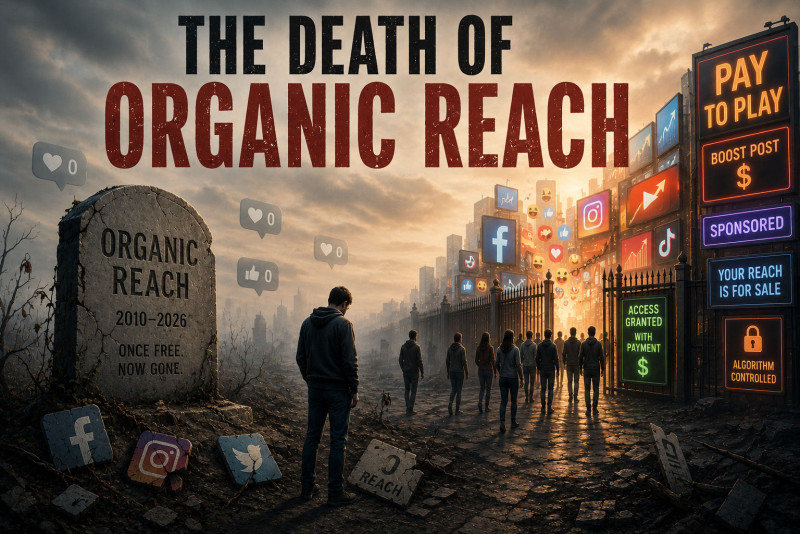
Not long ago, publishing something online felt like an opportunity.
A blog post, video, photo, or thoughtful comment had a genuine chance of finding an audience. You didn't need a large marketing budget or a team of growth experts. If your content resonated with people, it could spread naturally through shares, recommendations, and word of mouth.
That phenomenon became known as organic reach.
For many creators, businesses, and publishers, organic reach was the internet's greatest equalizer.
Today, many believe it is disappearing.
The internet still offers more ways to publish than ever before, but getting discovered has become increasingly difficult. Visibility is no longer determined solely by relevance or quality. Instead, algorithms, advertising systems, and platform incentives play a growing role in deciding what people see.
The result is an internet where attention is no longer earned as freely as it once was.
What Was Organic Reach?
Organic reach refers to the number of people who discover content without paid promotion.
For years, this was the foundation of online growth.
A creator could publish a video and gain thousands of views without spending money. A small business could build an audience through useful content. Independent publishers could compete with larger organizations if their work provided value.
Organic reach was built on a few simple principles:
-
Content could spread through sharing.
-
Discovery was largely driven by user interest.
-
Smaller creators had opportunities to grow.
-
Quality often mattered more than budget.
-
Audiences controlled much of what they consumed.
The system was far from perfect, but it created opportunities for newcomers.
The Shift Toward Algorithmic Control
As social platforms grew, attention became one of the most valuable resources on the internet.
Companies realized that controlling attention meant controlling revenue.
Instead of showing content chronologically or based primarily on user choice, platforms increasingly relied on sophisticated algorithms to determine visibility.
These systems were designed to maximize:
-
User engagement.
-
Time spent on platforms.
-
Advertising revenue.
-
Content consumption.
-
Platform retention.
The goals made business sense.
However, they also transformed how content was distributed.
Visibility became less predictable.
Creators who once reached large portions of their audiences suddenly saw engagement decline without understanding why.
The Pay-to-Play Internet
Perhaps the clearest sign of organic reach's decline is the rise of paid promotion.
Across many platforms, businesses and creators encounter the same message:
Want more reach?
Pay for it.
Advertising itself is not new. Businesses have always invested in promotion.
What changed was the expectation.
In many cases, creators first build an audience and then discover that reaching those same followers increasingly requires paid boosts, sponsored placements, or advertising campaigns.
The result is a system where:
-
Visibility can often be purchased.
-
Larger budgets create advantages.
-
Smaller creators struggle to compete.
-
Growth becomes increasingly dependent on spending.
The internet begins to resemble traditional media more than the open platform it once promised to be.
Why Small Creators Feel the Impact Most
Large brands usually adapt.
They have marketing budgets, dedicated teams, and advertising resources.
Independent creators often do not.
When organic reach declines, smaller publishers face several challenges:
-
Audience growth slows dramatically.
-
Content receives less exposure.
-
Revenue opportunities decrease.
-
Competition becomes more difficult.
-
Long-term sustainability becomes uncertain.
Many creators spend years building audiences only to discover that platform changes can dramatically reduce visibility overnight.
This uncertainty has become one of the defining realities of modern content creation.
The Attention Economy Has Changed
The internet now operates within what many call the attention economy.
In this environment, every platform competes for user attention while creators compete for visibility.
This creates powerful incentives.
Algorithms often prioritize content that generates strong reactions, including:
-
Controversy.
-
Outrage.
-
Fear.
-
Conflict.
-
Emotional intensity.
Content that encourages thoughtful discussion or deeper exploration may struggle to compete against material designed to maximize engagement.
The result is not necessarily a better-informed audience.
It is often a more engaged audience.
Those two outcomes are not always the same.
Search Engines Are Changing Too
Organic reach is not only declining on social platforms.
Search is evolving as well.
AI-powered search experiences increasingly summarize information directly within search results.
Users receive answers without necessarily visiting the websites that produced the original content.
For independent publishers, this presents a new challenge.
Even when content is valuable enough to influence search results, fewer visitors may actually reach the source.
Discovery becomes more centralized while traffic becomes more difficult to earn.
What Happens If Organic Reach Disappears?
The consequences extend beyond creators and businesses.
A decline in organic reach affects the entire internet ecosystem.
Potential outcomes include:
-
Less diversity of viewpoints.
-
Greater concentration of influence.
-
Reduced competition.
-
Fewer opportunities for newcomers.
-
Increased dependence on large platforms.
-
Higher barriers to entry.
The internet thrives when new voices can emerge.
When discovery becomes increasingly restricted, innovation often suffers alongside it.
Is Organic Reach Truly Dead?
Not entirely.
Opportunities still exist.
Many creators continue to build audiences without massive advertising budgets.
However, the process is becoming more difficult and often requires greater effort than it once did.
Success increasingly depends on:
-
Building direct relationships with audiences.
-
Creating highly differentiated content.
-
Developing communities rather than followers.
-
Diversifying traffic sources.
-
Owning communication channels such as email newsletters and websites.
The creators who rely entirely on platform algorithms often face the greatest risks.
The Future May Belong to Audience Ownership
One lesson has become increasingly clear.
Renting attention is different from owning an audience.
Platforms can change algorithms.
Policies can change.
Visibility can change.
Direct relationships are harder to take away.
This is why many creators are investing in:
-
Independent websites.
-
Newsletters.
-
Membership communities.
-
Podcasts.
-
Self-hosted platforms.
-
Direct audience engagement.
The goal is not to abandon platforms entirely.
The goal is to reduce dependence on systems that creators do not control.
Final Thoughts
The death of organic reach did not happen overnight.
It emerged gradually through thousands of algorithm updates, business decisions, advertising models, and platform incentives.
The internet still offers incredible opportunities.
Yet the reality is that visibility has become increasingly scarce, controlled, and competitive.
For creators, businesses, and publishers, the challenge is no longer simply creating great content.
The challenge is ensuring that people actually have the chance to discover it.
In many ways, the future of the internet may depend on whether discovery remains open—or whether attention becomes a resource controlled almost entirely by those who can afford to buy it.