



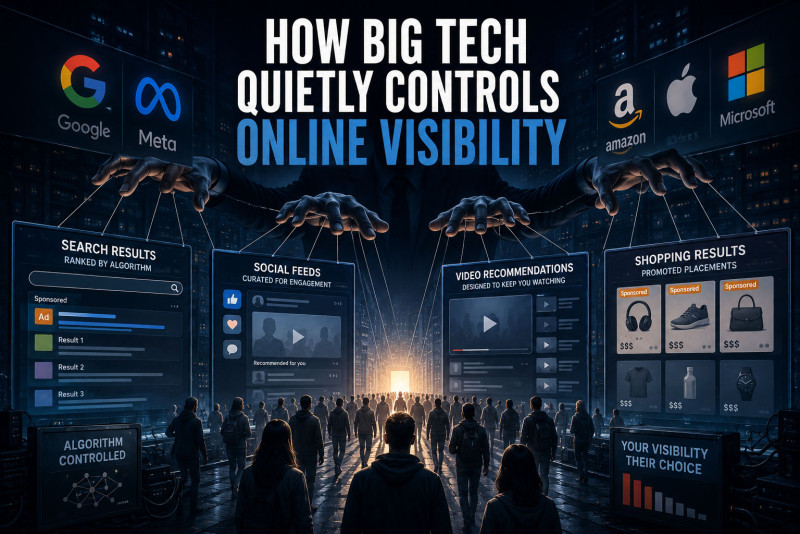
The internet was once seen as the ultimate level playing field.
A small business could compete with an industry giant. An independent blogger could challenge established media outlets. A developer working from a spare bedroom could build a website that attracted visitors from around the world.
Success was never guaranteed, but visibility felt attainable.
Today, that perception is increasingly being challenged.
Many people still believe the internet rewards the best content, the best products, or the most useful ideas. In reality, online visibility is often shaped by a complex web of algorithms, platform policies, advertising systems, and corporate partnerships that operate largely behind the scenes.
Most users never notice it.
Most creators experience it every day.
Visibility Has Become the Internet's Most Valuable Currency
Every website, video, article, product, and social media post is competing for one thing:
Attention.
The internet now contains more content than any person could consume in multiple lifetimes. As a result, visibility has become one of the most valuable resources in the digital economy.
The companies that control visibility effectively control:
- Traffic
- Discovery
- Advertising revenue
- Audience growth
- Business opportunities
- Public influence
This is where Big Tech's power becomes most apparent.
Companies do not need to control the entire internet.
They only need to control the pathways people use to navigate it.
The Gatekeepers of Discovery
Most online discovery happens through a surprisingly small number of platforms.
For many users, the internet begins and ends with:
- Search engines
- Social media feeds
- Video platforms
- Mobile app stores
- AI-powered assistants
- Large online marketplaces
These systems decide what users see first.
While platforms often describe their algorithms as neutral, every ranking system reflects choices made by the company operating it.
Questions such as:
- Which content appears first?
- Which creators are recommended?
- Which products are promoted?
- Which sources are considered trustworthy?
are ultimately determined by systems controlled by a handful of organizations.
The Algorithm Advantage
Algorithms are often presented as objective.
In reality, algorithms are designed around business goals.
Their purpose is not necessarily to find the most valuable content.
Their purpose is often to maximize:
- User engagement
- Platform retention
- Advertising performance
- Revenue generation
- User activity
These goals are understandable from a business perspective.
However, they can produce unintended consequences.
Content that generates strong emotional reactions often receives greater visibility than content that encourages deeper understanding.
Large publishers often outperform smaller competitors because algorithms view established authority as a safer choice.
The result is a feedback loop where visibility increasingly benefits those who already possess it.
Why Independent Creators Struggle
Many independent creators discover that producing quality work is only part of the challenge.
The larger challenge is getting discovered.
Unlike major corporations, independent creators often lack:
- Large advertising budgets
- Dedicated marketing teams
- Existing brand recognition
- Corporate partnerships
- Platform influence
Even exceptional content can remain largely invisible if algorithms choose not to amplify it.
This is one reason many creators feel that the internet has become more competitive despite offering more publishing opportunities than ever before.
Publishing is easy.
Discovery is hard.
Search Engines Have Changed
Search once functioned as a directory for the web.
Users searched for information and were directed to websites.
Today, search increasingly acts as a destination itself.
Modern search platforms now:
- Display direct answers
- Generate summaries
- Highlight selected sources
- Prioritize established authorities
- Keep users within the platform ecosystem
For users, this often feels convenient.
For smaller publishers, it can reduce opportunities for traffic and growth.
The internet becomes more centralized when fewer users leave the platforms that organize information.
The Role of Advertising
Advertising has quietly become one of the strongest influences on visibility.
Across much of the internet, organizations face a common reality:
The more they spend, the more visible they become.
Paid promotion is now deeply integrated into:
- Search results
- Social media feeds
- Video recommendations
- Online marketplaces
- Mobile applications
This creates a system where visibility increasingly reflects financial resources rather than purely merit or quality.
Large organizations can often afford to dominate attention while smaller competitors struggle to gain exposure.
AI May Strengthen Existing Power Structures
Artificial intelligence is transforming how people discover information.
Instead of browsing websites, users increasingly ask AI systems for answers.
Instead of comparing multiple sources, users receive summarized responses generated by a single platform.
While this may improve convenience, it also introduces new concerns.
AI systems decide:
- Which information is included
- Which sources are referenced
- Which perspectives are emphasized
- Which websites receive visibility
If a small number of companies control these systems, they gain extraordinary influence over how knowledge is distributed online.
The concern is not necessarily intentional manipulation.
The concern is concentration of power.
Most Control Happens Quietly
One reason these changes attract limited public attention is that they rarely occur through dramatic announcements.
Visibility shifts gradually.
A ranking update.
A recommendation adjustment.
A policy change.
A redesign.
An AI feature.
Individually, each change may seem insignificant.
Collectively, they can reshape entire industries.
Websites lose traffic.
Creators lose audiences.
Businesses lose customers.
Meanwhile, users often remain unaware that anything changed at all.
Why This Matters Beyond Technology
Online visibility is not just a technology issue.
It influences culture, business, education, politics, journalism, and public discourse.
When a small number of organizations control discovery, they indirectly influence:
- Which voices are heard
- Which businesses grow
- Which ideas spread
- Which communities thrive
- Which perspectives remain unseen
This influence may not always be intentional, but its impact can be profound.
The internet shapes modern society.
Whoever controls visibility shapes a significant part of the internet.
The Future of Discovery
Big Tech does not need to censor information to influence outcomes.
Controlling visibility can be equally powerful.
The challenge facing the modern internet is not whether information exists.
More information exists today than ever before.
The challenge is whether people can discover it.
As search, social media, AI, and digital platforms continue to evolve, one question becomes increasingly important:
Will the future internet help users explore a diverse landscape of ideas, creators, and businesses, or will discovery become concentrated within a handful of systems controlled by a few powerful organizations?
The answer may determine whether the internet remains open in practice—or merely open in theory.