



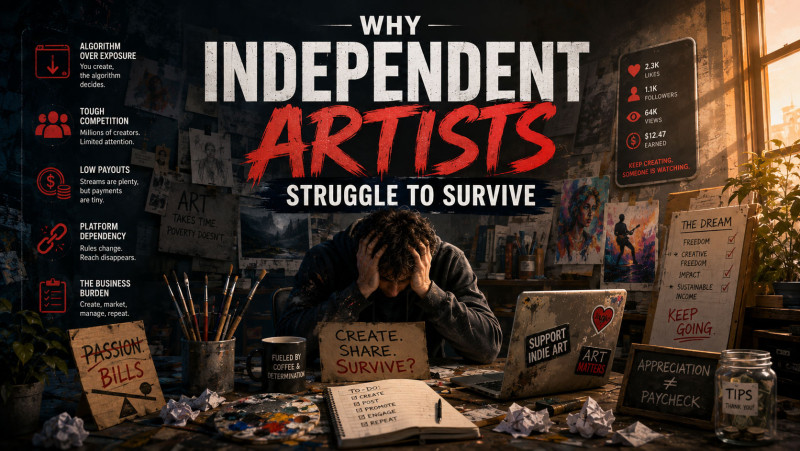
Never before has it been easier to share creative work with the world.
An artist can upload a song to streaming platforms, publish illustrations on social media, sell digital prints through an online marketplace, or release a film on a video-sharing website, all without needing a traditional publisher or record label.
On paper, this should be a golden age for independent creators.
Yet for many artists, the reality is very different.
Despite global audiences, powerful digital tools, and countless distribution platforms, earning a sustainable living from creative work has become increasingly difficult. Visibility is harder to achieve, competition is greater than ever, and monetization often favors platforms over creators.
Why do so many independent artists struggle to survive in an era that appears full of opportunity?
The Internet Opened the Door to Everyone
Digital platforms have dramatically lowered the barriers to entry.
Today, creators can publish:
- Music
- Paintings
- Photography
- Films
- Animation
- Digital illustrations
- Writing
- Podcasts
Without asking for permission from publishers or galleries.
This democratization has allowed millions of talented people to reach audiences they never could have accessed in previous generations.
The challenge is that everyone else gained the same opportunity.
Standing out has become far more difficult.
Visibility Has Become the Greatest Challenge
Creating great work is only the first step.
People must also discover it.
Modern platforms rely heavily on recommendation algorithms that determine what users see.
For independent artists, this creates uncertainty.
A single algorithm update can dramatically affect:
- Audience reach
- Engagement
- Sales
- Followers
- Advertising revenue
- Streaming numbers
Exceptional work does not automatically guarantee visibility.
Discovery increasingly depends on platform dynamics that creators cannot fully control.
Competition Is Global
An artist is no longer competing only with others in their city or country.
They are competing with creators from around the world.
Every day, millions of new pieces of content are published across digital platforms.
Audiences face an endless stream of:
- Songs
- Videos
- Illustrations
- Books
- Games
- Podcasts
- Short-form content
Attention has become one of the most valuable, and limited, resources on the internet.
Winning that attention is often harder than creating the work itself.
Small Payments Add Up Slowly
Digital distribution allows creators to earn revenue from multiple sources.
These may include:
- Streaming royalties
- Digital sales
- Merchandise
- Crowdfunding
- Membership platforms
- Sponsorships
- Licensing
- Commissions
While these opportunities are valuable, individual payments are often small.
Many artists need thousands, or even millions, of views, streams, or downloads before generating meaningful income.
Success is frequently measured by scale rather than craftsmanship.
The Business Side Cannot Be Ignored
Modern artists are expected to wear many hats.
Beyond creating, they often manage:
- Marketing
- Branding
- Social media
- Customer support
- Accounting
- Contracts
- Website maintenance
- Community management
For independent creators, running the business can consume as much time as producing the art itself.
Creativity alone is rarely enough to sustain a career.
Social Media Rewards Consistency
Many platforms encourage frequent posting.
Creators often feel pressured to produce content continuously in order to remain visible.
This can lead to:
- Creative fatigue
- Burnout
- Reduced experimentation
- Lower quality work
- Mental exhaustion
The pressure to satisfy algorithms sometimes conflicts with the slower, more thoughtful process that meaningful artistic work often requires.
AI Is Changing the Creative Landscape
Artificial intelligence has introduced both opportunities and uncertainty.
Many artists now use AI to:
- Generate ideas
- Improve workflows
- Edit content
- Explore concepts
- Automate repetitive tasks
At the same time, AI-generated artwork, music, and writing have intensified debates about originality, ownership, and compensation.
Some creators view AI as a powerful creative assistant.
Others worry it increases competition by making content faster and cheaper to produce.
The conversation continues to evolve.
Communities Matter More Than Virality
While viral success captures headlines, sustainable careers often depend on loyal communities rather than fleeting attention.
Independent artists increasingly focus on building direct relationships through:
- Newsletters
- Membership programs
- Private communities
- Live events
- Crowdfunding
- Exclusive content
- Personal websites
A dedicated audience of a few thousand supporters can often provide greater long-term stability than millions of one-time views.
Connection is becoming more valuable than reach alone.
Success Is Being Redefined
Not every artist dreams of global fame.
For many, success means:
- Creative independence
- Financial stability
- Meaningful work
- Artistic freedom
- Flexible lifestyles
- A supportive audience
Digital platforms have made these goals more achievable for some creators, even if the journey remains challenging.
The definition of success is becoming more personal.
Creativity Still Has a Future
Independent artists face undeniable obstacles.
Competition is intense.
Algorithms are unpredictable.
Monetization remains difficult.
Yet creativity continues to thrive.
Every generation discovers new voices, fresh perspectives, and innovative forms of expression because independent creators continue producing work despite uncertainty.
Technology has changed how art is shared, marketed, and consumed.
It has not changed why people create.
Stories still inspire.
Music still connects.
Paintings still provoke emotion.
Films still shape culture.
The future of independent art will not be determined solely by algorithms or platform policies.
It will belong to creators who combine artistic vision with adaptability, build genuine relationships with their audiences, and continue creating work that resonates beyond trends.
In a world overflowing with content, authenticity remains one of the rarest, and most valuable, qualities an artist can offer.