



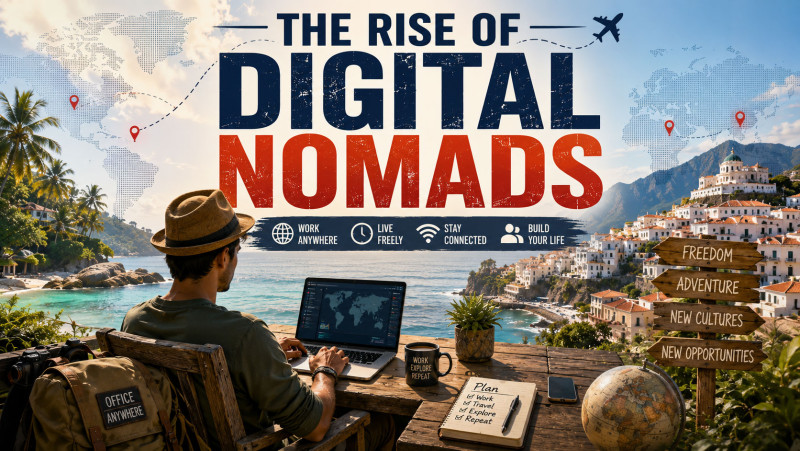
Not long ago, work was closely tied to a physical location.
People commuted to offices every morning, worked fixed hours, and often spent decades building careers in the same city, or even the same company. Location was one of the biggest factors shaping professional opportunities.
Today, that model is rapidly evolving.
Thanks to high-speed internet, cloud computing, collaboration software, and remote-friendly businesses, millions of professionals can now work from almost anywhere in the world.
A beachfront café in Bali.
A coworking space in Lisbon.
A mountain town in Colombia.
A small apartment in Tokyo.
For a growing number of people, the office is no longer a building. It is wherever they open their laptop.
This global movement has given rise to one of the most significant workplace trends of the digital era: the digital nomad.
Work Is No Longer Defined by Geography
For decades, career opportunities depended largely on where someone lived.
Today, remote technology has changed that equation.
Professionals can collaborate across continents using tools for:
- Video conferencing
- Project management
- Cloud storage
- Instant messaging
- File sharing
- Online payments
- Digital collaboration
Physical distance has become far less important than reliable internet access.
The workplace has expanded beyond national borders.
The Pandemic Accelerated the Shift
Although remote work existed long before 2020, the global pandemic dramatically accelerated its adoption.
Businesses that once resisted remote work discovered that many employees could remain productive outside traditional offices.
This unexpected experiment changed perceptions permanently.
Companies began offering:
- Fully remote positions
- Hybrid work arrangements
- Flexible schedules
- International hiring
- Distributed teams
For many workers, the possibility of combining career and travel suddenly became realistic.
Technology Made It Possible
The digital nomad lifestyle depends on modern technology.
Essential tools include:
- Cloud-based software
- High-speed internet
- Virtual private networks (VPNs)
- Video communication platforms
- Online banking
- Digital payment systems
- AI productivity tools
These technologies allow professionals to manage businesses, communicate with clients, and deliver projects regardless of their location.
The office now fits inside a backpack.
Why People Choose the Lifestyle
The appeal extends beyond travel.
Many digital nomads value:
- Flexible schedules
- Geographic freedom
- Lower living costs
- Cultural experiences
- Better work-life balance
- Personal independence
- Career flexibility
Some move frequently between countries.
Others settle for several months before relocating again.
The defining characteristic is freedom of choice rather than constant travel.
Entire Countries Are Competing for Remote Workers
Governments have recognized the economic potential of attracting digital professionals.
Many countries now offer specialized visas and incentives for remote workers.
Benefits include:
- Extended residency options
- Simplified visa processes
- Tax incentives in some jurisdictions
- Modern coworking spaces
- Improved digital infrastructure
Cities that once relied heavily on tourism increasingly view remote workers as long-term contributors to local economies.
Competition for digital talent is becoming global.
The Challenges Behind the Lifestyle
Social media often presents digital nomadism as an endless vacation.
Reality is more complicated.
Common challenges include:
- Time zone differences
- Visa requirements
- Tax complexity
- Healthcare access
- Loneliness
- Unstable internet
- Maintaining routines
Balancing work responsibilities while constantly adapting to new environments requires discipline.
Freedom brings responsibility.
Coworking Spaces Are Creating New Communities
One concern many remote workers face is isolation.
Coworking spaces have emerged as a solution.
They provide:
- Reliable internet
- Professional work environments
- Networking opportunities
- Business events
- Skill-sharing workshops
- Social connections
These spaces help recreate some of the collaboration traditionally found in offices while preserving location independence.
For many digital nomads, community matters just as much as mobility.
Companies Are Hiring Without Borders
Remote work has expanded hiring opportunities for both employers and employees.
Businesses can recruit talent regardless of geography.
Professionals can pursue opportunities with companies they may never physically visit.
This shift creates advantages such as:
- Larger talent pools
- Increased diversity
- Flexible staffing
- Reduced office costs
- Access to specialized expertise
The concept of a "local workforce" is gradually becoming less relevant in many industries.
AI Is Empowering Solo Professionals
Artificial intelligence is making the digital nomad lifestyle even more practical.
Independent professionals increasingly use AI to:
- Draft documents
- Translate languages
- Automate repetitive tasks
- Analyze data
- Generate creative ideas
- Improve customer support
- Increase productivity
A single entrepreneur can now accomplish work that previously required an entire team.
Technology continues lowering the barriers to location-independent careers.
The Future of Work Is More Flexible
Digital nomadism will not replace traditional employment.
Many professions still require physical presence.
Healthcare, manufacturing, construction, transportation, and countless other industries depend on people working on-site.
However, for knowledge-based careers, flexibility is becoming a defining expectation rather than an exceptional benefit.
Employees increasingly value freedom alongside salary.
Companies increasingly compete on workplace flexibility as much as compensation.
More Than a Trend
The rise of digital nomads represents more than a new way of working.
It reflects a broader shift in how people define success, productivity, and quality of life.
Technology has made it possible for millions to separate where they earn a living from where they choose to live.
This freedom creates exciting opportunities, but also new responsibilities involving discipline, financial planning, and cultural awareness.
The future of work is unlikely to belong exclusively to offices or remote locations.
Instead, it will belong to flexibility.
For many professionals, the question is no longer whether work can happen anywhere.
It is where they want that "anywhere" to be.