



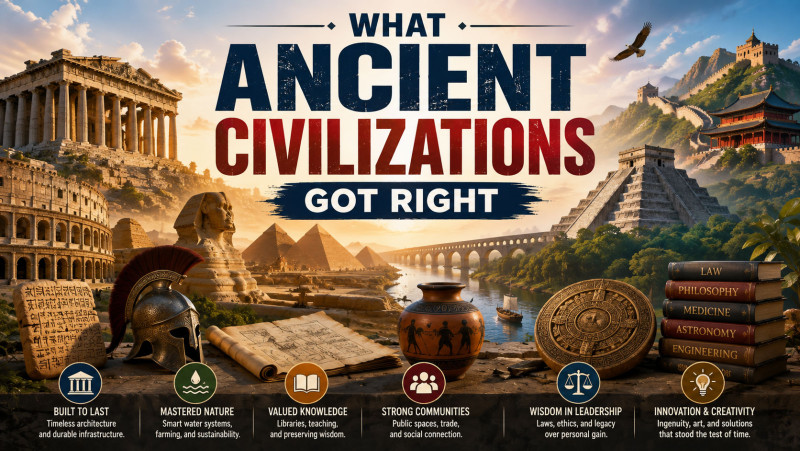
Modern society often views ancient civilizations through the lens of what they lacked.
No internet.
No electricity.
No airplanes.
No artificial intelligence.
It is easy to assume that thousands of years of technological progress have made the past largely irrelevant.
Yet many of the world's greatest civilizations solved problems that continue to challenge humanity today.
They built cities that endured for centuries, created legal systems that influenced modern governments, engineered remarkable infrastructure without modern machinery, and developed philosophies that still shape how people think about ethics, leadership, and community.
While history often focuses on why civilizations collapsed, there is equal value in understanding what they got right.
Their successes continue to offer lessons for the modern world.
They Built for Generations, Not Quarters
Many ancient societies approached construction with extraordinary patience.
Rather than designing buildings to last decades, they built for centuries.
Examples include:
- Roman aqueducts
- Egyptian temples
- Greek theaters
- Incan stone cities
- Chinese defensive walls
- Persian road networks
Many of these structures remain standing today despite wars, natural disasters, and the passage of thousands of years.
Their builders prioritized durability over speed.
Modern societies, often driven by short-term economic cycles, can still learn from that long-term perspective.
Infrastructure Was Treated as a Public Investment
Great civilizations understood that prosperity depended on strong infrastructure.
They invested heavily in:
- Roads
- Bridges
- Water systems
- Ports
- Irrigation
- Public baths
- Marketplaces
These projects improved trade, sanitation, communication, and economic growth.
The Roman road network, for example, connected vast territories and enabled efficient movement of people, goods, and information.
Infrastructure was viewed not merely as construction—but as the foundation of civilization itself.
Knowledge Was Worth Preserving
Long before digital storage, civilizations recognized the importance of recording knowledge.
Libraries became symbols of intellectual achievement.
Scholars documented:
- Science
- Mathematics
- Medicine
- Astronomy
- Literature
- Law
- Philosophy
Although many priceless collections were eventually lost, their influence survived through generations of copied manuscripts and translated works.
Civilizations advanced because they valued learning as a shared resource rather than temporary information.
Community Came Before Individual Convenience
Ancient societies often emphasized collective responsibility.
Cities were designed around shared public spaces where people gathered to:
- Trade
- Debate
- Celebrate
- Learn
- Worship
- Resolve disputes
Markets, forums, temples, and town squares encouraged interaction between citizens.
Strong communities helped societies remain resilient during difficult times.
While modern technology has made communication easier than ever, many communities continue searching for the same sense of connection these public spaces naturally encouraged.
They Adapted to Their Environment
Without modern technology, survival depended on understanding nature.
Ancient civilizations carefully observed:
- Seasonal weather
- Rivers
- Soil quality
- Wildlife
- Agricultural cycles
- Water availability
Rather than forcing nature to conform to their needs, many societies adapted their cities and farming techniques to local conditions.
Terraced agriculture, irrigation canals, and flood management systems demonstrated remarkable environmental awareness.
Sustainability was often a necessity rather than a marketing strategy.
Education Was Respected
Many civilizations viewed education as essential for leadership.
Future administrators, philosophers, military officers, and scholars underwent years of study.
Subjects often included:
- Logic
- Mathematics
- Rhetoric
- Ethics
- Astronomy
- Engineering
- History
Although educational opportunities were not equally available to everyone, societies consistently recognized that knowledge strengthened governments and economies.
Learning was considered an investment in future stability.
Innovation Existed Without Computers
Innovation did not begin with the digital age.
Ancient civilizations developed remarkable technologies using observation and experimentation.
Among their achievements were:
- Concrete construction
- Advanced metallurgy
- Mechanical devices
- Navigation techniques
- Calendars
- Surgical instruments
- Water-powered machinery
These innovations solved practical problems using the resources available at the time.
Creativity has always been one of humanity's defining strengths.
Leadership Was Measured by Legacy
Many historical leaders understood that their reputation would ultimately depend on what they left behind.
Successful rulers often invested in:
- Infrastructure
- Legal reform
- Public works
- Education
- Economic stability
- Cultural preservation
Not every leader governed wisely, of course.
History contains countless examples of poor leadership.
Yet many civilizations celebrated those whose accomplishments benefited future generations rather than only their own rule.
Legacy mattered.
Culture Was Central to Identity
Art, music, architecture, storytelling, and religious traditions played vital roles in preserving cultural identity.
Civilizations invested heavily in creative expression because culture strengthened social cohesion.
Through monuments, festivals, literature, and craftsmanship, people passed shared values across generations.
Many of these artistic achievements continue to inspire modern architects, writers, musicians, and designers.
Culture was never treated as an afterthought.
It was considered essential to civilization itself.
Progress Is More Than Technology
Looking back at ancient civilizations reminds us that progress cannot be measured solely by technological advancement.
Modern society enjoys extraordinary innovations that previous generations could scarcely imagine.
Yet many challenges remain familiar:
- Building resilient communities
- Managing resources wisely
- Preserving knowledge
- Developing ethical leadership
- Balancing growth with sustainability
- Investing in future generations
These are not new problems.
They are human problems.
The civilizations that endured the longest often approached them with remarkable foresight.
The Past Still Has Something to Teach
Ancient civilizations were far from perfect.
They experienced conflict, inequality, disease, and political instability.
But reducing them to their shortcomings overlooks the remarkable achievements that continue to shape the modern world.
Their engineering still inspires architects.
Their philosophies continue influencing ethics and politics.
Their legal systems remain the foundation of many modern institutions.
Their innovations remind us that creativity has never depended on advanced technology.
History is more than a record of what humanity once accomplished.
It is a guidebook filled with ideas that remain surprisingly relevant.
The greatest lesson ancient civilizations offer is perhaps the simplest one:
True progress is not defined only by what we invent today, but by what we build that future generations will still value tomorrow.