



The video game industry has never been larger.
Global revenues now surpass those of the film and music industries combined, millions of players connect online every day, and blockbuster releases generate billions of dollars within weeks. From massive open-world adventures to competitive esports titles, gaming has become one of the defining forms of modern entertainment.
Yet behind this remarkable success lies a growing crisis.
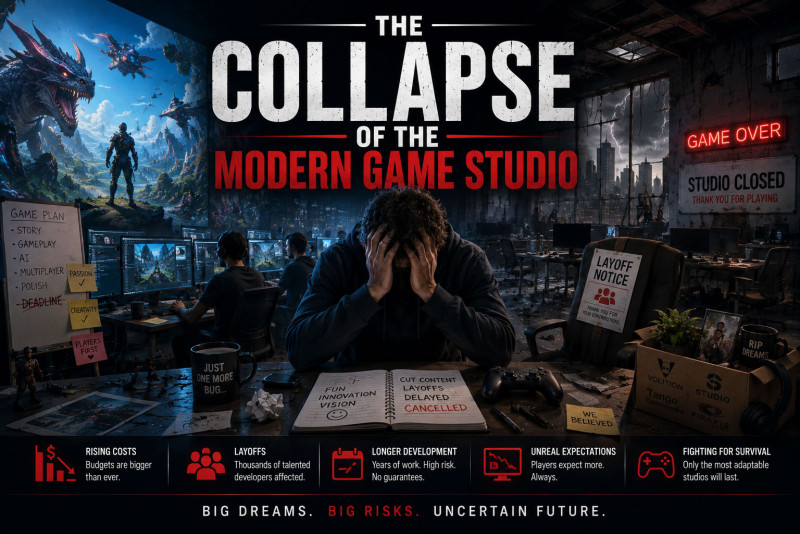
In recent years, hundreds of game studios have closed their doors, thousands of developers have lost their jobs, and once-celebrated companies have struggled to deliver successful releases. High-profile cancellations, ballooning budgets, delayed launches, and disappointing sales have become increasingly common.
For an industry enjoying record player numbers, the situation seems contradictory.
Why are so many game studios struggling?
Bigger Games, Bigger Risks
Modern games have become incredibly ambitious.
Players expect:
- Photorealistic graphics
- Massive open worlds
- Motion-captured performances
- Online multiplayer
- Cross-platform support
- Frequent updates
- Live events
- High-quality storytelling
Meeting these expectations requires teams that often include hundreds, or even thousands, of developers.
Projects that once took two years may now require five, six, or even seven years of development.
As production grows more complex, financial risks increase dramatically.
Development Costs Have Exploded
Creating a major AAA title is no longer comparable to making games twenty years ago.
Budgets now frequently include:
- Large development teams
- Motion capture
- Voice actors
- Marketing campaigns
- Server infrastructure
- Licensing fees
- Quality assurance
- Post-launch support
Some blockbuster games reportedly cost hundreds of millions of dollars before reaching players.
At these levels, even commercially successful releases may struggle to recover their investments.
Studios are betting more money than ever on fewer projects.
Live Service Changed Expectations
Many publishers shifted toward live-service games.
Instead of releasing a complete product, developers increasingly build platforms designed to evolve over years.
Successful live-service games generate recurring revenue through:
- Cosmetic items
- Battle passes
- Expansions
- Seasonal content
- Premium currencies
- Subscription services
When successful, this model can be extremely profitable.
When unsuccessful, years of development may disappear within months after launch.
Only a small number of live-service games achieve lasting success.
Competition is intense.
Players Have More Choices Than Ever
Today's gamers face an endless supply of entertainment.
Every week introduces:
- New indie releases
- AAA launches
- Free-to-play titles
- Mobile games
- Subscription libraries
- Cloud gaming
- Early Access projects
- Classic remasters
Attention has become one of the industry's most valuable resources.
A technically impressive game is no longer enough.
Players expect originality, quality, and long-term support.
Winning that attention has become increasingly difficult.
Layoffs Across the Industry
Despite strong consumer demand, the gaming industry has experienced significant waves of layoffs.
Studios have reduced staff because of:
- Rising operating costs
- Slower investment
- Project cancellations
- Changing market conditions
- Company restructuring
- Lower-than-expected sales
Many talented developers have found themselves searching for new opportunities despite years of experience.
The layoffs highlight that industry growth does not always translate into organizational stability.
Independent Studios Are Changing the Landscape
While large publishers face increasing pressure, independent developers continue producing critically acclaimed games.
Smaller teams benefit from:
- Lower production costs
- Faster development
- Greater creative freedom
- Flexible decision-making
- Strong community engagement
Many independent games succeed by focusing on innovative gameplay rather than expensive visuals.
Their success demonstrates that creativity often competes effectively with enormous budgets.
Technology Is Reshaping Development
Artificial intelligence and modern development tools are changing how games are created.
Studios increasingly use technology to:
- Generate concept art
- Assist programming
- Automate testing
- Improve animation
- Create dialogue
- Analyze player behavior
These tools can reduce production time and improve efficiency.
They also raise questions about future employment and how creative work will evolve within the industry.
Technology is becoming both an opportunity and a disruption.
Publishers Face Growing Pressure
Large publishers must satisfy multiple groups simultaneously.
They answer to:
- Players
- Investors
- Employees
- Platform holders
- Shareholders
- Business partners
Balancing creativity with financial performance has never been more challenging.
Pressure to deliver record-breaking profits sometimes encourages conservative decisions, sequels, and familiar franchises rather than bold experimentation.
Innovation becomes harder when every release carries enormous financial risk.
A Sustainable Future Requires Balance
The future of game development may look very different from the past decade.
Studios are increasingly exploring:
- Smaller development teams
- Shorter production cycles
- Sustainable budgets
- Community-driven feedback
- Modular content
- Cross-platform engines
- AI-assisted workflows
Rather than pursuing endless expansion, many companies are recognizing the importance of long-term sustainability.
Success may increasingly depend on efficiency rather than scale.
Great Games Still Begin With Great Ideas
The challenges facing modern game studios are real.
Development has become more expensive.
Competition has intensified.
Player expectations continue to rise.
Yet the gaming industry remains one of the world's most creative industries.
History repeatedly shows that technological breakthroughs, unforgettable stories, and innovative gameplay rarely emerge simply because a project has the largest budget.
They emerge because talented people build experiences that players genuinely love.
The future of gaming will not be determined solely by bigger studios or larger investments.
It will belong to developers who balance ambition with sustainability, embrace innovation without losing creativity, and remember that the most successful games have always been driven by compelling ideas rather than production budgets alone.
The modern game studio is not collapsing because players no longer love games.
It is being challenged to rediscover how great games can be built in a changing industry.