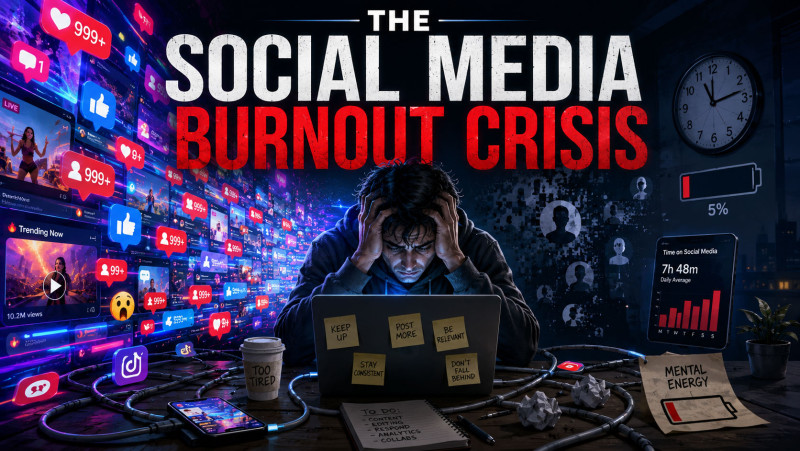
Social media was created to connect people.
It promised a world where friends could stay in touch across continents, creators could build audiences without traditional gatekeepers, and anyone with an internet connection could share ideas with the world.
In many ways, it succeeded.
Today, billions of people use social platforms every day to communicate, learn, shop, entertain themselves, and grow businesses.
Yet despite this unprecedented connectivity, many users report feeling exhausted.
Scrolling that begins as a five-minute break often turns into an hour. Notifications compete constantly for attention. Endless feeds create pressure to stay informed, entertained, and visible.
The result is a growing phenomenon affecting people of all ages.
Social media burnout.
Designed to Keep You Engaged
Modern social platforms are carefully engineered to maximize engagement.
Every feature is designed to encourage users to return.
These include:
- Infinite scrolling
- Personalized recommendations
- Push notifications
- Short-form videos
- Auto-playing content
- Likes and reactions
- Streaks and badges
- Trending topics
These features make platforms highly engaging.
The challenge is that engagement is not always the same as satisfaction.
Many users spend more time online without feeling more fulfilled.
Information Never Stops
Unlike newspapers or evening television broadcasts, social media never ends.
There is always:
- Breaking news
- Viral videos
- Trending debates
- New comments
- Fresh content
- Live broadcasts
- Product launches
- Cultural moments
Missing even a few hours can create the feeling of falling behind.
This constant stream of information makes it difficult for the brain to truly disconnect.
The fear of missing out, often called FOMO, encourages people to keep checking their feeds, even when they no longer enjoy doing so.
The Pressure to Always Be Present
Social media has blurred the line between personal and public life.
Many people now feel pressure to:
- Respond quickly
- Post regularly
- Maintain an online presence
- Share achievements
- Stay relevant
- Follow trends
- Build personal brands
For creators, entrepreneurs, and professionals, stepping away from social media can sometimes feel like disappearing entirely.
Being constantly available has quietly become an expectation.
Comparison Is Everywhere
One of the most significant contributors to burnout is comparison.
Every day, users are exposed to carefully curated highlights of other people's lives.
Luxury vacations.
Career promotions.
Perfect homes.
Successful businesses.
Fitness transformations.
Creative achievements.
While these moments may be genuine, they rarely represent everyday reality.
Comparing ordinary life to someone else's best moments can create unrealistic expectations and unnecessary self-doubt.
Creators Face Constant Pressure
Content creators experience a unique form of burnout.
Many platforms reward consistency.
Creators often feel they must produce content every day to remain visible.
Their workload frequently includes:
- Filming
- Editing
- Writing
- Designing thumbnails
- Responding to comments
- Managing partnerships
- Studying analytics
- Following algorithm changes
Success increasingly depends not only on creativity but also on maintaining an exhausting production schedule.
Many creators describe feeling trapped by the very audiences they worked so hard to build.
Algorithms Reward Attention
Social media platforms compete for one valuable resource:
Attention.
The longer users remain engaged, the more opportunities platforms have to display advertising and recommend content.
This business model encourages algorithms to prioritize material that generates strong emotional reactions.
As a result, users often encounter:
- Outrage
- Controversy
- Conflict
- Fear
- Excitement
- Endless novelty
While engaging in the short term, constant emotional stimulation can become mentally exhausting over time.
Burnout Is Affecting Younger Generations
Young people have grown up in a world where social media has always existed.
For many, online identity develops alongside real-world identity.
This creates unique challenges, including:
- Constant comparison
- Fear of exclusion
- Pressure to perform
- Digital dependency
- Reduced attention spans
- Difficulty disconnecting
Schools, parents, and technology companies are increasingly recognizing that digital well-being deserves the same attention as physical health.
Learning healthy online habits is becoming an essential life skill.
Digital Wellness Is Becoming Important
Burnout does not necessarily require deleting social media entirely.
Many people are finding healthier ways to engage by:
- Limiting screen time
- Disabling unnecessary notifications
- Following positive accounts
- Taking regular breaks
- Curating their feeds intentionally
- Scheduling offline activities
- Prioritizing real-world relationships
Technology works best when it supports life rather than replacing it.
Small changes can significantly improve how social media feels.
The Platforms Are Evolving
Technology companies are beginning to recognize concerns around excessive usage.
Many platforms now offer features such as:
- Screen time reports
- Quiet modes
- Notification controls
- Focus settings
- Usage reminders
- Content filters
Whether these tools are sufficient remains a topic of debate.
Ultimately, responsibility is shared between platform designers and users themselves.
Healthy technology depends on both thoughtful design and mindful habits.
Connection Should Never Become Exhaustion
Social media remains one of the most influential inventions of the digital age.
It has connected families, launched businesses, amplified important voices, and given millions of people opportunities that were once unimaginable.
The goal should not be to reject these platforms.
It should be to use them intentionally.
The true value of social media has never been measured by hours spent scrolling or the number of notifications received.
Its purpose is connection.
When technology begins creating more stress than value, it is worth reconsidering how it fits into daily life.
The healthiest digital future will not belong to those who spend the most time online.
It will belong to those who know when to connect, and when to disconnect.