



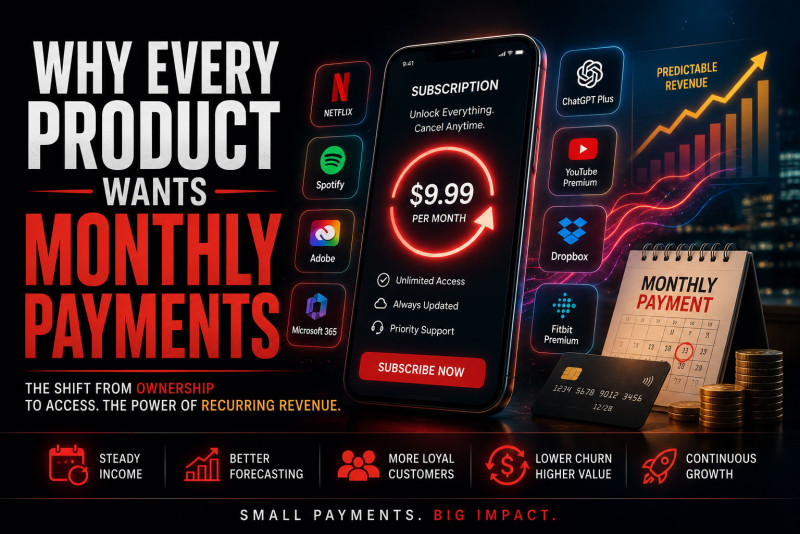
It seems like almost everything has become a subscription.
Software that was once purchased with a single payment now requires a monthly fee. Streaming platforms compete for recurring subscribers. Fitness apps, cloud storage, AI assistants, productivity tools, online education, digital newspapers, even car manufacturers, are increasingly asking customers to pay every month instead of owning what they use outright.
For consumers, it can feel overwhelming.
For businesses, however, the shift makes perfect sense.
Recurring revenue has fundamentally changed how companies build products, forecast growth, and interact with customers. The subscription model has become so successful that businesses across nearly every industry are trying to adopt it.
But is this transformation always good for customers?
Or has the pursuit of predictable revenue gone too far?
The One-Time Sale Is Becoming Rare
For decades, buying a product meant exactly that, you bought it.
Whether it was software, a music album, or a professional tool, ownership was permanent.
Today, companies increasingly prefer ongoing relationships instead of one-time transactions.
Products commonly sold through subscriptions now include:
- Productivity software
- Streaming services
- AI platforms
- Cloud storage
- Design applications
- Cybersecurity tools
- Video games
- Smart home services
- Business software
- Online learning platforms
The business model has shifted from selling products to selling continuous access.
Predictable Revenue Changes Everything
From a business perspective, recurring payments solve one of the biggest challenges: uncertainty.
Instead of hoping customers return for another purchase months or years later, companies receive a more stable stream of income.
This predictable revenue helps businesses:
- Plan future investments
- Hire employees with greater confidence
- Expand infrastructure
- Improve customer support
- Develop new features
- Attract investors
- Forecast long-term growth
A subscription creates financial stability that one-time sales rarely provide.
That stability often allows businesses to grow faster.
Investors Love Recurring Businesses
Subscription companies are attractive to investors for a simple reason.
Future revenue becomes easier to estimate.
Rather than relying solely on acquiring new customers every month, businesses can measure:
- Monthly recurring revenue
- Customer retention
- Churn rate
- Lifetime customer value
- Growth trends
- Renewal rates
These metrics make companies easier to evaluate and often increase their perceived value.
In today's technology sector, recurring revenue has become one of the most desirable business models.
Customers Pay Less, At First
Subscriptions often lower the barrier to entry.
Instead of paying hundreds of dollars upfront, customers can start using a product for a relatively small monthly fee.
This approach offers several benefits:
- Lower initial cost
- Immediate access
- Automatic updates
- Continuous improvements
- Technical support
- Cloud synchronization
- Flexible cancellation
For many people, paying a smaller amount each month feels more manageable than making one large purchase.
The challenge appears over time.
Small Payments Become Large Expenses
Ten dollars a month rarely feels expensive.
Neither does fifteen.
Or twenty.
But when dozens of subscriptions accumulate, the total monthly cost can become surprisingly high.
Many consumers pay for services they:
- Rarely use
- Forgot they subscribed to
- Intended to cancel
- Replaced with similar alternatives
Because recurring payments happen automatically, they often receive far less attention than one-time purchases.
The convenience of subscriptions can quietly become an ongoing financial commitment.
Ownership Is Quietly Disappearing
One of the biggest consequences of subscription models is the gradual decline of ownership.
When customers stop paying, they often lose access to:
- Software
- Cloud files
- Streaming libraries
- Premium features
- Online services
- Digital content
In many cases, years of use end the moment a subscription expires.
Consumers increasingly rent access rather than own products.
For some services, this makes perfect sense.
For others, many people miss the permanence that ownership once provided.
Not Every Product Needs a Subscription
There are genuine reasons why certain businesses rely on recurring payments.
Cloud infrastructure requires ongoing maintenance.
Streaming services continually license new content.
Cybersecurity software demands constant updates.
AI platforms consume computing resources every time users interact with them.
In these cases, subscriptions help fund continuous operation.
The criticism arises when companies convert products requiring little ongoing support into recurring payments simply because the business model is more profitable.
Consumers are becoming increasingly aware of this distinction.
Alternatives Are Returning
As subscription fatigue grows, some companies are exploring different pricing models.
These include:
- Lifetime licenses
- One-time purchases
- Optional maintenance plans
- Pay-as-you-go services
- Hybrid pricing
- Self-hosted software
Many customers appreciate having the choice.
Some prefer predictable monthly payments.
Others value long-term ownership and independence.
The most successful businesses increasingly recognize that flexibility itself can become a competitive advantage.
The Future Will Likely Be Hybrid
Subscriptions are unlikely to disappear.
They offer genuine value for many products and services.
However, consumer expectations are changing.
People increasingly expect transparency, fair pricing, and the ability to cancel without unnecessary complexity.
Businesses that balance recurring revenue with customer trust are likely to build stronger long-term relationships than those focused solely on maximizing monthly income.
The subscription economy is maturing.
Success will depend not just on attracting subscribers, but on continuously earning their loyalty.
Recurring Revenue Should Create Recurring Value
Monthly payments are not inherently good or bad.
They are simply a business model.
When subscriptions fund meaningful improvements, reliable support, innovation, and better customer experiences, they benefit everyone involved.
Problems arise when recurring payments exist primarily to increase revenue without delivering ongoing value.
Customers are becoming more selective.
Businesses are becoming more competitive.
In the years ahead, the companies that thrive will not necessarily be those with the most subscribers.
They will be the ones that consistently prove each monthly payment is worth making.
In a world where nearly every product wants a recurring fee, lasting success will belong to the businesses that remember a simple principle:
Recurring revenue should always be matched by recurring value.