



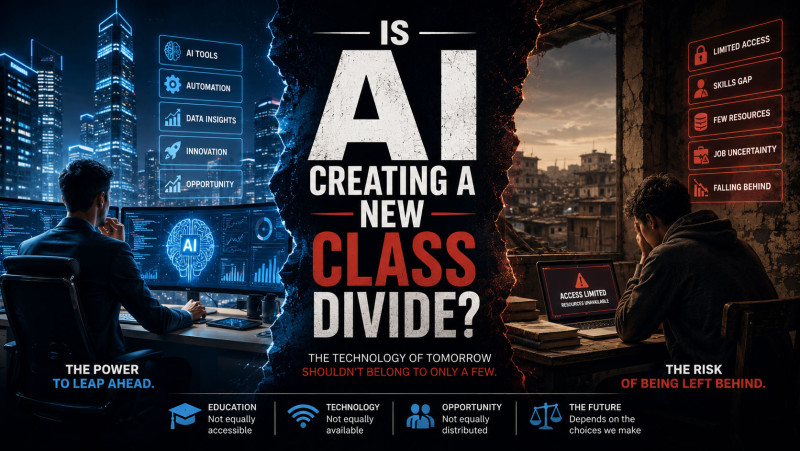
Artificial intelligence is transforming society at a pace few technologies have matched.
Businesses are automating repetitive tasks. Students are using AI to accelerate learning. Doctors are receiving assistance with diagnoses. Developers are writing software faster. Marketers are producing content in minutes instead of days.
For many people, AI feels like an incredible equalizer, a technology that gives individuals capabilities once reserved for large organizations.
But beneath the excitement lies a growing concern.
As AI becomes more powerful, access to its benefits is becoming increasingly unequal.
Those with the resources, knowledge, and infrastructure to leverage AI are moving ahead faster than ever, while others risk falling behind.
Could artificial intelligence be creating a new class divide?
Every Technological Revolution Creates Winners
History shows that major technological breakthroughs rarely affect everyone equally.
The Industrial Revolution transformed manufacturing.
The internet reshaped communication.
Smartphones changed daily life.
Each innovation created enormous opportunities while also disrupting existing industries and careers.
Artificial intelligence appears to be following the same pattern.
The difference is the speed.
AI is advancing so quickly that workers, businesses, and educational systems are struggling to keep pace.
Access Is Becoming a Competitive Advantage
Not everyone has equal access to advanced AI tools.
Differences often include:
- Premium AI subscriptions
- High-performance computers
- Fast internet connections
- Technical training
- Enterprise software
- Large proprietary datasets
- Experienced AI professionals
For businesses with significant resources, these advantages can dramatically increase productivity.
For smaller companies and individuals, keeping up may become increasingly difficult.
Technology is becoming a competitive advantage in itself.
AI Rewards Knowledge
Artificial intelligence is powerful.
Using it effectively requires skill.
The people gaining the greatest benefits often know how to:
- Write effective prompts
- Verify AI-generated information
- Combine multiple AI tools
- Automate repetitive workflows
- Interpret data
- Improve productivity
- Integrate AI into existing processes
Simply having access to AI is no longer enough.
Understanding how to use it strategically has become a valuable skill.
This creates a new form of digital literacy.
Businesses Are Moving Faster
Large organizations have embraced AI at remarkable speed.
Many now use it to:
- Analyze customer behavior
- Improve logistics
- Generate marketing content
- Assist software development
- Enhance customer support
- Forecast demand
- Detect fraud
- Optimize operations
The result is greater efficiency and lower operating costs.
Smaller businesses often recognize the same opportunities but may lack the resources to implement them at the same scale.
Over time, this gap can become increasingly difficult to close.
Education Faces a New Challenge
Schools and universities are adapting to a world where AI is becoming a standard workplace tool.
Students who learn how to work alongside AI may graduate with significant advantages.
Those without access to modern technology or AI education may enter the workforce less prepared.
Educational inequality has always existed.
Artificial intelligence has the potential to widen that gap if opportunities remain unevenly distributed.
Preparing students for an AI-driven economy is becoming just as important as teaching traditional academic subjects.
The Workplace Is Changing
Artificial intelligence is not replacing every job.
It is changing many of them.
Routine tasks are increasingly automated, allowing employees to focus on work that requires:
- Creativity
- Critical thinking
- Communication
- Leadership
- Strategy
- Problem-solving
- Emotional intelligence
Workers who continuously develop these skills are likely to remain valuable even as automation expands.
Those who rely primarily on repetitive tasks may face greater uncertainty.
The future of work increasingly favors adaptability.
The Risk of an AI Divide
Technology has always created economic differences.
AI introduces a new dimension.
A future divide may emerge between:
- People who effectively use AI
- People who have limited access to it
- Businesses that automate successfully
- Businesses unable to compete
- Countries investing heavily in AI
- Countries falling behind technologically
This divide would not necessarily be based on intelligence or talent.
It could simply reflect unequal access to tools and education.
That possibility deserves serious attention.
AI Can Also Reduce Inequality
The story is not entirely pessimistic.
Artificial intelligence also has enormous potential to make knowledge more accessible.
It already helps people:
- Learn new skills
- Translate languages
- Access educational resources
- Build businesses
- Improve accessibility
- Increase productivity
- Solve technical problems
For entrepreneurs and independent creators, AI often acts as a force multiplier.
Tasks that once required entire teams can now be completed by a single individual with the right tools.
In this sense, AI can lower barriers rather than raise them.
Its impact depends largely on how widely these tools become available.
Responsible Development Matters
Governments, educators, technology companies, and businesses all have a role to play.
Reducing future inequality may require:
- Affordable AI access
- Digital literacy programs
- Workforce retraining
- Ethical AI development
- Transparent regulation
- Investment in education
- Support for small businesses
Technology itself is neutral.
The way society chooses to distribute its benefits is not.
Ensuring that AI creates opportunity rather than exclusion will require thoughtful decisions long before today's challenges become permanent.
The Future Depends on Inclusion
Artificial intelligence has the potential to become one of humanity's most transformative inventions.
It can improve healthcare, accelerate scientific discovery, strengthen businesses, and expand educational opportunities across the world.
Yet every technological revolution raises an important question.
Who benefits first?
If access to AI remains concentrated among those with the greatest resources, the technology could deepen existing economic and educational divides.
If its benefits become widely accessible, AI may instead become one of history's greatest tools for expanding opportunity.
The future is not predetermined.
Artificial intelligence will undoubtedly reshape society.
Whether it creates a larger divide, or helps close one, depends less on the technology itself and more on the choices people, institutions, and governments make in the years ahead.