



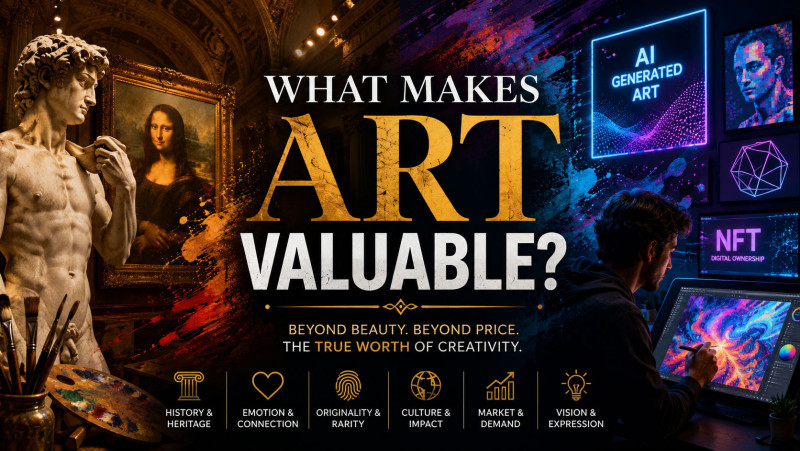
Walk into a museum and you may find a painting worth hundreds of millions of dollars hanging beside works created centuries ago. Visit a local gallery and you might discover an unknown artist selling equally beautiful pieces for a fraction of the price. Scroll through social media and you'll see digital artwork reaching millions of people, sometimes without ever being sold.
This raises a timeless question.
What actually makes art valuable?
Is it the skill of the artist?
The story behind the work?
Its rarity?
The emotional response it creates?
Or is value simply determined by what someone is willing to pay?
The answer is far more complex than a price tag.
Art has always existed at the intersection of creativity, culture, emotion, and economics. While markets can assign a monetary value to a painting or sculpture, the true worth of art often extends far beyond money.
Beauty Is Only Part of the Story
Many people assume valuable art must be visually beautiful.
History tells a different story.
Some of the world's most influential works challenge viewers rather than please them. Others appear surprisingly simple, while a few spark debate precisely because they break traditional artistic rules.
Art can be valuable because it:
- Tells a powerful story
- Challenges accepted ideas
- Captures an important moment
- Expresses human emotion
- Represents cultural identity
- Inspires conversation
- Changes how people see the world
Beauty may attract attention.
Meaning often gives art lasting significance.
The Artist Matters
The reputation of an artist can dramatically influence how their work is perceived.
Collectors often consider factors such as:
- Historical importance
- Originality
- Career achievements
- Influence on future artists
- Cultural impact
- Proven authenticity
When an artist reshapes an entire movement or introduces a new way of thinking, their work often becomes historically significant as well as financially valuable.
The artwork becomes part of a larger story.
Rarity Creates Demand
Like many collectibles, scarcity influences value.
A one-of-a-kind painting naturally attracts more attention than something reproduced thousands of times.
Collectors often seek works that are:
- Original
- Limited in number
- Authenticated
- Well preserved
- Historically documented
The fewer examples that exist, the greater their potential demand.
Scarcity alone, however, does not guarantee artistic importance.
Emotion Cannot Be Measured
Perhaps the most fascinating aspect of art is that its greatest value is often impossible to calculate.
A painting may remind someone of childhood.
A song can preserve memories for decades.
A photograph might capture a moment that changes how people understand history.
These emotional connections cannot be measured by auctions or market prices.
Art often becomes valuable because it creates experiences that remain long after someone leaves a gallery or finishes listening to a piece of music.
Culture Shapes Perception
Art rarely exists in isolation.
It reflects the society that creates it.
Throughout history, artistic works have documented:
- Political movements
- Religious beliefs
- Social change
- Scientific progress
- Cultural traditions
- Human struggles
- Everyday life
Centuries later, these works provide insight into civilizations that no longer exist.
Their value extends beyond aesthetics into historical preservation.
The Market Doesn't Always Decide
Art markets can influence prices dramatically.
Collectors, galleries, auction houses, and investors all play important roles.
Sometimes prices reflect genuine historical importance.
Other times, they are influenced by trends, speculation, or public attention.
History has repeatedly shown that overlooked artists can become celebrated decades after their deaths.
Likewise, works that once commanded enormous prices may later lose cultural relevance.
Markets determine financial value.
They do not always determine artistic significance.
Digital Art Is Redefining Ownership
Technology has expanded the definition of art itself.
Digital illustrations, animations, interactive experiences, and AI-assisted creations are now recognized alongside traditional forms.
Artists can publish work instantly to global audiences without relying on galleries.
Digital platforms have introduced new possibilities:
- Global exposure
- Direct audience support
- Interactive experiences
- Digital collections
- Creative collaboration
- New artistic mediums
The conversation is no longer limited to canvas and sculpture.
Art continues evolving alongside technology.
Can Artificial Intelligence Create Valuable Art?
Artificial intelligence has become one of the most controversial developments in modern creativity.
AI can generate paintings, music, illustrations, and poetry within seconds.
Supporters view it as another creative tool.
Critics question whether art created by algorithms carries the same emotional authenticity as work produced through human experience.
The debate is unlikely to end soon.
Instead, it challenges society to reconsider what creativity truly means.
Perhaps value lies not only in the finished work but also in the intention behind its creation.
Value Changes Over Time
Many masterpieces were not immediately recognized.
Some artists struggled financially throughout their lives.
Others gained recognition only after their work influenced future generations.
The significance of art often grows as society changes.
New audiences discover different meanings.
Historical context evolves.
What once seemed ordinary can later become extraordinary.
Time itself can become one of the greatest creators of value.
More Than a Price Tag
Art has never been valuable simply because someone placed a high price on it.
Its true worth comes from its ability to communicate ideas, preserve culture, inspire imagination, and connect people across generations.
Some works become priceless because they define an era.
Others become meaningful because they define a single person's life.
Whether displayed in a world-famous museum, painted on a neighborhood wall, created digitally, or shared online, art continues to remind us that creativity is one of humanity's most enduring achievements.
Money may determine what art sells for.
But its lasting value is often measured by something far more powerful, the impact it leaves on those who experience it.