



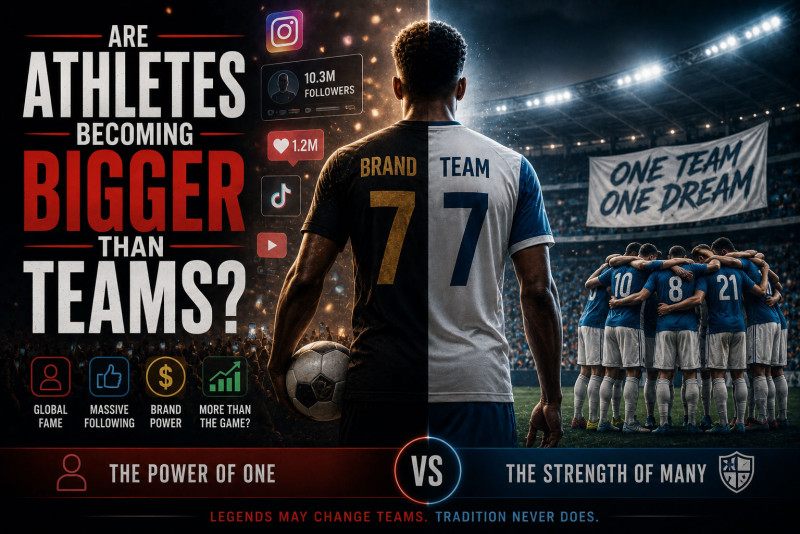
For generations, sports have been built around teams.
Supporters proudly wore club colors, celebrated championships together, and passed their loyalty from one generation to the next. Players came and went, but the identity of the team remained. A club was more than the athletes on the field, it represented a city, a history, and a community.
Today, that balance is beginning to change.
Social media, global broadcasting, sponsorships, and personal branding have transformed elite athletes into worldwide celebrities. Many fans now follow individual players more closely than the teams they represent, and a single transfer can shift millions of supporters from one club to another overnight.
This raises an intriguing question.
Are athletes becoming bigger than the teams themselves?
The Rise of the Personal Brand
Not long ago, fans primarily connected with athletes during games, interviews, or occasional magazine features.
Today, athletes communicate directly with millions of followers every day.
Through platforms like Instagram, YouTube, TikTok, and X, they share:
- Training sessions
- Personal milestones
- Business ventures
- Family moments
- Charity work
- Behind-the-scenes content
- Opinions and commentary
This constant connection has transformed athletes into personal brands that exist independently of their clubs.
For many supporters, following the athlete has become just as important as following the sport.
Global Stars Create Global Audiences
Modern sports are no longer limited by geography.
A football supporter in Brazil can follow a club in England.
A basketball fan in Europe can watch every NBA game.
A tennis player can build a worldwide fanbase regardless of nationality.
As broadcasting expanded globally, individual stars became international icons.
Many people now begin watching a sport because of a single athlete rather than a specific team.
That personal connection often remains even after the player changes clubs.
Transfers Move Millions of Fans
Professional sports have always involved transfers.
The difference today is the scale of their impact.
When a superstar joins a new team, the effects can be immediate:
- Millions of social media followers shift attention.
- Merchandise sales surge.
- Television audiences increase.
- Sponsorship opportunities expand.
- Global media coverage intensifies.
- New fans begin following the club.
In some cases, the athlete becomes the primary reason people watch the team.
The badge on the jersey becomes secondary to the name printed above the number.
Social Media Rewards Individuals
Algorithms naturally favor personalities over organizations.
A highlight from a famous athlete often reaches far more people than a team's official announcement.
Personal accounts frequently generate:
- Higher engagement
- More video views
- Greater sponsorship opportunities
- Stronger fan interaction
- Faster global reach
This creates an environment where athletes can build audiences that rival, or even surpass, the organizations employing them.
In the digital era, attention has become a valuable currency.
Teams Still Build Legacies
Despite the rise of superstar athletes, teams continue to provide something individuals cannot.
Clubs represent decades, or even centuries, of history.
They create traditions, rivalries, and identities that extend beyond any single generation of players.
Supporters celebrate:
- Historic championships
- Legendary coaches
- Club culture
- Local identity
- Community pride
- Shared memories
Players eventually retire.
Teams continue.
This enduring identity remains one of the strongest foundations of professional sports.
Business Has Changed the Game
Modern sports have evolved into global entertainment businesses.
Athletes increasingly launch their own companies, clothing brands, documentaries, investment funds, and media ventures.
Many have become entrepreneurs as well as competitors.
Their influence now extends beyond the field into industries such as:
- Fashion
- Technology
- Health
- Fitness
- Media
- Finance
- Entertainment
Success is no longer measured solely by trophies.
Brand value has become an important part of an athlete's legacy.
Fans Support People, Not Just Jerseys
The emotional relationship between fans and athletes has also changed.
Through documentaries, podcasts, and social media, supporters gain unprecedented insight into players' personalities.
Fans celebrate their successes.
Understand their struggles.
Follow their careers across multiple teams.
For younger audiences especially, loyalty often begins with a favorite athlete before expanding to the club they represent.
The connection feels more personal than ever before.
The Pressure of Being a Global Icon
Greater visibility brings greater expectations.
Today's elite athletes are expected to perform not only during competition but also as public figures.
They must manage:
- Media attention
- Sponsorship commitments
- Social media presence
- Public criticism
- Personal privacy
- Brand partnerships
Every interview, post, and performance can influence both reputation and commercial value.
Being a superstar now extends far beyond athletic ability.
The Future of Sports Fandom
Technology will continue strengthening personal connections between athletes and fans.
Artificial intelligence, immersive broadcasts, virtual reality, and direct-to-fan platforms may further reduce the distance between supporters and their favorite players.
Teams will remain central to professional sports.
But athletes are likely to become even more influential as global personalities.
The relationship between clubs and players will increasingly resemble a partnership between two powerful brands.
Bigger Than the Team, or Simply More Visible?
Elite athletes have never been more recognizable.
Their influence stretches across sports, business, entertainment, and culture.
Millions of people now follow individual careers with the same passion previous generations reserved for clubs alone.
Yet teams still provide the history, traditions, and communities that make sports meaningful.
Without clubs, there would be no rivalries, no championships, and no stage for athletes to become legends.
Rather than replacing teams, superstar athletes are redefining what fandom looks like in the digital age.
The future of sports is unlikely to belong exclusively to clubs or players.
It will belong to the powerful connection between both.