There was a time when buying something meant owning it.
You purchased software once, bought a movie to keep forever, or paid for a product that remained yours without additional fees. The transaction was simple, predictable, and permanent.
Today, that model is becoming increasingly rare.
From entertainment and productivity software to cloud storage, fitness apps, online education, and even household products, subscriptions have become the preferred business model for countless companies.
For businesses, recurring revenue provides stability.
For consumers, subscriptions offer convenience and lower upfront costs.
But as monthly payments quietly accumulate, many people are beginning to ask an important question:
Have we entered a subscription economy that is becoming difficult to escape?
Everything Is Becoming a Monthly Payment
Subscriptions were once limited to a handful of services.
Today, they are almost everywhere.
Consumers now subscribe to:
- Music streaming
- Video platforms
- Cloud storage
- Productivity software
- Design tools
- AI assistants
- Gaming services
- Fitness applications
- News publications
- Online learning platforms
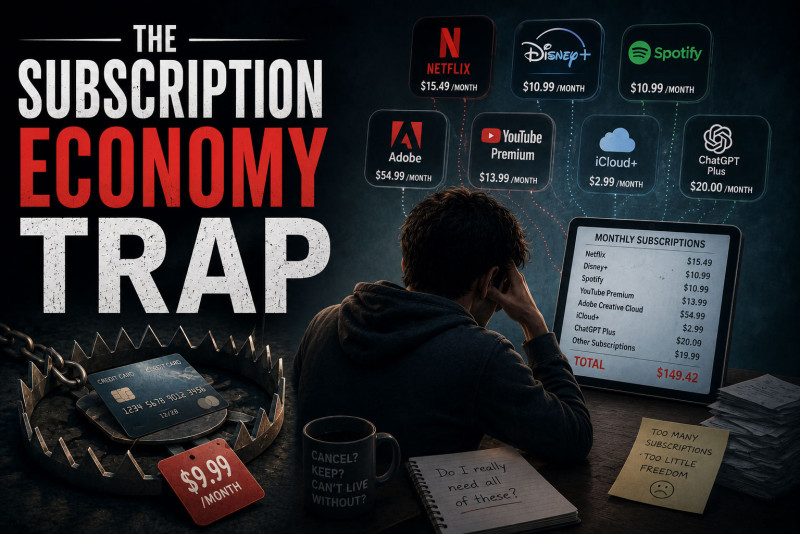
Each subscription may seem affordable on its own.
Together, they can represent a significant monthly expense.
Many people no longer realize how much they are spending until they review their bank statements.
Convenience Comes at a Cost
There is a reason subscriptions have become so popular.
They remove many traditional barriers.
Instead of paying hundreds of dollars upfront, customers gain immediate access for a relatively small monthly fee.
This approach offers several advantages:
- Lower initial cost
- Continuous updates
- Cloud synchronization
- Cross-device access
- Ongoing customer support
- New features delivered automatically
For many users, this flexibility is genuinely valuable.
The challenge arises when dozens of small payments quietly replace occasional larger purchases.
You Rarely Own What You Pay For
One of the biggest changes introduced by subscriptions is the concept of access instead of ownership.
When you stop paying:
- Software may stop working.
- Cloud storage becomes restricted.
- Streaming libraries disappear.
- Premium features are removed.
- Your account may lose important functionality.
Unlike traditional purchases, subscriptions often provide temporary permission rather than permanent ownership.
For many consumers, this shift happened gradually and almost unnoticed.
Businesses Love Predictable Revenue
It is easy to understand why companies embrace subscriptions.
Recurring revenue creates greater financial stability.
Instead of relying on occasional sales, businesses benefit from predictable monthly income that helps with:
- Hiring
- Product development
- Customer support
- Infrastructure planning
- Investor confidence
Subscription models also encourage companies to continually improve their products rather than relying solely on new customer acquisition.
When executed fairly, both businesses and customers benefit.
Subscription Fatigue Is Growing
Consumers are beginning to experience what many describe as subscription fatigue.
Managing numerous recurring payments has become increasingly frustrating.
Common concerns include:
- Forgotten subscriptions
- Rising monthly costs
- Price increases
- Multiple payment dates
- Duplicate services
- Paying for features rarely used
The simplicity that subscriptions originally promised can quickly become financial clutter.
Many people now spend time canceling services they no longer remember signing up for.
The Hidden Cost of Small Payments
Human psychology plays an important role in subscription pricing.
Ten dollars per month feels inexpensive.
Twenty dollars often seems reasonable.
Even fifty dollars may appear manageable.
However, dozens of subscriptions combined can easily exceed hundreds of dollars every month.
Because these payments are distributed over time, consumers often underestimate their total spending.
Small recurring costs frequently have a greater long-term financial impact than one-time purchases.
Are Consumers Really Saving Money?
Subscriptions are often marketed as affordable alternatives to traditional purchases.
In some cases, they truly are.
For software that receives constant updates or services that require ongoing infrastructure, recurring payments make practical sense.
In other situations, consumers may eventually pay far more than they would have through a one-time purchase.
The value depends on how frequently the service is used.
A subscription that improves daily productivity may justify its cost.
One used only occasionally may not.
Ownership Is Making a Quiet Comeback
Interestingly, some consumers are beginning to reconsider ownership.
Self-hosted software, DRM-free games, digital downloads, physical media, and lifetime licenses are attracting renewed interest.
Many people appreciate knowing that what they purchase remains available regardless of future subscription decisions.
Ownership provides something subscriptions cannot always guarantee:
Long-term control.
This shift reflects a growing desire for independence in an increasingly subscription-based world.
Finding the Right Balance
Subscriptions are not inherently good or bad.
Many provide exceptional value.
Others create unnecessary recurring expenses.
The key is intentional decision-making.
Before subscribing, it is worth asking:
- Will I use this regularly?
- Does it genuinely improve my life or work?
- Could I achieve the same result another way?
- Is ownership a better long-term option?
These questions help distinguish valuable services from unnecessary monthly commitments.
Paying for Value, Not Habit
The subscription economy is likely here to stay.
Recurring services have transformed how businesses operate and how consumers access products.
For many industries, subscriptions provide flexibility, continuous innovation, and reliable customer support.
At the same time, they have fundamentally changed our relationship with ownership.
The challenge is not avoiding subscriptions altogether.
It is ensuring that every recurring payment reflects genuine value rather than becoming another forgotten charge quietly accumulating month after month.
The smartest consumers are not necessarily those with the fewest subscriptions.
They are the ones who understand exactly what they are paying for, and why.