



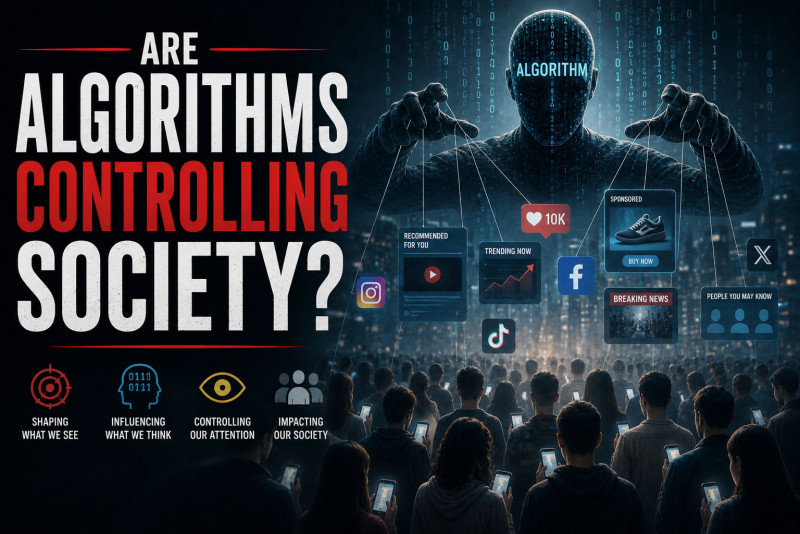
Every day, billions of decisions are made without people realizing that software played a role.
The videos we watch.
The news we read.
The products we buy.
The music we discover.
The routes our navigation apps recommend.
Even the people we connect with online are often influenced by algorithms working quietly in the background.
Most of the time, these systems are designed to make life more convenient.
They save time, personalize experiences, and help us navigate an overwhelming amount of information.
But as algorithms become more sophisticated, a larger question is emerging.
Are they simply helping us make decisions, or are they beginning to make those decisions for us?
What Is an Algorithm?
An algorithm is simply a set of instructions designed to solve a problem or complete a task.
They have existed long before computers.
Today's algorithms, however, process enormous amounts of data in real time.
Modern platforms use them to determine:
- Which videos appear first
- What news reaches your feed
- Which advertisements you see
- What products are recommended
- Which songs play next
- Who appears in search results
- Which social posts become viral
Without algorithms, much of the modern internet would be impossible to navigate.
The challenge is that convenience often comes with influence.
Personalization Is Powerful
Most people appreciate personalized experiences.
Instead of sorting through millions of choices, algorithms present content based on previous behavior.
They analyze patterns such as:
- Search history
- Viewing habits
- Purchases
- Likes
- Comments
- Watch time
- Location
- Interests
This personalization saves time.
It also quietly shapes future choices.
The more an algorithm learns about someone, the more effectively it predicts what will capture their attention.
Attention Has Become the Product
Many digital platforms operate on an advertising-driven business model.
Success often depends on keeping users engaged for as long as possible.
Algorithms are therefore optimized to maximize:
- Clicks
- Watch time
- User interaction
- Session length
- Content sharing
- Return visits
These objectives are not necessarily harmful.
However, they do influence which information receives the greatest visibility.
Content that generates strong emotional reactions often performs better than calm, balanced discussions.
As a result, algorithms may unintentionally reward controversy, outrage, or sensationalism.
The Invisible Editors
Traditional media relied on human editors to decide which stories appeared on the front page.
Today, many of those decisions are made automatically.
Algorithms now determine much of what billions of people see every day.
Unlike human editors, these systems continuously adjust based on user behavior.
Every click becomes feedback.
Every pause contributes new data.
Every interaction teaches the algorithm what to recommend next.
The result is an information environment that evolves constantly, often without users noticing.
Are We Living in Filter Bubbles?
Personalization creates another challenge.
When algorithms repeatedly recommend similar viewpoints, users may encounter fewer perspectives that challenge their existing beliefs.
This phenomenon is often described as a filter bubble.
Over time, people may primarily consume information that reinforces what they already think.
Potential consequences include:
- Reduced exposure to diverse opinions
- Increased political polarization
- Stronger confirmation bias
- Limited public debate
- Greater social division
Algorithms do not intentionally create these outcomes.
They simply optimize for engagement.
The unintended effects can still be significant.
Artificial Intelligence Is Accelerating the Trend
Recommendation systems are becoming increasingly intelligent.
Modern AI can understand language, recognize images, summarize information, and predict user preferences with remarkable accuracy.
Instead of merely recommending content, AI systems are beginning to:
- Answer questions directly
- Summarize articles
- Generate personalized responses
- Curate information
- Produce original content
This makes digital experiences faster and more convenient.
It also concentrates greater influence within the systems deciding what information users receive.
Convenience Versus Control
Algorithms offer undeniable benefits.
They help people discover new music.
Find relevant products.
Avoid traffic.
Translate languages.
Detect fraud.
Recommend educational content.
Without them, modern digital life would be far less efficient.
The concern is not their existence.
It is the growing dependence on systems that operate largely behind the scenes.
When recommendations become nearly invisible, influence becomes difficult to recognize.
Can People Regain Control?
Technology itself is not the problem.
Awareness is.
Users can make more intentional choices by:
- Following diverse sources
- Verifying information
- Searching beyond recommendations
- Supporting independent creators
- Limiting passive scrolling
- Understanding how platforms operate
Algorithms influence behavior.
They do not eliminate personal responsibility.
Critical thinking remains one of the most valuable skills in the digital age.
The Future Will Be Increasingly Algorithmic
Artificial intelligence will continue making recommendation systems more accurate.
Smart devices will become more personalized.
Search engines will provide more direct answers.
Digital assistants will anticipate user needs before questions are even asked.
Algorithms will become more deeply integrated into everyday life.
The challenge will be ensuring they remain tools that serve people rather than systems that quietly shape society without sufficient transparency or accountability.
The Choice Is Still Ours
Algorithms are not secretly controlling society.
They are influencing it.
There is an important difference.
They help organize information, improve efficiency, and simplify countless daily tasks.
At the same time, they shape what people discover, what captures attention, and sometimes even how opinions are formed.
The future is unlikely to involve a world without algorithms.
Instead, it will depend on building systems that are transparent, ethical, and designed to empower users rather than simply maximize engagement.
Technology should expand human choice, not quietly replace it.