



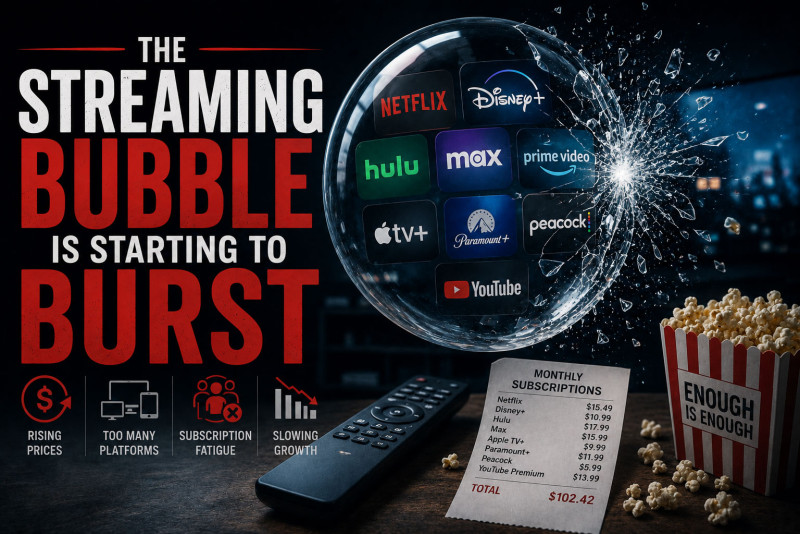
Streaming transformed entertainment faster than almost any technology before it.
What began as a simple alternative to cable television and physical media quickly evolved into a global industry worth hundreds of billions of dollars. For consumers, it promised unlimited entertainment at affordable prices. For studios, it offered direct access to audiences without relying on traditional broadcasters.
For a while, everyone seemed to win.
Today, however, the industry looks very different.
Subscription prices continue to rise. Exclusive content is scattered across dozens of competing platforms. Password sharing is being restricted. Advertising is returning. Consumers are beginning to cancel subscriptions they rarely use, while streaming companies are facing increasing pressure to remain profitable.
The era of effortless growth appears to be coming to an end.
Has the streaming bubble finally begun to burst?
The Golden Age of Streaming
When streaming services first emerged, they solved problems that frustrated millions of viewers.
People no longer needed to:
- Wait for scheduled television broadcasts
- Purchase DVDs
- Rent movies
- Watch excessive commercials
- Commit to long cable contracts
Instead, thousands of movies and television shows became available instantly for one affordable monthly fee.
It was a revolutionary shift that permanently changed how audiences consumed entertainment.
Competition Changed Everything
The success of early streaming platforms inspired nearly every major media company to launch its own service.
Today, consumers can choose from numerous platforms, each competing for exclusive content and subscriber growth.
This competition has produced impressive original programming, but it has also fragmented the viewing experience.
Instead of finding everything in one place, audiences now encounter content spread across multiple subscriptions.
To watch a handful of favorite shows, viewers may need to pay for several different services.
Subscription Costs Keep Rising
One of streaming's biggest selling points was affordability.
Over time, however, prices have steadily increased.
Many platforms now offer:
- Higher monthly fees
- Premium subscription tiers
- Ad-supported plans
- Family plans
- Additional charges for extra users
- Annual pricing options
Individually, these increases may seem manageable.
Combined, they can rival, or even exceed, the cost of traditional cable television that streaming originally sought to replace.
For many households, the financial advantage is becoming less obvious.
Exclusive Content Created New Problems
Original programming became the industry's primary competitive weapon.
Studios invested billions of dollars to produce exclusive movies, documentaries, and television series designed to attract new subscribers.
While audiences benefited from high-quality productions, exclusivity also created frustration.
Popular franchises became locked behind individual platforms.
Shows disappeared when licensing agreements changed.
Viewers found themselves constantly switching between subscriptions simply to keep up with their favorite content.
Convenience slowly gave way to fragmentation.
Advertising Is Making a Comeback
One of streaming's greatest attractions was the absence of commercials.
That promise is changing.
Many services now offer lower-priced plans supported by advertising.
Others encourage subscribers to upgrade to more expensive ad-free tiers.
This shift reflects a simple reality.
Subscription revenue alone is no longer sufficient for many companies to sustain continued growth and expensive content production.
Ironically, streaming is beginning to resemble the television model it once disrupted.
The Race for Growth Has Slowed
For years, investors rewarded streaming platforms based on subscriber growth.
As markets matured, attracting millions of new users became increasingly difficult.
Most households already subscribe to at least one streaming service.
Future growth now depends less on attracting new customers and more on:
- Reducing cancellations
- Increasing viewing time
- Raising subscription prices
- Expanding internationally
- Improving profitability
The focus has shifted from rapid expansion to sustainable business models.
Consumers Are Becoming More Selective
Subscription fatigue is changing consumer behavior.
Rather than maintaining numerous streaming services year-round, many people now rotate subscriptions.
A viewer might subscribe for one month to watch a particular series before canceling and moving to another platform.
This strategy allows consumers to reduce costs while still accessing the content they want.
It also creates new challenges for streaming companies attempting to retain subscribers over the long term.
Content Alone Is No Longer Enough
The streaming market has become crowded.
Every platform offers thousands of titles.
Every service produces original content.
As competition intensifies, simply creating more shows may no longer guarantee success.
Consumers increasingly value:
- Strong libraries
- Fair pricing
- Reliable recommendations
- High-quality streaming
- User-friendly interfaces
- Flexible subscription options
- Consistent content releases
The overall experience has become just as important as the content itself.
What Comes Next?
Streaming is not disappearing.
It has fundamentally changed how people consume entertainment.
The industry is simply entering a more mature phase.
Future success will likely depend on balancing profitability with customer satisfaction.
Companies that continually increase prices while reducing value may struggle to retain subscribers.
Those that prioritize quality, transparency, and convenience are more likely to build lasting relationships with audiences.
Innovation will continue, but growth is unlikely to resemble the explosive expansion of the past decade.
The Future Belongs to Value
The streaming revolution changed entertainment forever.
It made movies, television, documentaries, and live content more accessible than ever before.
But no industry can grow indefinitely without adapting.
The current challenges facing streaming platforms do not necessarily signal collapse.
Instead, they reflect a natural transition from rapid disruption to long-term sustainability.
Consumers have more choices than ever, and they are becoming increasingly thoughtful about where they spend their money.
In the years ahead, the platforms that succeed will not simply offer the largest libraries or the biggest budgets.
They will be the ones that consistently deliver genuine value, respect their subscribers, and remember why audiences embraced streaming in the first place.