



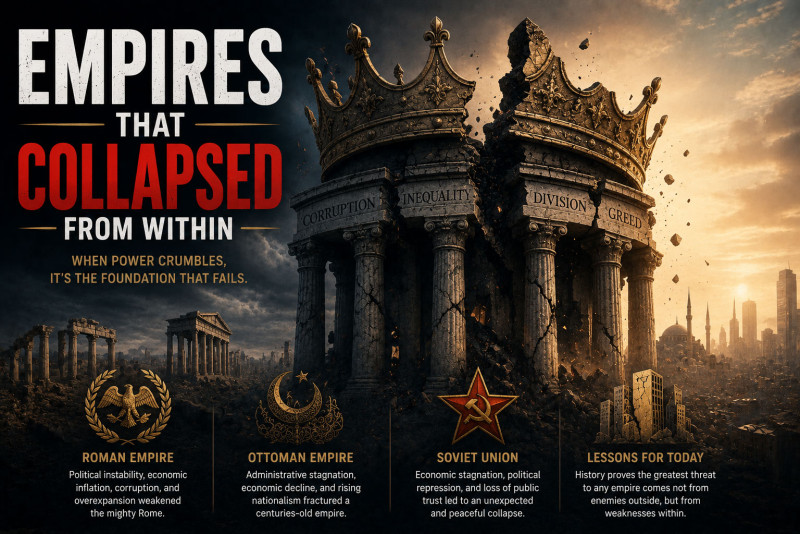
History often remembers empires for the wars they fought, the territories they conquered, and the monuments they left behind.
From ancient civilizations to global superpowers, empires have shaped the course of humanity by expanding trade, spreading culture, and redefining political borders.
Yet while many fell after devastating invasions or military defeats, some of history's greatest empires were undone by something far less visible.
They collapsed from within.
Corruption, economic instability, political division, declining public trust, and institutional decay gradually weakened these powerful states long before external enemies delivered the final blow.
Their stories remind us that the greatest threat to a nation is not always at its borders.
Sometimes, it begins at its center.
Power Can Hide Weakness
At their height, empires often appear invincible.
Their economies grow.
Their armies expand.
Their influence stretches across continents.
To outsiders, their strength seems permanent.
Internally, however, cracks may already be forming.
Warning signs often include:
- Political instability
- Increasing corruption
- Economic inequality
- Declining public confidence
- Bureaucratic inefficiency
- Leadership struggles
- Social unrest
These problems rarely emerge overnight.
They develop gradually, often becoming visible only after significant damage has already been done.
The Roman Empire's Slow Decline
The Roman Empire remains one of history's most influential civilizations.
Its legal systems, engineering achievements, and military organization shaped much of the modern world.
Yet Rome's decline was not caused by a single event.
For centuries, the empire struggled with:
- Political instability
- Civil wars
- Economic inflation
- Heavy taxation
- Corruption
- Declining military discipline
- Administrative complexity
External invasions accelerated Rome's fall, but many historians argue that internal weaknesses had already made the empire increasingly vulnerable.
Its collapse was a long process rather than a sudden catastrophe.
The Ottoman Empire and Administrative Stagnation
For more than six centuries, the Ottoman Empire controlled vast territories across Europe, Asia, and Africa.
It connected cultures, expanded trade, and became one of history's great political powers.
Over time, however, internal challenges grew.
Among them were:
- Administrative inefficiency
- Economic pressures
- Technological stagnation
- Political rivalries
- Growing nationalism within its territories
As neighboring nations modernized, the empire struggled to reform quickly enough to remain competitive.
Its gradual decline illustrates how resisting necessary change can weaken even the strongest institutions.
The Soviet Union's Internal Pressures
The collapse of the Soviet Union surprised much of the world.
Although international competition played an important role, internal factors proved equally significant.
These included:
- Economic stagnation
- Bureaucratic inefficiency
- Political dissatisfaction
- Limited economic reform
- Public distrust
- Rising regional tensions
As internal pressures intensified, maintaining unity became increasingly difficult.
The Soviet Union ultimately dissolved without a major foreign invasion.
Its collapse demonstrated that economic and political stability are deeply connected.
Economic Strength Is Never Guaranteed
Strong economies often support powerful nations.
Weak economies can quietly undermine them.
Throughout history, financial instability has contributed to imperial decline through:
- Unsustainable debt
- Inflation
- Resource shortages
- Declining productivity
- Wealth inequality
- Reduced public investment
Economic crises rarely affect governments alone.
They influence employment, public confidence, military readiness, and social cohesion.
Prosperity can disappear surprisingly quickly when structural problems remain unresolved.
Public Trust Holds Nations Together
Governments depend on more than military strength.
They also depend on legitimacy.
When citizens lose confidence in institutions, maintaining stability becomes increasingly difficult.
Public trust can erode because of:
- Corruption
- Political polarization
- Unequal justice
- Economic hardship
- Poor leadership
- Lack of transparency
History repeatedly shows that societies become more resilient when institutions earn public confidence rather than simply demand obedience.
Trust is often one of a nation's most valuable assets.
Change Is Often Resisted
Many declining empires recognized their problems.
The challenge was responding to them.
Large institutions frequently struggle to reform because change threatens established interests.
As a result:
- Necessary reforms are delayed.
- Problems become more expensive to solve.
- Public frustration increases.
- Competitors gain advantages.
- Opportunities disappear.
History rewards adaptability.
Nations that embrace innovation often remain competitive longer than those that resist transformation.
Modern Nations Face Similar Challenges
Today's world differs dramatically from ancient empires.
Technology has transformed communication.
Global trade connects economies.
Information spreads instantly.
Yet many historical lessons remain surprisingly relevant.
Modern societies continue confronting issues such as:
- Political division
- Economic inequality
- Institutional trust
- Technological disruption
- Demographic change
- Global competition
While circumstances differ, the underlying principles of stability remain remarkably consistent.
Strong institutions require constant maintenance.
Decline Is Rarely Sudden
Popular culture often portrays the collapse of civilizations as dramatic events.
Reality is usually far less spectacular.
Decline often unfolds over decades.
Small problems accumulate.
Warnings are ignored.
Short-term solutions replace long-term planning.
By the time the consequences become obvious, reversing the trend may require extraordinary effort.
Understanding this gradual process helps explain why powerful societies sometimes struggle to recognize their own vulnerabilities.
The Greatest Lessons From History
History is not merely a record of victories and defeats.
It is a collection of lessons about leadership, governance, resilience, and human behavior.
The empires that endured the longest were rarely perfect.
They adapted.
They reformed.
They invested in institutions.
They recognized that power alone could not guarantee permanence.
The greatest civilizations were not destroyed simply because external enemies became stronger.
Many became vulnerable because internal problems quietly weakened the foundations that once made them great.
History reminds us that lasting strength is built from within.
Military power, economic prosperity, and technological advancement all matter.
But without trust, effective institutions, responsible leadership, and the willingness to adapt, even the mightiest empires can become surprisingly fragile.