



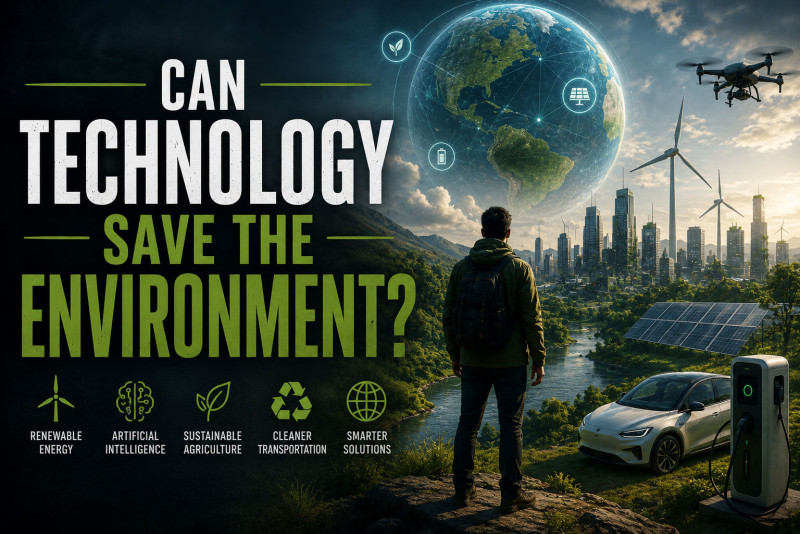
Few challenges are as urgent, or as complex, as protecting the environment.
From climate change and deforestation to pollution and biodiversity loss, the world faces environmental issues that affect every country, every economy, and every generation. Governments, businesses, scientists, and communities are searching for solutions that can reduce humanity's impact while supporting a growing global population.
Technology is often presented as the answer.
Electric vehicles, renewable energy, artificial intelligence, carbon capture, smart agriculture, and advanced recycling systems are frequently described as breakthroughs that could help build a more sustainable future.
But can technology truly save the environment?
Or is it only one piece of a much larger solution?
Technology Has Already Changed the Way We Live
Throughout history, innovation has transformed society.
Advances in medicine have extended life expectancy.
Modern transportation has connected continents.
Digital communication has made information instantly accessible.
Environmental technology is following a similar path.
Today, innovation is helping reduce emissions, improve energy efficiency, and monitor ecosystems with a level of precision that was impossible just a few decades ago.
The question is no longer whether technology can help.
It is how much of the solution it can realistically provide.
Renewable Energy Is Reshaping Power Generation
One of the most visible examples of environmental technology is renewable energy.
Around the world, countries are investing in cleaner alternatives to fossil fuels, including:
- Solar power
- Wind energy
- Hydroelectric generation
- Geothermal energy
- Offshore wind farms
- Advanced battery storage
These technologies are reducing dependence on traditional energy sources while making electricity production cleaner and more sustainable.
As costs continue to fall, renewable energy is becoming increasingly competitive with conventional power generation.
Artificial Intelligence Is Improving Efficiency
Artificial intelligence is often associated with automation and productivity, but it is also becoming an important environmental tool.
AI helps researchers and organizations:
- Monitor deforestation
- Predict extreme weather
- Optimize energy consumption
- Improve traffic management
- Detect water leaks
- Analyze climate data
- Support precision agriculture
By processing enormous amounts of information, AI enables faster decisions that can reduce waste and improve resource management.
Technology is making environmental protection smarter as well as faster.
Agriculture Is Becoming More Sustainable
Feeding billions of people while protecting natural resources is one of the world's greatest challenges.
Modern farming technologies are helping farmers produce more while using fewer resources.
Innovations include:
- Precision irrigation
- Drone monitoring
- Soil sensors
- Automated equipment
- Satellite imaging
- Data-driven crop management
These tools help reduce water consumption, minimize fertilizer use, and improve crop yields without expanding farmland unnecessarily.
Sustainable agriculture increasingly depends on information as much as machinery.
Cleaner Transportation Is Expanding
Transportation remains a major source of global emissions.
New technologies are changing how people and goods move around the world.
Current innovations include:
- Electric vehicles
- Hydrogen-powered transport
- Improved public transit
- Sustainable aviation fuels
- Battery advancements
- Smart traffic systems
While challenges remain, including charging infrastructure and battery production, transportation is steadily becoming more efficient.
The transition will likely take decades, but progress is already visible.
Technology Has Its Own Environmental Costs
Innovation is not without consequences.
Producing advanced technologies requires raw materials, manufacturing, and global supply chains.
Electronic waste continues to grow.
Mining for battery materials affects ecosystems.
Data centers consume significant amounts of electricity.
Even renewable technologies require resources to manufacture and maintain.
Every technological solution introduces new environmental considerations.
This does not mean innovation should stop.
It means sustainability must extend across the entire lifecycle of new technologies.
Human Behavior Still Matters
Technology can create opportunities.
People determine whether those opportunities become meaningful change.
Simple choices continue to have a significant impact:
- Conserving energy
- Reducing waste
- Recycling responsibly
- Supporting sustainable products
- Using public transportation
- Protecting natural habitats
- Consuming resources thoughtfully
Even the most advanced technology cannot solve environmental problems if society continues using resources without considering long-term consequences.
Innovation works best when paired with responsible behavior.
Governments and Businesses Share Responsibility
Large-scale environmental progress depends on more than individual action.
Governments establish policies.
Businesses develop new technologies.
Researchers create scientific breakthroughs.
Investors fund innovation.
Communities adopt sustainable practices.
Environmental success requires cooperation across every sector of society.
No single organization, or single invention, can solve global environmental challenges alone.
The Future Will Depend on Balance
Technology is advancing at an extraordinary pace.
Artificial intelligence, robotics, renewable energy, biotechnology, and advanced materials will continue opening new possibilities for environmental protection.
Yet the future is unlikely to be shaped by technology alone.
Success will depend on balancing innovation with conservation, economic growth with sustainability, and progress with responsibility.
The goal is not simply to invent cleaner technologies.
It is to build systems that allow people and the planet to thrive together.
Innovation Is Part of the Solution
Technology has already improved countless aspects of environmental protection.
It has made energy cleaner, agriculture more efficient, transportation more sustainable, and scientific research more powerful.
But expecting technology alone to save the environment places too much responsibility on innovation while overlooking the importance of human choices.
The greatest environmental progress will come when technology, policy, business, and individual responsibility work together toward the same goal.
Innovation gives humanity remarkable tools.
How we choose to use them may ultimately determine the future of our planet.