



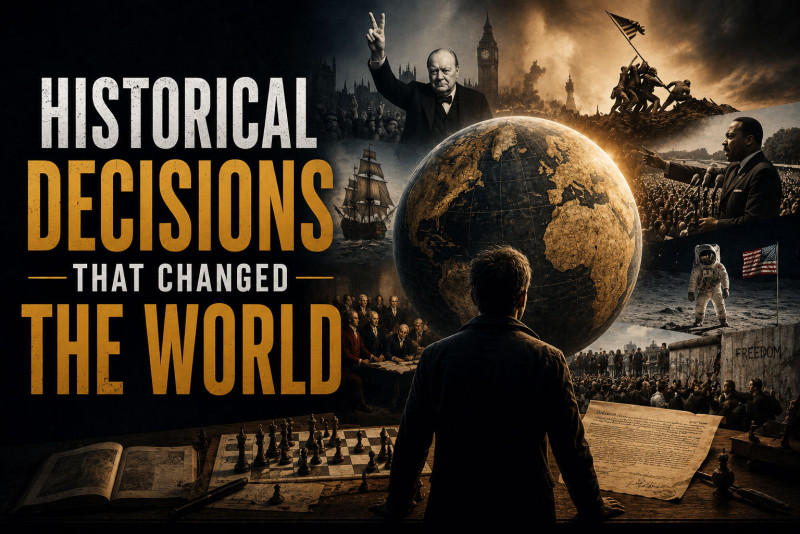
History is often remembered through wars, revolutions, and extraordinary individuals.
Yet behind many of the world's defining moments lies something much simpler, a decision.
A signature on a document.
A vote in a government chamber.
A military command.
A scientific investment.
A political compromise.
Some decisions seemed relatively small at the time. Others were surrounded by controversy and uncertainty. But together, they altered the course of civilizations, influenced generations, and reshaped the world we live in today.
Looking back, it becomes clear that history is not only shaped by what happens, but by the choices people make when faced with moments of uncertainty.
The Decision to Cross Unknown Oceans
For thousands of years, much of the world remained disconnected.
When European powers decided to invest in long-distance exploration, they were driven by trade, competition, and curiosity.
Those decisions led to:
- New trade routes
- Global exploration
- Cultural exchange
- Scientific discoveries
- Colonial expansion
- The movement of people, goods, and ideas across continents
They also brought conflict, exploitation, and lasting consequences for indigenous populations.
Few decisions in history transformed the global map as dramatically as the choice to explore beyond familiar horizons.
Investing in the Industrial Revolution
The Industrial Revolution did not begin because a single machine was invented.
It accelerated because governments, entrepreneurs, and investors chose to embrace new technologies instead of preserving older ways of working.
Their decisions reshaped society through:
- Mass manufacturing
- Railways
- Steam power
- Urban growth
- Modern factories
- Global commerce
The world moved from largely agricultural economies to industrial societies in just a few generations.
Modern life still reflects those choices.
Choosing Diplomacy Over Endless Conflict
History contains countless wars.
It also contains remarkable moments where leaders chose negotiation instead of continued violence.
Peace agreements, international cooperation, and diplomatic partnerships have often prevented conflicts from expanding even further.
These decisions helped establish:
- International alliances
- Trade cooperation
- Global institutions
- Diplomatic frameworks
- Long-term regional stability
While diplomacy rarely dominates history books as dramatically as war, its impact can be just as significant.
Funding Scientific Discovery
Many of humanity's greatest achievements began with decisions to invest in research rather than immediate results.
Governments, universities, and private organizations supported projects that initially seemed uncertain.
Those investments eventually contributed to advances in:
- Medicine
- Space exploration
- Telecommunications
- Computing
- Renewable energy
- Biotechnology
Progress often depends on decisions whose benefits may not become visible for decades.
Building the Internet
The internet did not emerge overnight.
It evolved through decades of scientific collaboration, technological innovation, and public investment.
The decision to expand digital communication fundamentally changed how humanity:
- Shares information
- Conducts business
- Learns
- Communicates
- Shops
- Creates entertainment
- Builds communities
Today, billions of people rely on technologies that originated from decisions made long before smartphones and social media existed.
The digital world is built upon choices that prioritized connectivity over isolation.
Opening Global Markets
Economic policies have repeatedly reshaped international relationships.
As countries reduced trade barriers and expanded global commerce, businesses gained access to larger markets and consumers gained access to products from around the world.
Globalization brought significant benefits:
- Increased trade
- Economic growth
- Technological exchange
- International investment
- Faster innovation
It also introduced new challenges, including supply chain dependence, labor competition, and economic inequality.
The effects continue to shape global politics today.
Decisions That Changed Everyday Life
Not every world-changing decision occurred on a battlefield or inside a parliament.
Some transformed ordinary life in unexpected ways.
Choosing to develop public education systems expanded literacy.
Investing in vaccination programs dramatically improved public health.
Building transportation networks connected communities that had once been isolated.
Supporting scientific research led to technologies that millions now use every day without a second thought.
History is often made through practical decisions that quietly improve daily life.
The Weight of Leadership
Leadership has always involved uncertainty.
The people making history rarely knew how future generations would judge their choices.
Every major decision carried risk.
Some produced remarkable progress.
Others led to unintended consequences that lasted for centuries.
The difference between success and failure often depended on information that was unavailable at the time.
Looking backward provides clarity that decision-makers themselves never possessed.
Today's Decisions Will Become Tomorrow's History
It is easy to think of history as something completed.
In reality, history is unfolding every day.
Governments are making decisions about:
- Artificial intelligence
- Climate policy
- Energy
- Healthcare
- Space exploration
- Cybersecurity
- Education
Businesses are shaping future industries through innovation and investment.
Scientists are pushing the boundaries of knowledge.
Communities are redefining how societies function.
Many of today's headlines may become tomorrow's history lessons.
The Legacy of Choice
History reminds us that the future is rarely inevitable.
Major turning points are often created not by chance alone, but by people willing to make difficult decisions during uncertain times.
Some choices lead to innovation.
Others prevent conflict.
Some create prosperity.
Others serve as cautionary lessons for future generations.
Every era inherits the consequences of decisions made before it.
And every generation leaves behind decisions that will shape those still to come.
Understanding history means understanding the power of choice.
Because while individuals may not control every event, the decisions they make can influence the course of the world in ways that are impossible to predict at the moment they are made.