



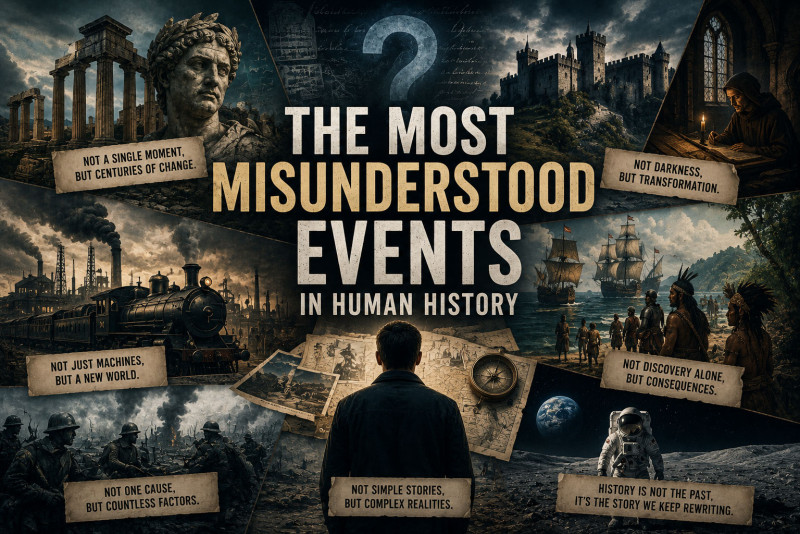
History is often presented as a collection of facts.
Dates are memorized, battles are summarized, and famous figures are reduced to a few paragraphs in textbooks. While this approach makes history easier to teach, it also creates a problem: complex events become simplified until they lose much of their original meaning.
Many of history's defining moments are remembered not because people fully understand them, but because a particular narrative has been repeated for generations.
The reality is often far more complicated.
Every historical event unfolds through countless political decisions, economic pressures, cultural shifts, and human ambitions. Reducing these moments to a single cause or a single hero rarely tells the complete story.
Understanding history requires more than remembering what happened. It requires asking why it happened and recognizing that there are often multiple perspectives.
History Is Written Through Human Perspective
One of the oldest sayings about history is that it is written by the victors.
While this isn't always literally true, it highlights an important point: every historical account is shaped by the people recording it.
Historians rely on surviving evidence, including:
- Government records
- Personal letters
- Newspapers
- Archaeological discoveries
- Diaries
- Official documents
- Oral traditions
Each source carries its own biases, limitations, and cultural context.
As new evidence emerges, historians frequently revisit long-held assumptions, leading to a deeper understanding of events once thought to be settled.
History is not constantly changing because facts are unreliable.
It changes because our understanding becomes more complete.
The Fall of the Roman Empire Was Not a Single Event
Many people imagine the Roman Empire collapsing almost overnight.
In reality, its decline unfolded over centuries.
A combination of factors gradually weakened one of history's greatest civilizations, including:
- Political instability
- Economic challenges
- Military pressures
- Internal divisions
- Population changes
- External invasions
There was no single day when Rome simply fell.
Instead, generations witnessed the slow transformation of an empire that eventually evolved into something entirely different.
History often favors dramatic endings, even when reality is much more gradual.
The Middle Ages Were Not Simply the "Dark Ages"
The period following the fall of the Western Roman Empire is frequently portrayed as an age of ignorance and stagnation.
Modern scholarship paints a far more balanced picture.
During the Middle Ages, many important developments took place:
- Universities emerged.
- Gothic architecture flourished.
- Agricultural innovations increased food production.
- Trade expanded across continents.
- Scientific knowledge continued to develop in many parts of the world.
While Europe experienced periods of instability, other civilizations made extraordinary advances in mathematics, medicine, astronomy, engineering, and philosophy.
The world never stopped progressing.
It simply progressed differently in different regions.
The Industrial Revolution Changed More Than Machines
The Industrial Revolution is often remembered as the beginning of modern manufacturing.
Its impact extended far beyond factories.
It fundamentally reshaped society by influencing:
- Urbanization
- Education
- Transportation
- Global trade
- Labor rights
- Public health
- Family life
Millions of people left rural communities for rapidly growing cities.
Entire economies shifted toward industrial production.
Many of today's modern institutions emerged during this period of dramatic transformation.
Understanding the Industrial Revolution means recognizing its social consequences, not just its technological achievements.
Wars Rarely Begin for a Single Reason
History books often identify one event that triggered a major conflict.
While specific incidents may serve as catalysts, wars almost always develop from years—or even decades—of growing tensions.
Political rivalries, economic competition, territorial disputes, cultural differences, and diplomatic failures frequently combine to create conditions where conflict becomes increasingly likely.
Focusing on a single event can obscure the deeper forces that made war possible in the first place.
History is rarely driven by isolated moments.
It is shaped by long chains of interconnected decisions.
Exploration Was More Than Discovery
The great age of exploration is often described through stories of courageous voyages and remarkable discoveries.
Those achievements were certainly significant.
However, exploration also brought profound consequences for indigenous populations around the world.
Its legacy includes:
- Cultural exchange
- Scientific advancement
- Global trade
- Colonization
- Disease
- Conflict
- Economic transformation
Understanding exploration requires acknowledging both its achievements and its costs.
History becomes more meaningful when multiple perspectives are considered together.
The Digital Age Is Becoming History Too
Many people think of history as something distant.
In reality, today's events will become tomorrow's historical record.
Future historians may study:
- The rise of the internet
- Social media
- Artificial intelligence
- Climate policy
- Global pandemics
- Space exploration
- Digital economies
Just as we debate the causes of past events, future generations will likely debate the decisions being made today.
History is never truly finished.
It is constantly being written.
Why Misunderstandings Persist
Historical misunderstandings survive for many reasons.
Some stories become simplified because they are easier to teach.
Others become shaped by politics, culture, or national identity.
Popular films, novels, documentaries, and social media can further reinforce familiar narratives, even when historians present more nuanced interpretations.
This does not necessarily make these stories false.
It simply means they are often incomplete.
The more we learn, the more we recognize that history rarely fits into simple categories of right and wrong, hero and villain, victory and defeat.
Why History Still Matters
Studying history is not about memorizing names and dates.
It is about understanding how societies change, how decisions shape generations, and how human behavior often repeats across time.
History reminds us that progress is rarely inevitable.
Civilizations rise.
Institutions evolve.
Technologies transform society.
Ideas spread across borders.
Challenges that seem unique today often echo problems faced centuries ago.
By examining the past with curiosity rather than certainty, we become better equipped to understand the present and make wiser decisions about the future.
The greatest lesson history offers may be that it is always more complex, more human, and more fascinating than the simplified versions we often inherit.