



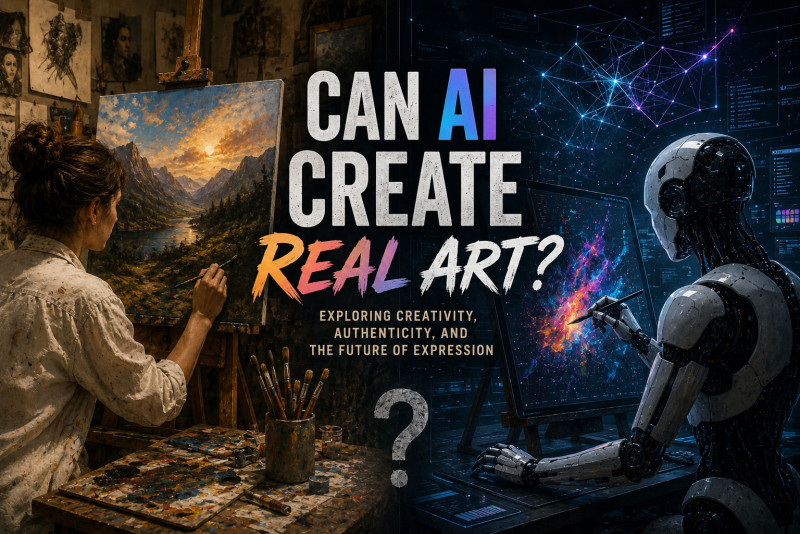
For centuries, art has been one of humanity's most personal forms of expression.
From cave paintings and sculptures to music, literature, photography, and digital design, every generation has found new ways to communicate ideas, emotions, and stories through creativity. While the tools have evolved, one belief has remained remarkably consistent: art is something created by people.
Artificial intelligence is challenging that assumption.
Today, AI can generate paintings, compose music, write poetry, design logos, and even produce realistic videos within seconds. What once required years of technical skill can now be accomplished with a carefully written prompt.
This rapid evolution has sparked one of the biggest cultural debates of the digital age.
If a machine creates something beautiful, meaningful, or emotionally moving, can it truly be called art?
Art Has Always Evolved With Technology
Every major technological advancement has changed the way artists work.
Photography transformed portrait painting.
Digital cameras changed filmmaking.
Graphic tablets reshaped illustration.
Computer software revolutionized music production.
In almost every case, new technology was initially met with skepticism before eventually becoming another creative tool.
Artificial intelligence may simply be the next chapter in that story.
The difference is that previous tools still relied heavily on human execution.
AI can now produce finished works with minimal technical input from the user.
That changes the conversation entirely.
What Does AI Actually Create?
Artificial intelligence does not experience inspiration in the way humans do.
It does not dream, remember childhood experiences, or attach emotions to a canvas.
Instead, AI analyzes enormous amounts of existing information and identifies patterns.
It learns from:
- Paintings
- Photography
- Music
- Literature
- Graphic design
- Film
- Architecture
Using those patterns, it generates something new based on the instructions it receives.
Supporters argue that this process resembles how humans learn throughout their lives.
Critics argue that AI is fundamentally different because it lacks personal experience, intention, and emotional understanding.
Is Creativity More Than Skill?
Many people associate creativity with technical ability.
History suggests otherwise.
Two artists can use the same brush, the same paints, and the same subject, yet produce completely different works because each brings unique experiences and perspectives.
Creativity often involves:
- Personal memories
- Emotional expression
- Cultural influences
- Life experiences
- Individual interpretation
- Original ideas
These elements cannot easily be measured.
While AI can imitate artistic styles with remarkable accuracy, whether it can replicate genuine human experience remains an open question.
The Role of the Human Creator
One reason opinions differ is that AI rarely works entirely alone.
Behind every generated image, song, or story is usually a person making decisions.
That person chooses:
- The concept
- The style
- The subject
- The composition
- The revisions
- The final selection
Some argue that AI is simply another creative instrument, much like a camera or digital editing software.
Others believe the technology performs so much of the creative process that it changes the nature of authorship itself.
The answer may depend on how much creative direction the human provides.
Opportunities for Artists
Despite understandable concerns, AI also offers significant advantages.
Many artists now use it to accelerate parts of their workflow rather than replace creativity altogether.
AI can help with:
- Brainstorming ideas
- Creating concept art
- Testing compositions
- Editing images
- Generating references
- Automating repetitive tasks
For independent creators with limited budgets, these tools can reduce production costs and make ambitious projects more achievable.
Rather than replacing artists, AI may expand what individual creators are capable of producing.
The Concerns Cannot Be Ignored
The rise of AI has also raised difficult ethical and economic questions.
Many artists worry about:
- Copyright and ownership
- Training data used without permission
- Job displacement
- Loss of creative opportunities
- Market saturation
- Difficulty distinguishing human-made work from AI-generated content
These concerns extend beyond individual careers.
They touch on broader questions about fairness, intellectual property, and the value society places on human creativity.
As AI continues to improve, these discussions are likely to become even more important.
Does the Audience Decide What Counts as Art?
Throughout history, art has often been defined by the emotional response it creates.
A painting does not become meaningful because of the brush used.
It becomes meaningful because of the connection people feel when they experience it.
If an AI-generated image inspires wonder, nostalgia, or reflection, some argue that it has already fulfilled one of art's primary purposes.
Others believe that knowing a human lived the experiences behind a work adds depth that artificial intelligence simply cannot replicate.
Perhaps the debate is less about the artwork itself and more about the story behind its creation.
The Future of Human Creativity
Artificial intelligence is unlikely to replace creativity.
Instead, it may redefine it.
Future artists may combine traditional techniques with AI-assisted tools in ways that seem completely natural to the next generation.
Just as photographers are still considered artists despite using cameras, tomorrow's creators may be recognized for how they direct AI rather than how they manually produce every detail.
Creative expression has always adapted to new technologies.
There is little reason to believe that will change now.
The Question We Are Really Asking
The debate surrounding AI art is about more than technology.
It challenges our understanding of creativity, originality, and what it means to be human.
Perhaps the real question is not whether AI can create art.
It is whether art is defined by the finished work, the creative process, or the person behind it.
As artificial intelligence becomes an increasingly common creative partner, society will continue exploring where the line between tool and creator truly exists.
That answer may shape not only the future of art, but the future of creativity itself.