



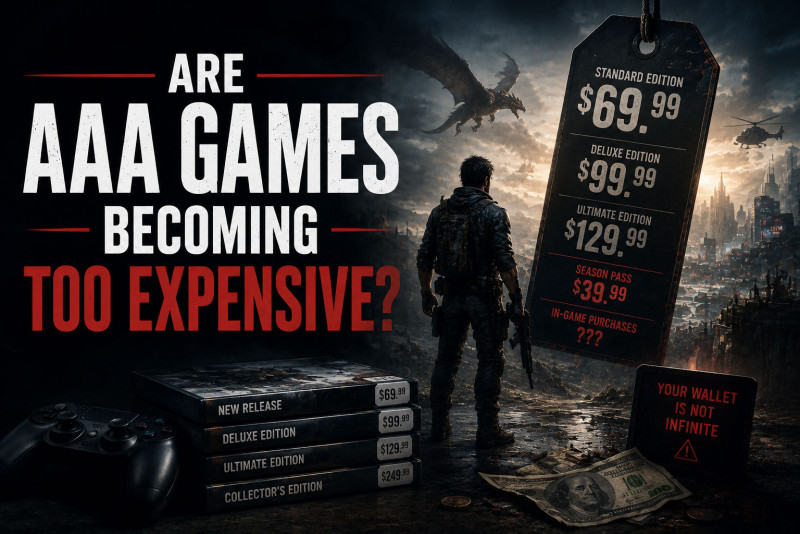
The video game industry has never been larger.
Blockbuster releases generate billions of dollars, gaming communities span every continent, and technological advances continue to push the boundaries of realism. Modern AAA games feature vast open worlds, lifelike characters, cinematic storytelling, and production values that rival Hollywood films.
Yet alongside this growth, another trend has become impossible to ignore.
Games are becoming significantly more expensive—not just to develop, but also to buy and play.
As development costs continue to rise, publishers are introducing higher retail prices, premium editions, season passes, downloadable content, cosmetic purchases, and battle passes. For many players, buying a single game is no longer the end of the purchase. It is often just the beginning.
The question is no longer whether games cost more to make.
It is whether the modern pricing model still delivers fair value to players.
The Cost of Building Modern Games
Creating a major AAA title is an enormous undertaking.
Large studios may spend five to seven years developing a single game while employing hundreds—or even thousands—of artists, programmers, designers, writers, composers, and testers.
Modern development budgets often include:
- Motion capture
- Professional voice acting
- Cinematic animation
- Massive open-world environments
- Advanced physics systems
- Online infrastructure
- Years of post-launch support
Marketing can add hundreds of millions of dollars to a game's total investment.
From a publisher's perspective, rising prices are often presented as a reflection of these increasing production costs.
The Price Tag Keeps Growing
For many years, the standard price for a major console game remained relatively stable.
Recently, however, many publishers have adopted higher launch prices.
At the same time, players increasingly encounter additional purchases such as:
- Deluxe editions
- Collector's editions
- Early access packages
- Expansion passes
- Cosmetic items
- In-game currency
- Battle passes
While each option may be voluntary, together they create a gaming ecosystem where the total cost can be significantly higher than the advertised retail price.
For dedicated fans, spending well over one hundred dollars on a single title is becoming increasingly common.
Bigger Doesn't Always Mean Better
One justification for higher prices is that games are larger than ever before.
Many modern titles offer hundreds of hours of gameplay.
But size alone does not guarantee quality.
Some players argue that many open-world games have become filled with repetitive objectives designed to extend playtime rather than improve the overall experience.
A shorter, carefully crafted adventure may leave a stronger impression than a sprawling world filled with repetitive tasks.
Players increasingly value meaningful experiences over sheer quantity.
Live Service Has Changed Expectations
Many publishers no longer view a game as a finished product released on launch day.
Instead, games are treated as ongoing platforms that evolve through continuous updates.
This approach offers clear benefits:
- New content
- Community events
- Competitive seasons
- Regular improvements
- Long-term support
However, it also introduces recurring monetization.
Players may find themselves making purchases months or even years after buying the game.
For some communities, this creates an engaging long-term experience.
For others, it raises concerns about where entertainment ends and continuous spending begins.
Independent Games Are Changing the Conversation
While blockbuster budgets continue to grow, independent developers have demonstrated that great games do not always require enormous investments.
Many indie titles succeed through:
- Original gameplay
- Strong storytelling
- Unique artistic direction
- Creative mechanics
- Passionate development teams
These games often cost significantly less while earning widespread praise from players and critics alike.
Their success reminds the industry that innovation does not always depend on the size of a budget.
Technology Is Both Helping and Hurting
Modern development tools have made many aspects of game creation more efficient.
Artificial intelligence can assist with animation, testing, dialogue generation, and asset creation.
Powerful game engines reduce technical barriers.
Cloud collaboration enables global development teams.
Yet player expectations continue to rise just as quickly.
Higher resolutions.
Larger worlds.
More realistic graphics.
Better performance.
Cross-platform support.
Every improvement introduces additional complexity.
Technology reduces some costs while creating new demands elsewhere.
What Players Really Want
Despite debates about pricing, surveys and community discussions consistently reveal similar priorities.
Most players are willing to pay for games that provide genuine value.
That value often comes from:
- Polished gameplay
- Memorable stories
- Fair pricing
- Complete experiences
- Respect for player time
- Honest monetization
Frustration usually arises when players feel they are paying more while receiving unfinished products or aggressive monetization.
Trust remains one of the industry's most valuable assets.
Is the Current Model Sustainable?
Development costs are unlikely to decrease dramatically.
At the same time, players have more choices than ever before.
Subscription services, independent studios, free-to-play games, and frequent digital sales have created a highly competitive marketplace.
If major publishers continue increasing prices without delivering corresponding value, consumers may simply spend their time and money elsewhere.
The gaming industry has reached a point where quality, transparency, and player trust may matter more than ever.
The Future of AAA Gaming
AAA games are not becoming expensive simply because publishers want higher profits.
They are the result of increasingly ambitious productions built for audiences with ever-growing expectations.
The real challenge is finding a balance.
Developers deserve sustainable budgets.
Publishers need profitable businesses.
Players deserve experiences that feel complete, fairly priced, and worthy of their investment.
As the industry continues to evolve, the biggest question may not be whether AAA games cost too much.
It may be whether the value they provide continues to justify the price players are being asked to pay.