



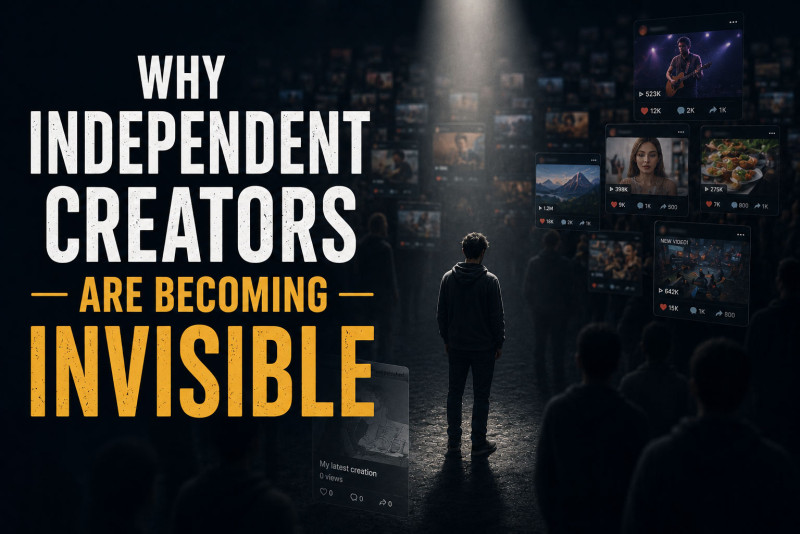
The internet was once celebrated as the greatest opportunity ever created for independent creators.
A writer could publish a blog from a small apartment and attract readers from around the world. A filmmaker could upload videos without needing a television network. A musician no longer depended entirely on record labels to build an audience. Designers, developers, educators, photographers, and entrepreneurs suddenly had direct access to millions of people.
For a while, it seemed as though creativity alone could compete with size.
Today, many independent creators tell a different story.
Publishing content has never been easier, yet being discovered has never been more difficult. Across blogs, podcasts, videos, newsletters, online stores, and social media, creators are finding themselves buried beneath algorithms, advertising, and an endless stream of professionally produced content.
The internet still gives everyone a voice.
The challenge is making sure anyone actually hears it.
More Content Than Ever Before
Every minute, millions of pieces of content are published online.
New videos appear on streaming platforms.
Articles are uploaded to news websites.
Photos flood social media.
Podcasts release new episodes.
AI tools generate text, images, music, and videos at unprecedented speed.
For audiences, this creates endless choice.
For creators, it creates unprecedented competition.
Standing out has become one of the hardest problems on the modern internet.
Algorithms Decide Who Gets Seen
Many creators believe their audience discovers content naturally.
In reality, algorithms often decide what appears first.
Social platforms, search engines, recommendation systems, and AI assistants constantly evaluate content before presenting it to users.
These systems consider factors such as:
- Engagement
- Watch time
- Click-through rates
- User behavior
- Advertising value
- Platform retention
Quality certainly matters.
But quality alone no longer guarantees visibility.
Even exceptional work can remain largely unseen if it fails to satisfy the priorities of the platform distributing it.
The Advantage of Being Already Famous
Success on today's internet often creates even more success.
Creators with large audiences receive:
- Greater recommendations
- More media coverage
- Higher search visibility
- Larger sponsorship opportunities
- Better advertising performance
This creates a feedback loop.
The more visible someone becomes, the easier it is to gain additional visibility.
Meanwhile, newcomers compete for increasingly limited attention.
Talent still matters.
So does timing, distribution, and platform support.
AI Is Changing Discovery Again
Artificial intelligence is transforming how people search for information.
Instead of visiting multiple websites, users increasingly receive summarized answers from AI-powered assistants.
Instead of comparing articles from different publishers, many people simply accept the response generated by a single platform.
For independent creators, this introduces a new challenge.
Even when their work contributes to an AI-generated answer, users may never visit the original source.
Knowledge continues to spread.
Recognition does not always follow.
Advertising Has Become the Shortcut
Many platforms now encourage creators to pay for visibility.
Organic growth still exists, but it often competes against sophisticated advertising systems designed to prioritize promoted content.
Businesses with significant marketing budgets can:
- Reach larger audiences.
- Test multiple campaigns.
- Optimize advertising continuously.
- Purchase premium visibility.
- Scale much faster.
Independent creators rarely have those resources.
As a result, creativity increasingly competes with financial investment rather than simply competing with other creative ideas.
The Creator Economy Is More Competitive Than It Appears
The phrase "creator economy" suggests a world filled with opportunity.
In many ways, that is true.
Millions of people now earn income through content creation.
However, the success stories often receive far more attention than the struggles.
Behind every well-known creator are thousands of talented individuals producing thoughtful work that never reaches a meaningful audience.
Many eventually stop creating—not because they lack ability, but because remaining invisible becomes discouraging.
Communities Matter More Than Followers
One of the biggest lessons emerging from today's internet is that audience size is not everything.
Creators with smaller but highly engaged communities often outperform those with massive followings but limited loyalty.
Building a genuine community means:
- Encouraging meaningful conversations.
- Listening to audience feedback.
- Providing consistent value.
- Developing trust over time.
- Creating experiences people want to return to.
Algorithms may introduce someone to your work.
Communities give them a reason to stay.
Owning Your Audience
Many experienced creators are changing their strategy.
Rather than relying entirely on platforms they do not control, they are investing in direct relationships.
This includes:
- Personal websites
- Email newsletters
- Membership communities
- Podcasts
- Independent forums
- Self-hosted platforms
These channels reduce dependence on algorithm changes and provide greater stability over the long term.
Building an audience may take longer.
Keeping it becomes far more sustainable.
The Internet Was Meant to Expand Opportunity
The original promise of the internet was simple.
Anyone with knowledge, creativity, or a unique perspective could share it with the world.
That promise still exists.
But reaching people has become increasingly difficult as discovery concentrates within a handful of platforms that control search, recommendations, and distribution.
The challenge is no longer finding somewhere to publish.
The challenge is finding a path to visibility.
The Future Belongs to Creators Who Adapt
Independent creators are not disappearing.
They are adapting.
Some are building niche communities instead of chasing viral moments.
Others are diversifying across multiple platforms rather than depending on a single algorithm.
Many are focusing on trust, expertise, and authentic relationships instead of short-term attention.
Visibility may be harder to earn than it once was.
But audiences continue searching for original voices, thoughtful perspectives, and meaningful content.
In a digital world overflowing with information, the creators who succeed may not be those who publish the most.
They may be the ones who build lasting connections that no algorithm can easily replace.